

The European Union approved its 21st sanctions package against Russia on July 23, targeting finance, energy, military industry and sanctions-evasion networks. According to Reuters, the package adds 218 individuals and entities, including 48 people and 170 entities, making it one of the EU’s largest single rounds of additions in nearly four years.
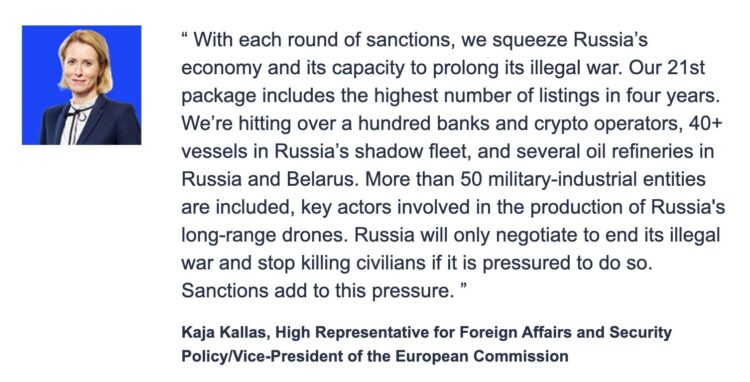
Kaja Kallas, the EU’s High Representative for Foreign Affairs and Security Policy, said the measures target more than 100 banks and crypto operators, while also hitting Russia’s shadow fleet, refineries and military supply chain.
Financial restrictions form the core of the package
The EU placed 94 banks and major financial institutions on its asset-freeze list, barring EU companies and individuals from making funds or economic resources available to them. Another 33 Russian credit and financial institutions were put under a transaction ban, cutting them off from dealings with the EU market.
Four non-Russian banks were also subjected to trading restrictions. One Kyrgyz bank was cited for links to Russia’s SPFS financial messaging system, while the other three foreign banks were accused of helping sanctioned entities evade restrictions.
Crypto platforms face direct action
Crypto services were identified more clearly as a target in this round. The EU placed 14 crypto-asset service platforms under a transaction ban. Those platforms were said to be spread across jurisdictions including Georgia, Panama, the United Arab Emirates, the Marshall Islands, Kyrgyzstan and Belarus.
The EU said those platforms had been used by Russia-related funds to get around existing financial restrictions and to support cross-border transfers and payments.
The package also introduces a broader tool that allows the EU, in specific cases, to prohibit transactions with crypto service providers across an entire third country. If a jurisdiction is deemed to allow crypto platforms to help Russia evade sanctions, the bloc could impose restrictions on that country’s related crypto services as a whole. That expands the sanctions framework from named platforms to the possibility of targeting a full jurisdictional crypto-service network.
The EU also designated four targets linked to the A7 cross-border payment network, including entities tied to its African operations. That points to third-country payment channels as a growing focus in sanctions-evasion investigations.
Shadow fleet and energy revenues remain under pressure
Energy measures were another major part of the 21st package. The EU added 41 vessels to the Russian shadow fleet list, bringing the total number of covered ships to 673. Those vessels were accused of helping bypass the Russian oil price cap or providing bunkering, supplies and other support services.
For the first time, the EU also listed an organization accused of helping the shadow fleet recruit crews, and imposed related restrictions on eight entities and one individual.
In the oil sector, the bloc added 18 entities and one person. The list includes three Russian refineries, one major Belarusian refinery and companies involved in selling Belarusian petroleum products inside Russia. A refinery in Kulevi, Georgia, will also face a transaction ban after a six-month transition period because it was accused of participating in Russian oil trading and processing. Five oil traders were also hit with trading restrictions over allegations that they undermined limits on purchases of Russian crude and petroleum products.
Defense industry and export controls broaden
On military and export controls, the EU added 56 individuals and companies tied to Russia’s defense industry, with 37 of those listings connected to long-range drone production and its supply chain. Another 51 entities were subjected to tighter controls on dual-use goods and technologies, covering companies in China, India, Turkey, Kazakhstan, Kyrgyzstan and the United Arab Emirates.
The restrictions cover aircraft, drones, missiles, corrosion-resistant engine coatings and other materials and equipment.
Sanctions now reach beyond Russia’s domestic system
This round shows the EU widening its focus from Russia’s domestic financial institutions to third-country banks, crypto platforms, payment networks, tanker service providers and military supply chains.
For the crypto sector, the blacklisting of 14 platforms and the creation of a country-level restriction tool point to tougher sanctions screening requirements for exchanges, custodians and payment service providers. Firms that cannot show compliance on fund origin, customer identity and transaction routes may face a higher risk of being treated as sanctions-evasion cases.