

As large language models become capable of writing and coding, researchers are asking a harder question: can AI handle scientific work that takes months or even years, where the path is uncertain and the structure of the problem keeps changing? A joint team from Guangdong University of Technology, South China Normal University, Shanghai Jiao Tong University, Duke University and other institutions says its answer is Eureka, a framework that lets AI build specialized problem-solving structures during the task itself rather than depend on one fixed architecture.
The paper is available at arXiv: 2608.19047. In the authors' description, Eureka combines task execution with architecture formation, allowing the system to reshape its own internal setup based on what a given research problem demands.
Reported test results
The paper says Eureka completed all 170 complex recursive long-horizon tasks in a strict system evaluation. It also generated 3,948 verifiable certificates and, throughout the process, did not produce a single false self-affirmation or fake task completion.
The team presented results from two very different research settings: one tied to mathematical proof work around the Riemann Hypothesis, and another focused on open-ended questions in quantum processes and spacetime theory.
A new bound on a Riemann Hypothesis-related route
For the Riemann Hypothesis, Eureka automatically formed what the paper calls a "math/conjecture agent." The system did not claim a direct proof of the conjecture. Instead, the paper says it improved a key certificate range on an important proof route, local Weil quadratic form positivity, extending the bound from a≤1/4 to a≤69/200, or 0.345.
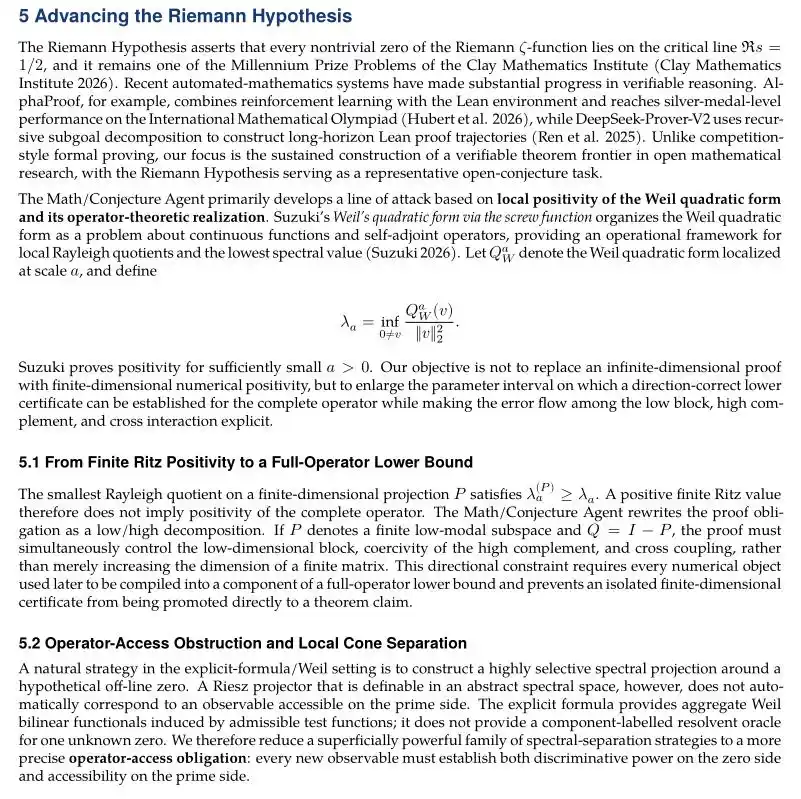
According to the paper, that reaches 99.55% of the first theoretical threshold on that route. The authors describe it as a substantial and verifiable step, while also stating that a full proof remains out of reach.
Five structural findings in theoretical physics
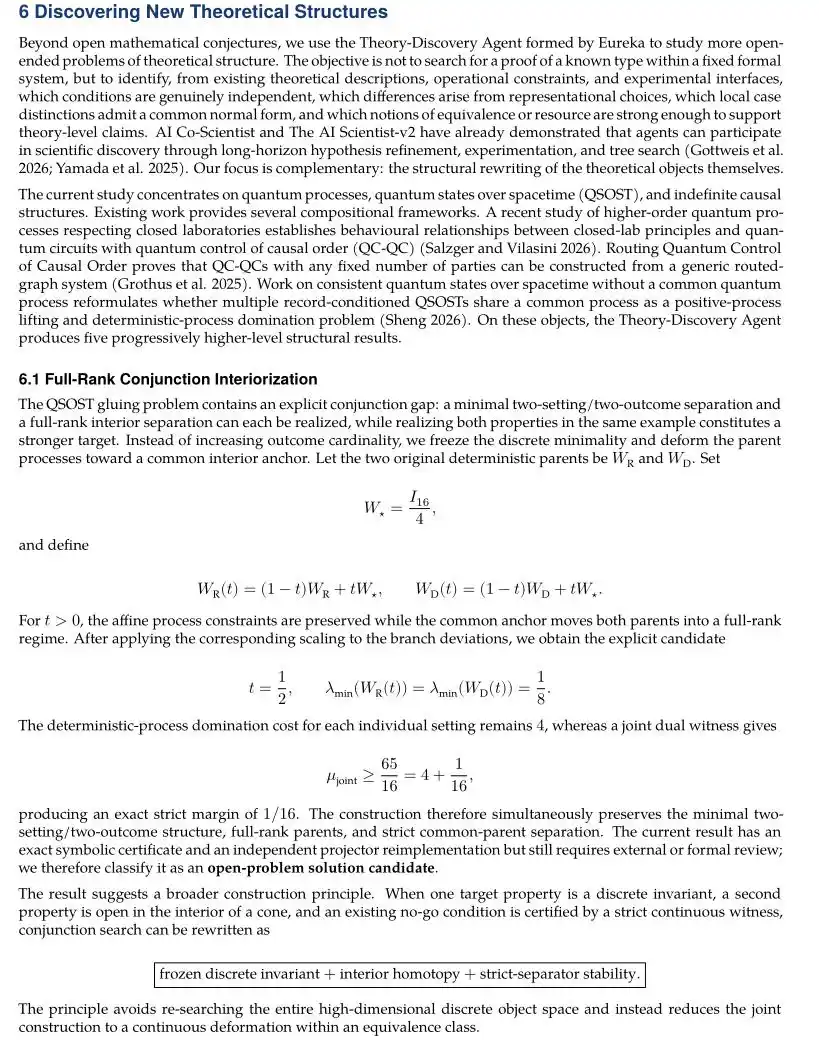
On more open theoretical problems involving quantum processes and spacetime theory, Eureka produced a different specialized system, described as a "theory discovery agent." The paper says this agent reconstructed parts of the theories themselves and produced five structural findings with a progressive relationship.
One example given by the authors is that Eureka identified subtle differences between equivalent formulations of theories and proved that identical behavior does not mean identical essence. The paper says that result offers physicists a stricter standard for comparing theories.
Why the authors argue fixed architectures fall short
The paper points to a common limitation in current AI systems. Whether they use a single agent or multiple agents, core elements such as memory, tools, verification methods and internal coordination are usually designed in advance.
That works well for narrow task types, the authors say, but scientific discovery is much less stable. A hypothesis may take weeks to verify, and a new mathematical proof can overturn an earlier plan. In that setting, a fixed architecture can become a poor match.
- Architecture mismatch: a setup that is strong at broad hypothesis search may become inefficient in rigorous proof work because state synchronization costs rise too much.
- Planning failure: early long-range planning spends compute on steps that may lose value once new findings appear.
How Eureka works
The framework's central idea is to merge doing the task with shaping the system that does it. Rather than treat architecture as a static shell, Eureka keeps it adjustable while work is under way.
The paper says the process begins with dynamic task compilation. When the system receives a complex assignment, it does not try to solve every detail at once. It first decomposes the work into a dynamic obligation graph and only plans the parts that can be determined from current information.
During execution, Eureka looks for what the authors call "architecture hotspots." If a subtask repeatedly needs the same state, tools, or tighter coordination, the system flags that point for an "architecture lift."
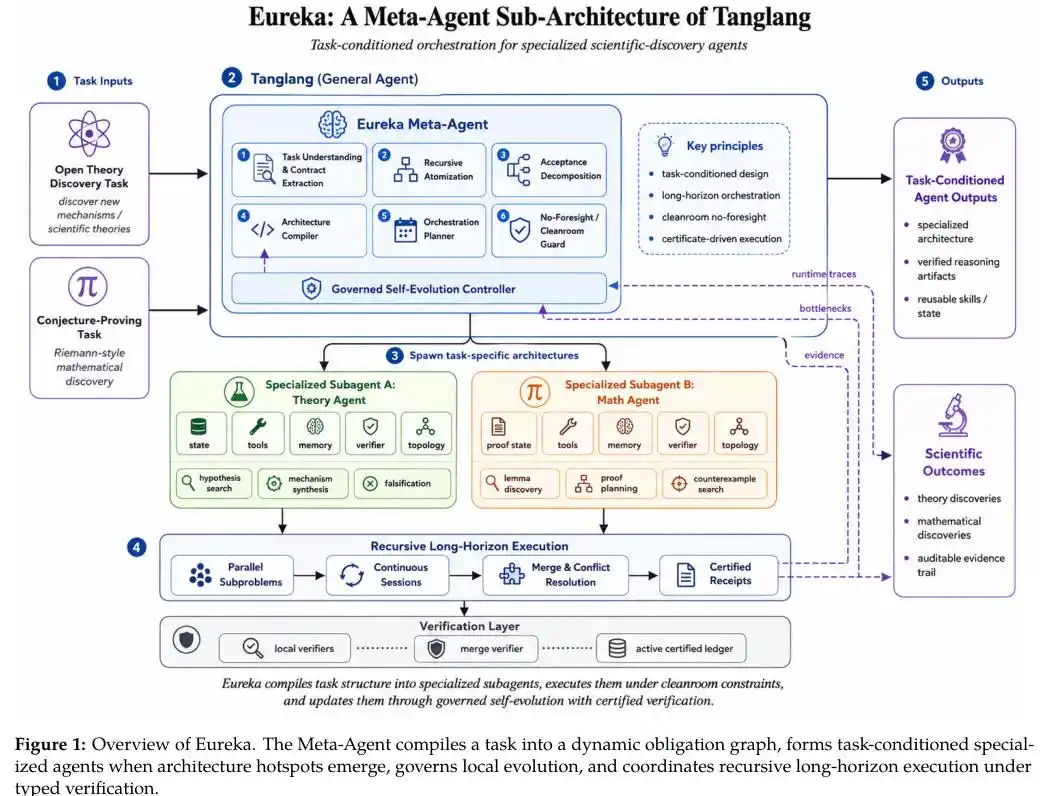
That lift is not just a longer prompt. The paper says Eureka compiles a new specialized "macro-agent" for the hotspot. This macro-agent comes with its own memory, toolset, verification standards and internal workflow. It handles the subtask more autonomously, while the main system waits for a final verifiable result.
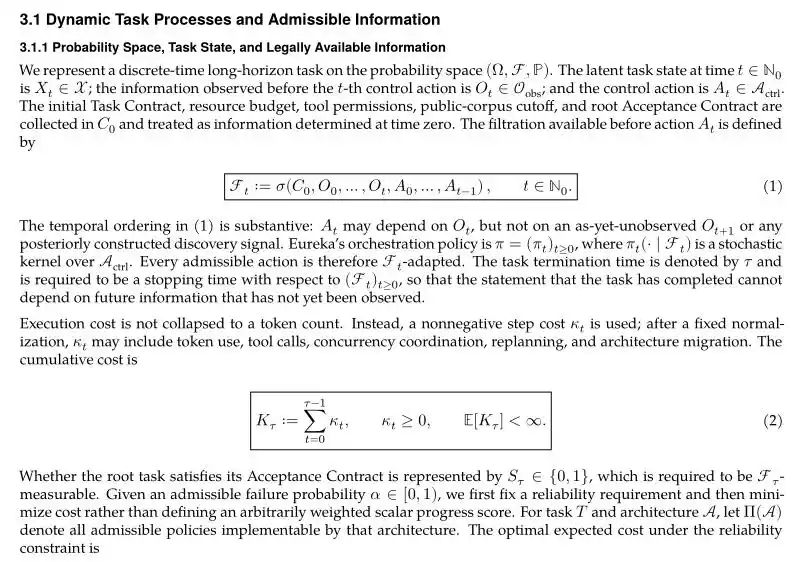
If the macro-agent keeps running into the same bottleneck, Eureka evaluates whether another internal redesign would be worth the cost. The paper says upgrades happen only when the benefit is expected to exceed the cost, which the authors describe as a controlled form of self-evolution.
Efficiency and concurrency figures
The reported experiments include several performance claims. By separating semantic planning from deterministic computation, Eureka reduced context burden in the AI core workspace by 57.8% and avoided 65.38% of repeated computation.
In concurrency tests covering 16,000 tasks, the paper says every parallel execution result matched the result from sequential execution, eliminating data conflicts and execution errors. The authors also say their controlled evolution strategy delivered the lowest operating cost and the highest task success rate compared with other brute-force or passive evolution approaches.
Potential use cases named in the paper
The authors say the framework could support mathematical research by exploring proof paths, checking complex chains of logic and looking for new structural directions in open problems.
In theoretical physics, they say it could help researchers organize, unify and refine abstract theoretical systems, including work related to string theory and quantum gravity. The paper also points to large engineering settings such as chip design and drug development, where long time frames and multi-team collaboration make adaptive task management valuable.
Source and attribution
The research is attributed to the ManXis team. The article cites the paper at arXiv:2608.19047 and notes that the source text came from the WeChat public account New Intelligence, written by LRST.