
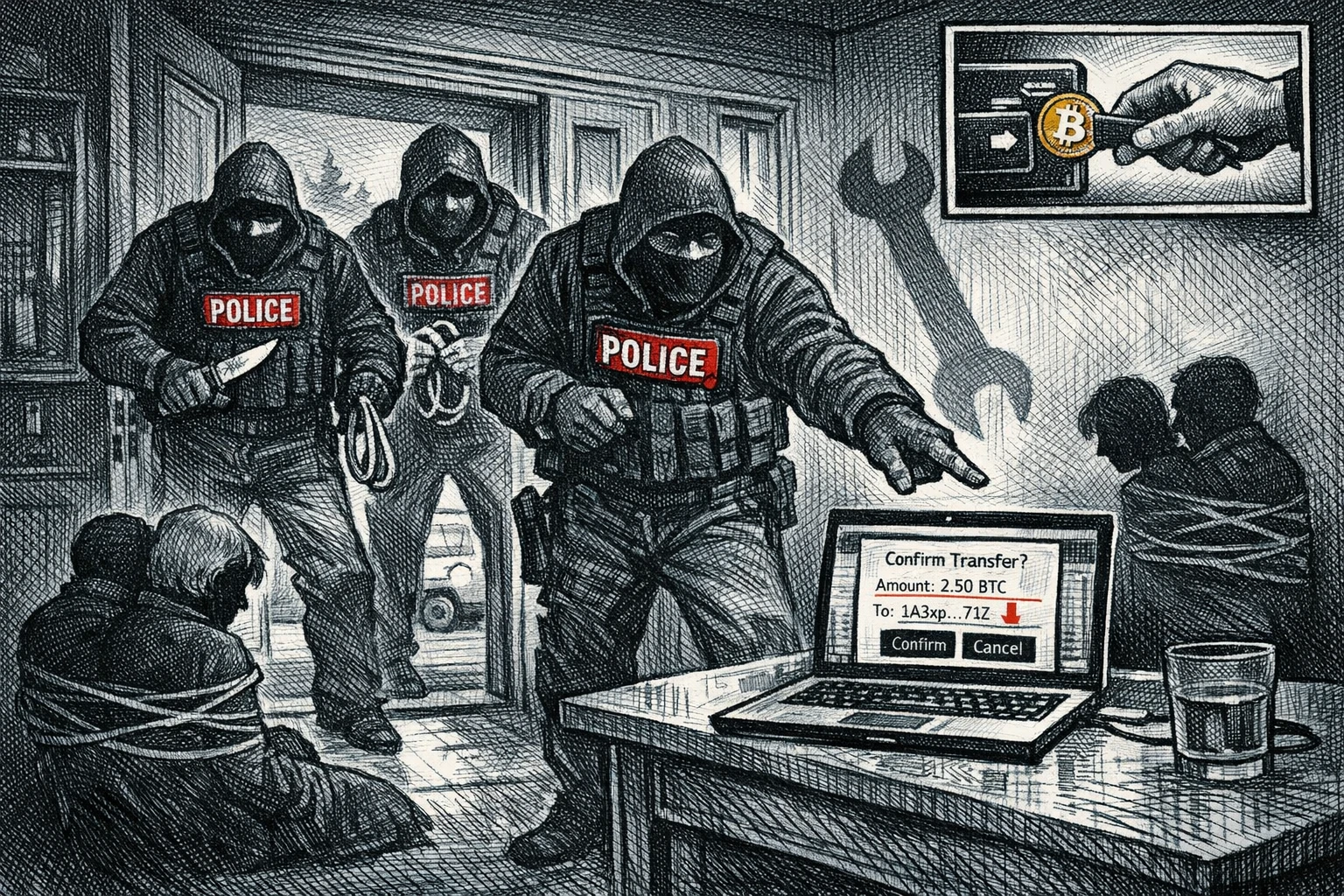
A violent home invasion in France has put the spotlight back on the real-world risks facing cryptocurrency holders. On March 9, 2026, a couple in their 50s living in Le Chesnay-Rocquencourt, in France’s Yvelines department, were attacked by three men posing as police officers. During the assault, the husband was tied up and forced to transfer about €900,000 in Bitcoin, or nearly $1 million.
Attackers Posed as Police
The home is located less than two kilometers from the Palace of Versailles. According to the report, the suspects wore police uniforms and gained access to the residence by presenting themselves as law enforcement officers. Once inside, they threatened the couple with a knife. Both victims were injured, and the husband was compelled to access his crypto wallet and send the Bitcoin to the attackers.
After obtaining the funds, the three suspects fled in a white van. French authorities are still investigating the case, and the original report said no arrest had been announced more than a month after the incident.
Physical Crypto Extortion Is Rising
This kind of crime is commonly described as a “wrench attack,” a term used for situations where criminals use physical force or threats rather than hacking, phishing links, or malware to seize digital assets. The appeal for attackers is simple: instead of breaking wallet security, they pressure the owner directly.
Data cited from CertiK’s 2025 year-end security report shows 72 verified cases of physical coercion involving crypto that year, up 75% from 2024. Reported financial losses reached $40.9 million, marking a 44% increase. Cases involving bodily harm rose from 4 in 2024 to 14 in 2025, a jump of 250%.
France Stands Out in Europe
Europe accounted for more than 40% of such incidents globally, compared with 22% in 2024. France emerged as one of the most affected countries, with 19 cases recorded in 2025, far above the 8 cases reported in the United States.
The report also referenced the January 2025 kidnapping of Ledger co-founder David Balland and his wife. In that case, the attackers allegedly cut off one of Balland’s fingers as part of a ransom demand totaling €10 million. Taken together, these incidents suggest that as crypto wealth becomes more visible, offline attacks are becoming a more serious threat.
Security Now Extends Beyond the Blockchain
The case is a reminder that crypto security is no longer limited to protecting seed phrases, avoiding phishing scams, or choosing secure custody solutions. Personal privacy and physical safety are becoming equally important. Avoiding public discussion of holdings, not sharing screenshots of balances, and limiting links between on-chain identity and real-life identity can all reduce exposure.
For larger holders, multisig arrangements, geographically separated key management, and reducing single points of control may help lower risk. As physical extortion cases rise, the challenge of securing digital assets is increasingly moving from online systems into everyday life.