
Fake World Assets, a new protocol on the Ethereum mainnet, generated about $1.3 million in revenue in a little over a week after launch, placing it No. 15 on the seven-day crypto app revenue rankings. At the same time, its token, $FWA, climbed from an initial market capitalization of about $47,550 to a peak of roughly $38.8 million.
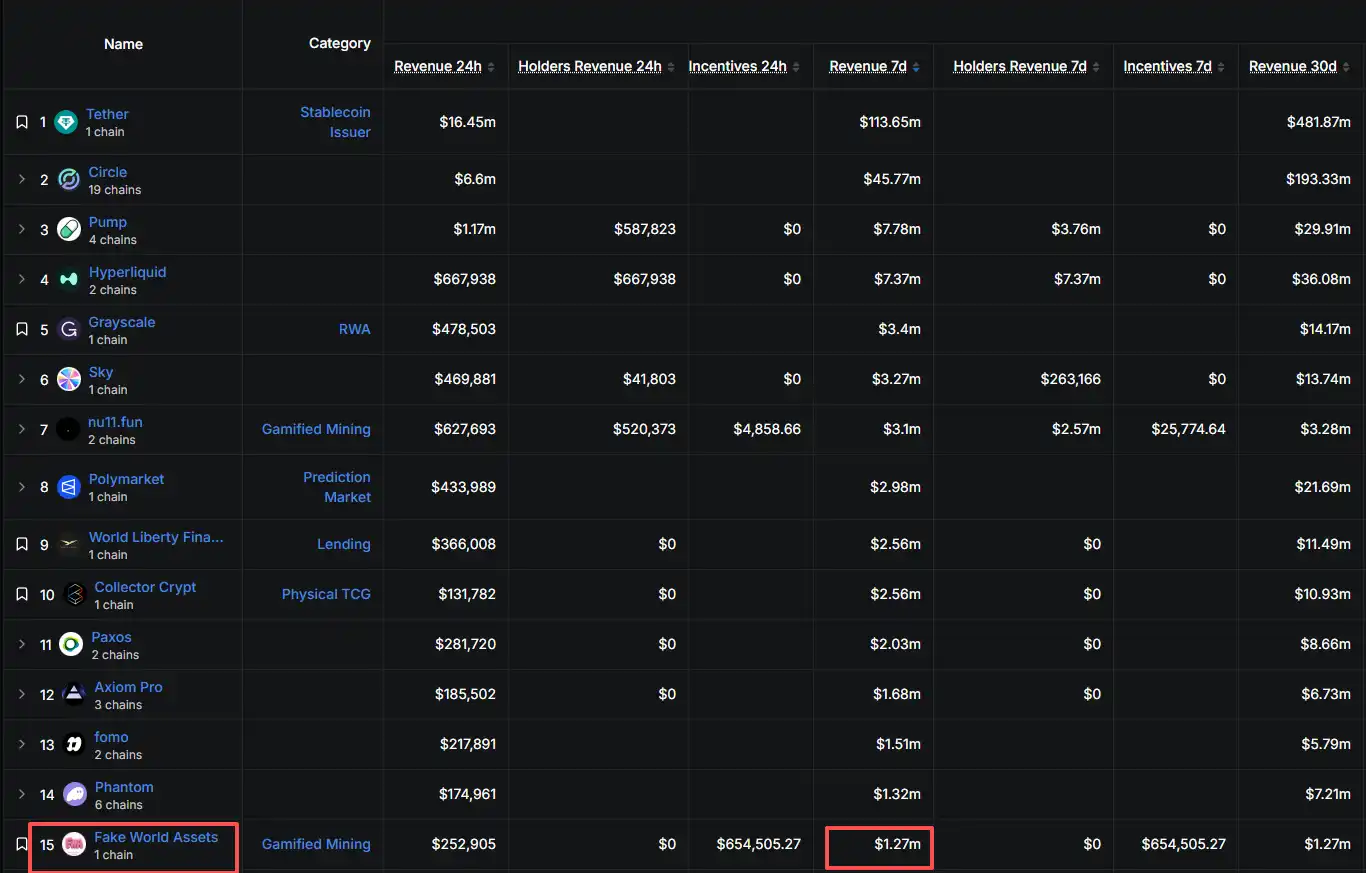
The rise came as the broader “draw card” narrative, already active in onchain TCG-style projects, spread to Ethereum. In contrast, Collector Cards continued to post strong revenue, but its token, $CARDS, fell from a peak close to $90 million in market capitalization about a month ago to roughly $28.87 million.
How the FWA system works
FWA was built by TokenWorks, the team behind PunkStrategy, a project that once reached a $300 million market capitalization within a month. Not every TokenWorks launch has performed the same way. Its previous project, TTT, or Ten Thousand Tokens, was released around the middle to later stage of the Uniswap v4 hook wave. The concept there was a launchpad where users needed an NFT to issue a token. The NFT supply was capped at 10,000, matching a limit of 10,000 tokens that could be launched through the platform, and fees were split among token issuers, NFT holders and the protocol. Because it failed to produce a breakout asset, the NFT price fell soon after launch.
At first glance, FWA looked like a simple NFT drawing game. The more important piece was the token loop layered on top of it. $FWA cannot be purchased directly on the outside. Anyone who wants the token has to participate in the draw mechanism.
NFTs in the system are deposited by users, and every deposit must be paired with ETH as two-sided liquidity. In practice, that means each depositor creates a separate pool. The more ETH attached to an NFT, the lower the probability that the NFT will be drawn.
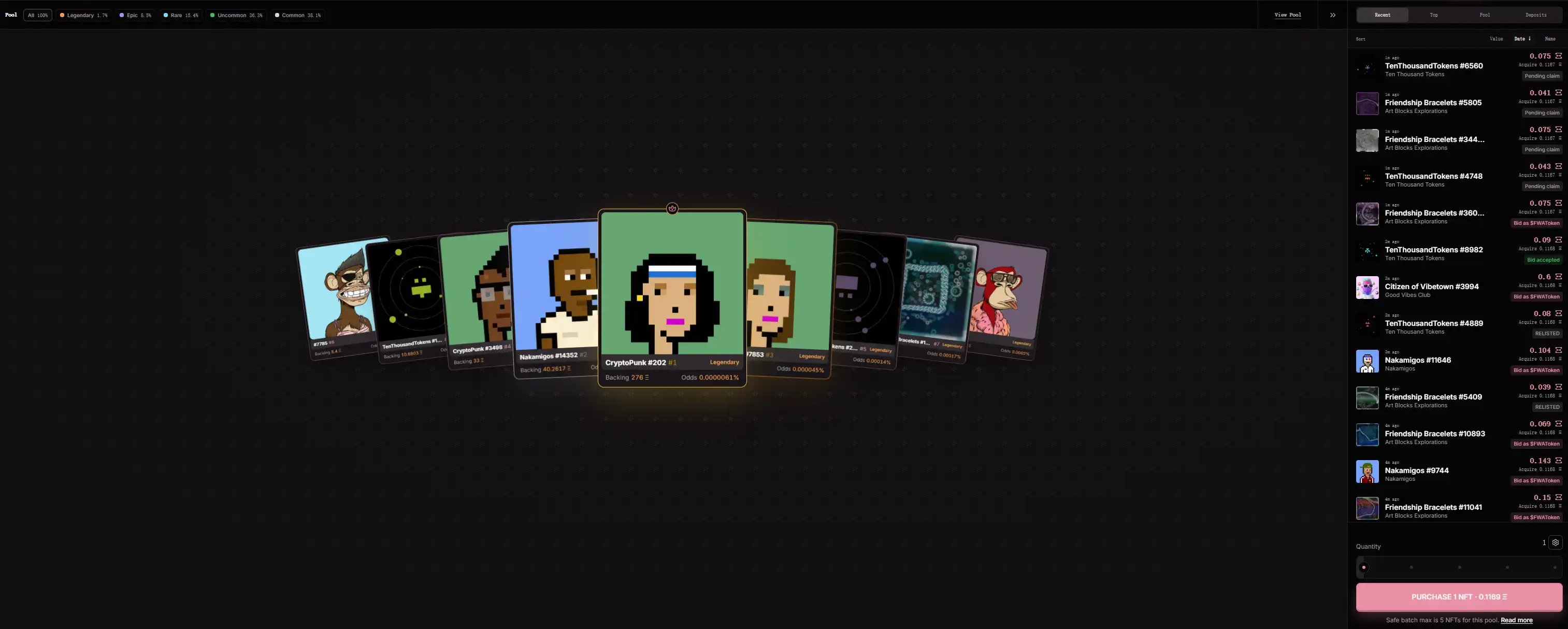
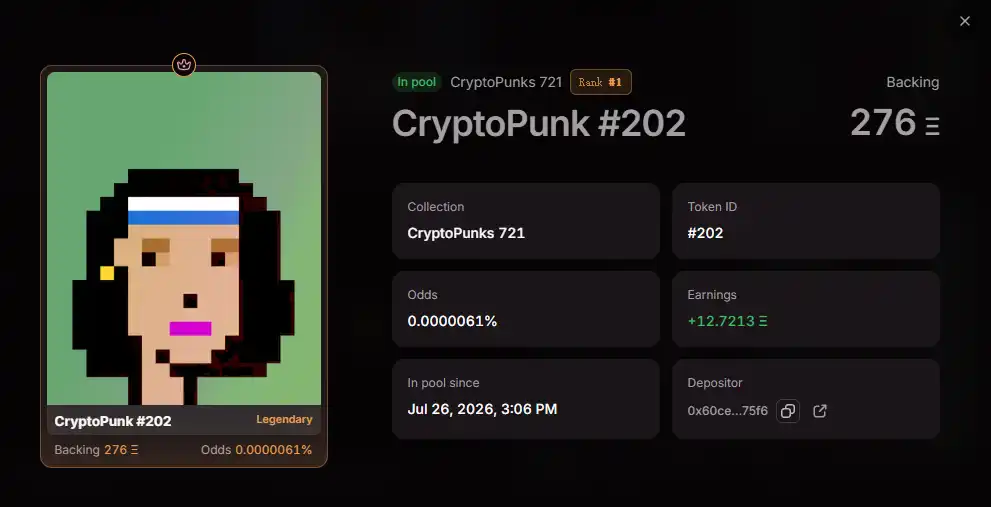
The article gives one CryptoPunks example. That position was paired with 276 ETH, which put the chance of being drawn at just 0.0000061%, or only after more than 10 million draws on expectation. Since July 3, the protocol had recorded a total of 73,884 draws, averaging more than 3,000 a day.
The same CryptoPunks depositor had already earned 12.7213 ETH in a little over a day. According to the source article, that income comes from three main channels:
- a fixed 1% fee charged on every draw,
- an additional 1% cut taken from the income generated for the depositor if a user draws an NFT and decides to keep it,
- and the spread created when most users draw ordinary NFTs and immediately sell them back to the depositor at an 85% discount.
How much a depositor earns does not depend on the nominal size of the assets deposited. It depends on how long the NFT remains in the pool. As long as the NFT is not drawn, the depositor keeps sharing in the profits. Once it is drawn, the payout stream ends and the user needs to deposit a new NFT.
That setup gives users a reason to add more ETH, because a thicker paired balance helps keep an NFT in the pool longer by lowering draw probability. In the source article’s framing, FWA looks like an NFT AMM with a draw-card layer added on top.
Why $FWA buying pressure is built into participation
The most unusual part of the token design is that users cannot simply buy $FWA from outside the protocol. To get the token, they have to use the NFT gacha-style machine.
According to the article, 50% of the token supply was allocated to seed initial liquidity, 30% was set aside for emissions during the first half month after launch, with 1% distributed daily to asset depositors and 1% distributed daily to draw participants, and the remaining 20% was reserved for an early snapshot airdrop.
The most common path to obtaining $FWA is through the draw flow itself. After drawing an unwanted NFT, a user can sell it back to the original depositor at an 85% discount. At that point the user can either take ETH back or receive $FWA instead. If $FWA is chosen, the protocol automatically converts the corresponding ETH amount into the token.
Most users have preferred to receive $FWA. Data cited in the article shows that over the past seven days, the share of operations in which users immediately sold back the NFT after drawing and took $FWA reached as high as 82.3%, especially in the early phase before the token price began to move. In recent days, after $FWA rose to higher levels and entered a pullback, more users started choosing ETH after an immediate resale, but the share opting for $FWA still stayed above 60% on a single-day basis.
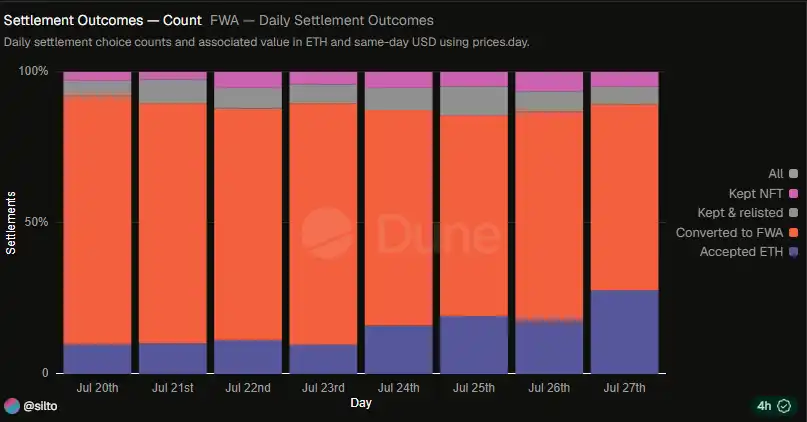
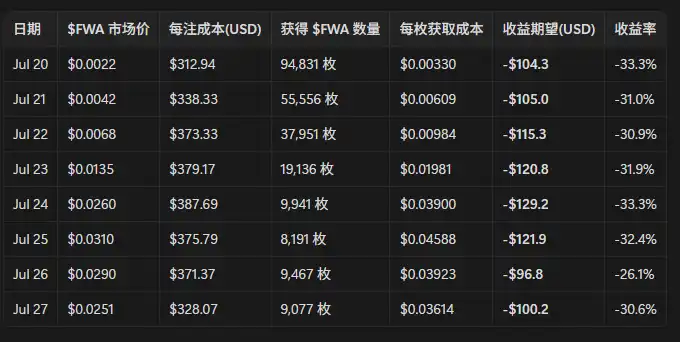
On a pure cost basis, the article says every draw carries negative expected value, and the effective cost of acquiring $FWA through the draw process was above the token’s same-day market price. In other words, users were paying a premium. Even so, anyone who chose to hold rather than sell immediately would have seen outsized gains on draw-to-$FWA transactions between July 20 and July 23.
The article compares that behavior with the earlier Blur airdrop farming period, when users accepted friction and losses while betting that future token upside would offset the cost. The difference here is the pace. FWA compresses the game into a much shorter cycle centered on attention. If the mechanism is discovered quickly and becomes a focal point, incoming draw activity is converted into fresh $FWA demand, lifting the value of positions accumulated by earlier participants.
Why the article says FWA overtook Collector Cards
That mechanism, in the source article’s view, explains how FWA managed to surpass Collector Cards in token market capitalization over a very short period. Both projects are built around a draw mechanic, and both derive core revenue from the discounted spread created when users immediately resell what they draw. Collector Cards may even have a broader theme appeal, since its draw content centers on Pokemon cards rather than NFTs, and the article says its profit performance has been better.
What weakened Collector Cards, according to the article, was token utility. Outside of project buybacks, the token had almost no use, and the details of those buybacks had still not been clearly disclosed because the Clarity Act had not passed. FWA, by contrast, embedded token acquisition directly into the product flow, turning user participation itself into recurring buy pressure.
The article also notes that even sizable daily buybacks at pump.fun had not fully won over the market, making the weaker buyback case at Collector Cards even less compelling.
Source article’s closing view
The source article argues that FWA’s flywheel will probably be difficult to sustain over the long run. While the token is rising, more users are likely to enter the draw game and describe it as an innovation that revives NFT trading. If the token price falls, though, the losses embedded in the draw process would no longer be offset by continued gains in $FWA, and the protocol could lose attention just as quickly.
The article’s broader takeaway is that in crypto markets, pure profitability can be overshadowed by structures that connect attention directly to buy-side conversion. In that framing, short-term valuation is driven less by earnings alone than by whether a product design can turn user behavior into demand for the token.