
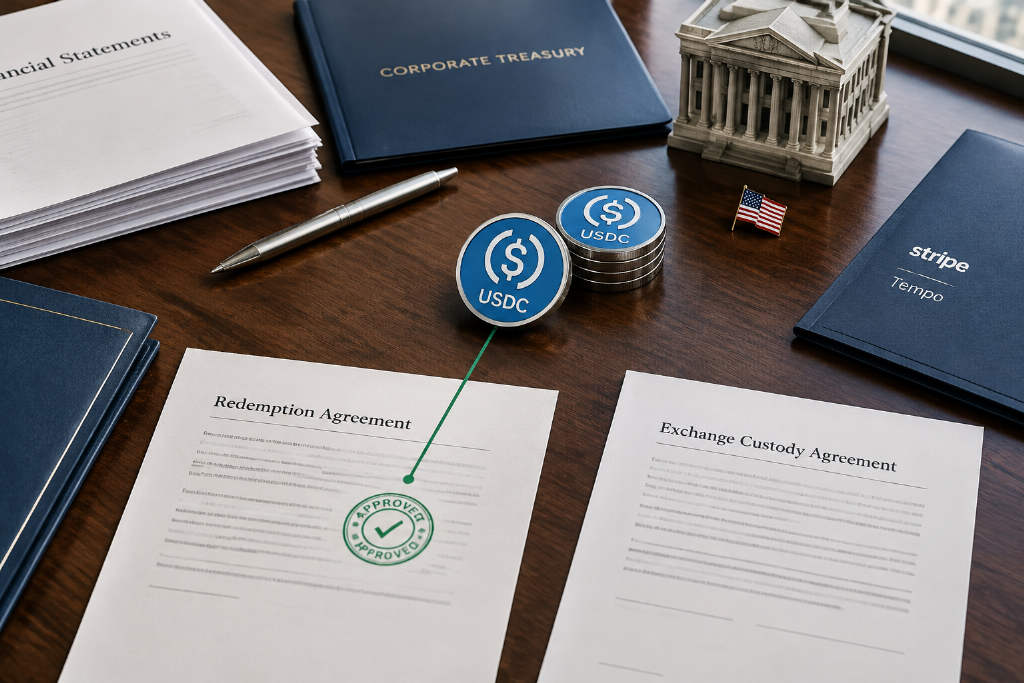
A proposed accounting update from the Financial Accounting Standards Board, or FASB, could give companies a new way to report qualifying stablecoin holdings on their balance sheets, according to a report published by Tempo, Stripe’s blockchain research unit.
The report says stablecoins that meet the proposed criteria may be classified as cash equivalents rather than being recorded, as they often are now, under intangible assets or other assets.
Direct redemption rights are the dividing line
Tempo said the central condition in FASB’s August proposal is whether a company has a direct redemption right with the stablecoin issuer.
That means a company holding USDC purchased through a crypto exchange would not automatically be able to classify that position as a cash equivalent. The determining factor is the contractual arrangement between the holder and the issuer.
Tempo summed up the point this way: “What qualifies your asset is your contract with the issuer, not the token itself.”
Coinbase cited as an example
The report points to Coinbase’s 2025 annual report, where the company classified USDC and other payment stablecoins as cash equivalents. The basis, according to the article, was a direct redemption mechanism with Circle.
Tempo said that treatment reflects the same standard at the center of the FASB proposal: whether the holder can redeem directly with the issuer.
Current accounting can understate liquidity
Under current accounting practice, even stablecoins backed by 100% U.S. dollar reserves are generally not included in reported cash reserves.
Tempo said that creates two practical effects. First, liquidity ratios can be understated. Second, companies may run into liquidity-related terms in loan covenants.
The article gives a hypothetical example of a technology company holding $50 million in USDC for cross-border payments. If a bank reviewing the company’s financial statements does not recognize that position as cash, the company could be asked to post additional collateral or pay a higher interest rate.
In that sense, the FASB proposal is aimed at narrowing the gap between assets that function like cash in practice and assets that are not treated that way on the balance sheet.
Part of a broader U.S. stablecoin framework
The accounting proposal comes after the GENIUS Act, which the article describes as the first U.S. federal regulatory framework for payment stablecoins, passed in July 2025.
According to the report, the law will take effect in January 2027, or 120 days after federal regulators finalize implementing rules, whichever comes first.
The GENIUS Act governs issuer-side obligations, including reserve requirements, redemption duties and compliance standards. The FASB proposal addresses accounting treatment on the holder side. Taken together, the article says, the two measures form a more complete framework for the U.S. stablecoin market.
Comment period runs through Nov. 19
FASB’s public comment period on the proposal remains open until Nov. 19. After that, the process moves to formal deliberation and the setting of an effective date.
The article says companies are focused on two questions: which stablecoins will ultimately qualify, and whether stablecoins already held through exchanges would need a different redemption arrangement.
The current draft appears to lean toward giving companies a transition period, though the details have not been finalized.
Market backdrop and policy context
Data from DefiLlama cited in the article shows the market capitalization of dollar-backed stablecoins has surpassed $300 billion.
Against that backdrop, Bloomberg reported that the Trump administration is evaluating projects with private-sector partners to promote dollar-backed stablecoins overseas. The effort could involve the Treasury Department, the State Department and the U.S. International Development Finance Corporation, or DFC.
The article frames the accounting change as a less visible but important part of that broader policy sequence: issuer regulation through the GENIUS Act, balance-sheet recognition through FASB accounting changes, and then wider use of dollar stablecoins in global payments.



