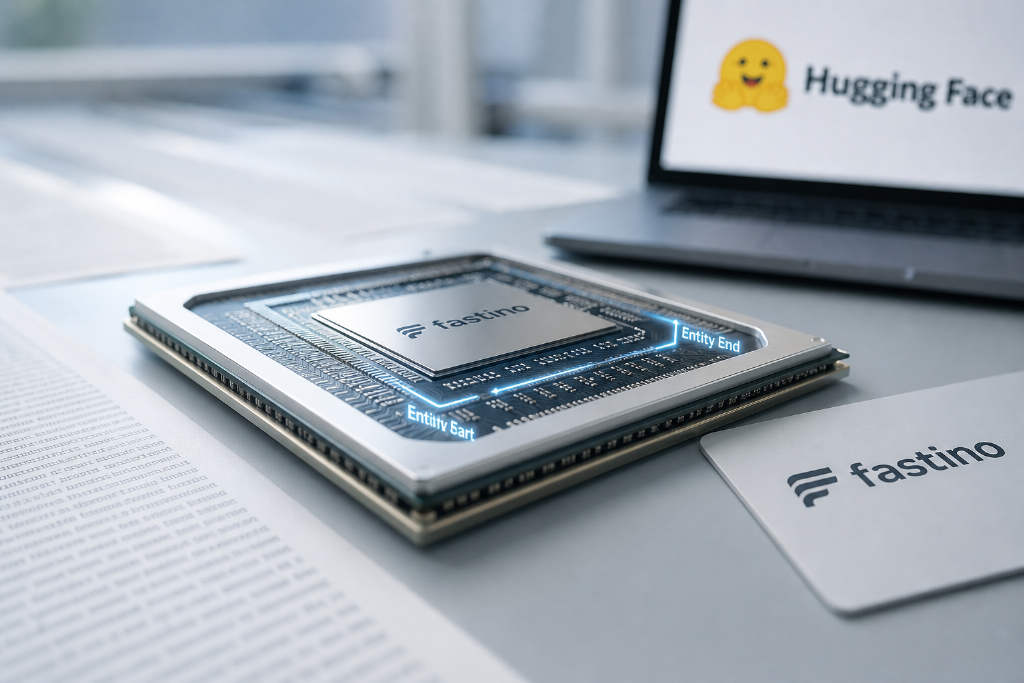
Fastino has released GLiNER2.5, a new information extraction model built on a boundary prediction architecture rather than the traditional span enumeration approach. The model directly predicts where entities begin and end, removing the maximum entity length constraint and allowing it to process contexts of up to 4,096 words. According to the report cited by Techub News, GLiNER2.5 also keeps computational complexity linear with sequence length and supports joint decoding of entities and relations.
On benchmark performance, GLiNER2.5 posted a macro F1 score of 56.17 across 16 zero-shot benchmarks, slightly ahead of its predecessor, GLiNER2. Fastino has released three checkpoints on Hugging Face with 74 million, 194 million, and 287 million parameters under the Apache 2.0 open-source license.
The model is aimed at use cases in legal contracts, medical documents, financial services, insurance claims, and AI safety tools. Tasks listed in the report include personally identifiable information detection and redaction, contract clause extraction, and knowledge graph construction. Fastino said the model supports local inference deployment on CPU, CUDA, and MPS environments.
Fastino has released GLiNER2.5, an information extraction model, according to Techub News.
A report cited from MarkTechPost said GLiNER2.5 uses a boundary prediction architecture in place of the traditional span enumeration method. The model directly predicts entity start and end positions, which removes the maximum entity length limit and allows for contexts of up to 4,096 words.
On the computation side, the model has complexity that scales linearly with sequence length. It also supports joint decoding of entities and relations.
In benchmark results, GLiNER2.5 recorded a macro F1 score of 56.17 across 16 zero-shot benchmarks, slightly better than the previous GLiNER2 model.
Fastino has published three model checkpoints on Hugging Face, with parameter sizes of 74 million, 194 million, and 287 million. The release uses the Apache 2.0 open-source license.
According to the report, the model is designed for use in legal contracts, medical documents, financial services, insurance claims, and AI safety tools. It can be used for tasks such as personally identifiable information detection and redaction, contract clause extraction, and knowledge graph construction. The model supports local inference deployment on CPU, CUDA, and MPS.
This article was originally published by Bit.Fan. For more cryptocurrency news and market insights, visit www.bit.fan. Disclaimer:
The market information, project data, and third-party content displayed on this platform are for industry information sharing only and do not constitute any form of investment advice or return commitment.
Cryptocurrency trading carries high risks. Users should fully assess their risk tolerance and make independent decisions. All profits, losses, and legal responsibilities are borne by the users themselves.