

The US Federal Reserve has named Andreessen Horowitz co-founder Marc Andreessen to help lead a task force studying how artificial intelligence and other new technologies could affect productivity and jobs.
In a Thursday press release, the Fed said the Productivity and Jobs task force will assess how general-purpose technologies such as AI could shape employment and productivity, with the goal of improving the central bank’s policymaking.
Andreessen will serve with Charles I. Jones, a Stanford University economics professor currently on leave at Anthropic, and Asha Sharma, Microsoft’s executive vice president and Xbox CEO.
Warsh rolls out five Fed task forces
The group is one of five task forces launched under new Fed Chair Kevin Warsh, each assigned to examine major areas of monetary policy conduct. The other four will focus on policy communication, balance sheet policy, data quality and inflation frameworks.
Warsh announced the leadership-led overhaul and the creation of the five groups during a June 17 press conference. He said, “These subjects are timely, consequential, and, in my view, worthy of a fresh look,” adding that each would be independently led by “some of the very best minds—both inside and outside the economics profession.”
He also said the Fed will work to publish policy statements and guidance in shorter, clearer language.
Andreessen’s ties to Warsh
Andreessen co-founded Andreessen Horowitz, one of Silicon Valley’s most influential venture capital firms and a major backer of crypto and AI startups.
His relationship with Warsh dates back to the early 1990s at Stanford University. In a 2025 interview with CNBC, Warsh said Andreessen and Palantir’s Peter Thiel “have been friends from my days in college.”
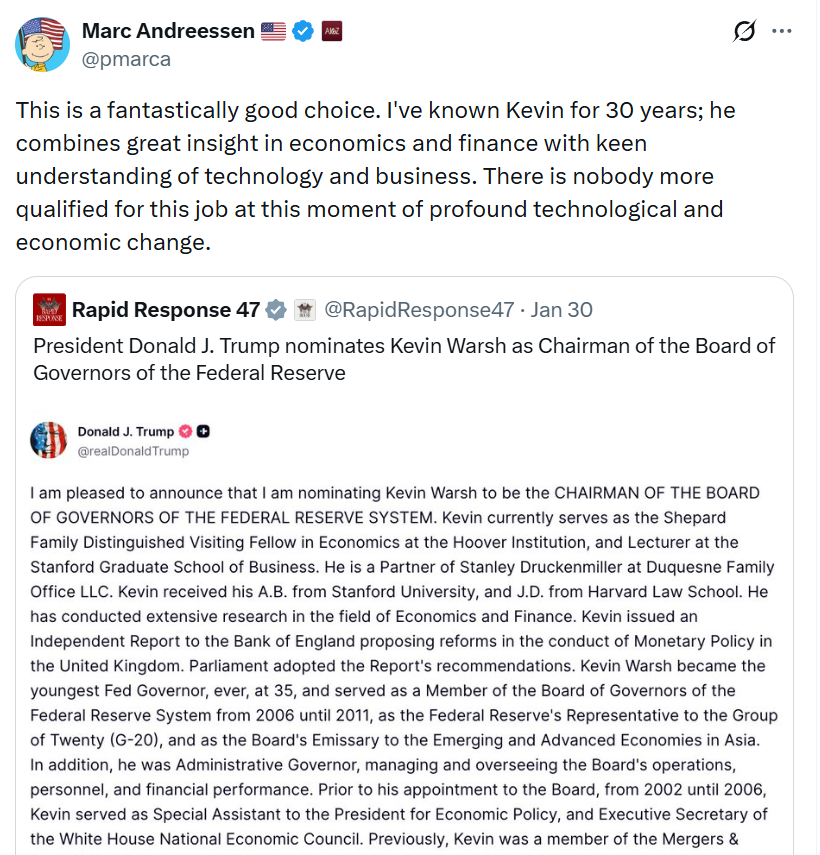
Andreessen also publicly supported Warsh’s appointment as Fed chair. After US President Donald Trump nominated Warsh, Andreessen wrote in a Jan. 30 post on X: “I've known Kevin for 30 years; he combines great insight in economics and finance with keen understanding of technology and business.”
FOMC split on AI and inflation
The Federal Open Market Committee remains divided over AI’s economic impact and over whether the technology is inflationary or disinflationary.
Some officials see AI as a long-term productivity boost that could ease inflationary pressure. Others argue that current spending on AI infrastructure is already pushing inflation higher.
In a May 27 speech, Fed Governor Lisa Cook said she expects AI to “boost productivity growth, contributing to my expectation that GDP will grow robustly,” while also warning of the risk of “higher inflation.”
Former Fed Chair Jerome Powell said in remarks from March 2026 that data center spending is “putting pressure on all kinds of goods and services” and is “probably pushing inflation up at the margin.”