
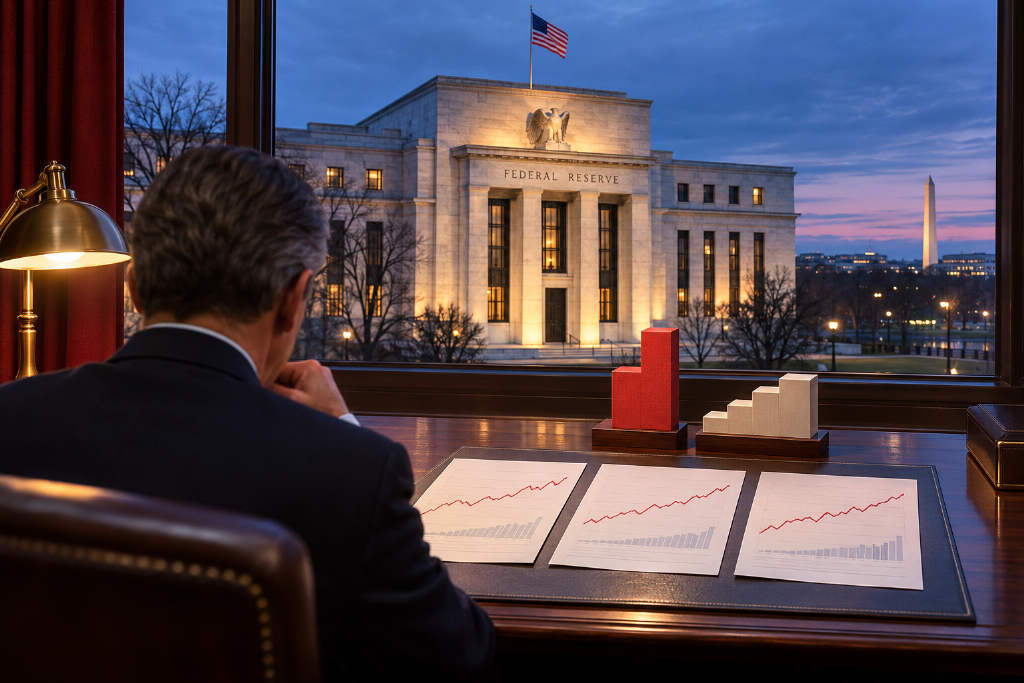
Three consecutive inflation reports showing persistent price pressure have made a Federal Reserve rate hike at the Dec. 8-9 meeting appear almost certain. The debate has shifted to the size and pace of the move: officials could raise rates by 50 basis points in December, or keep the 25-basis-point pace while making another increase more likely in January.
Wall Street Journal reporters Nick Timiraos and Matt Grossman wrote that the latest inflation data have sharply increased the likelihood of a December hike and reopened discussion of a faster tightening path. Officials are not only deciding how much to raise rates at the next meeting. They must also assess whether the current cycle needs only a few small adjustments or a longer period of tightening to bring price pressure down.
Core inflation has held at 0.3% for three months
Data from the U.S. Bureau of Labor Statistics showed that the core Consumer Price Index, which excludes food and energy, rose 0.3% in October from the previous month on a seasonally adjusted basis. The increase matched the readings for August and September. Monthly inflation did not accelerate, but it also failed to slow for a third straight month.
The Wall Street Journal reported that the annualized increase in core prices over the three months through October was 3.7%, compared with 1.6% over the three months through July. The stronger short-term trend has challenged officials who had previously resisted moving quickly with consecutive rate increases.
Fed officials had only begun trying in October to reduce market expectations for rapid, back-to-back hikes. The new inflation data have forced them to reassess whether a gradual approach will be enough to restrain prices or whether moving slowly could leave the central bank needing to tighten by more later.
Two ways to speed up tightening
Officials are discussing two ways to accelerate the process. One would be a direct 50-basis-point increase in December, equivalent to two 25-basis-point increments. The other would keep each move at 25 basis points while increasing the chance of another hike in January, without leaving a long observation period between meetings.
Fed Governor Waller said in a speech before the CPI release that the central bank should consider a 50-basis-point increase in December if October core CPI rose by about 0.3% or more from the previous month. The actual reading fell within that range, giving fresh attention to the case for a larger single move.
A faster tightening cycle does not necessarily mean one 50-basis-point hike. The report cited Matthew Luzzetti, Deutsche Bank’s chief U.S. economist, as saying that consecutive 25-basis-point increases were currently the more likely option. He expected the next three meetings to deliver one 25-basis-point hike each.
Anna Paulson, president of the Federal Reserve Bank of Philadelphia, favored gradual adjustments so that households and businesses would have time to adapt. She said faster action would be more necessary if price pressure began passing through to wages or the public’s inflation expectations. She said she had not seen that condition so far.
The chair will have to reconcile the split
In a post published late on Nov. 11 Taipei time, Timiraos grouped the choices into three possibilities: raising rates by 25 basis points at each meeting, moving to a 50-basis-point increase earlier, or signaling a more frequent sequence of 25-basis-point hikes. He wrote that such tactical decisions are usually integrated and set by the Fed chair, citing decisions made by Alan Greenspan in 1994 and 2000 and by Jerome Powell in 2022.
The Wall Street Journal said Kevin Warsh, who took over as chair this year, had offered little clear guidance on how he would respond to this type of data. Officials face two competing concerns. Moving too slowly could allow inflation to persist, while tightening more quickly could cool the economy more than necessary.
The disagreement covers both the size of each move and the interval between decisions. Even if every hike remains at 25 basis points, switching from acting at alternate meetings to raising rates at consecutive meetings would push borrowing costs to a higher level more quickly. It would also shorten the adjustment period for households and businesses facing higher borrowing costs.
The recent policy backdrop includes the Fed holding its target rate at 3.75% to 4.00%, with two votes supporting another 25-basis-point hike. Voting member Logan argued for at least two more 25-basis-point increases, while Deutsche Bank expected the tightening cycle to extend into next year.



