
Crypto market slides as macro support weakens
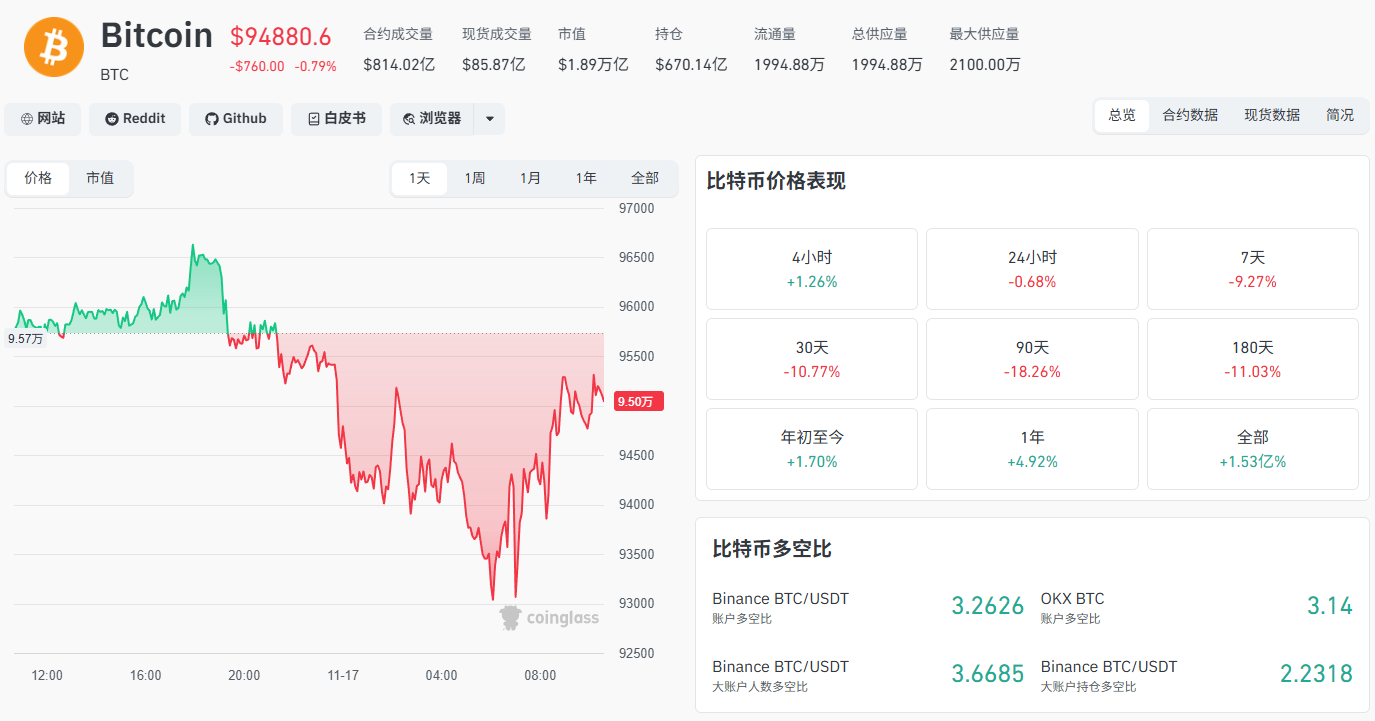
Crypto assets started the week on the back foot, with risk sentiment deteriorating sharply in early Monday trading. On the morning of November 17 Beijing time, Bitcoin fell below $94,000 and briefly touched $93,005. Ethereum also lost the $3,000 area, hitting an intraday low of $3,004. Price action across the board suggested more than a routine pullback, as traders appeared to be reducing exposure ahead of a cluster of macro catalysts.
The pressure was even more visible in altcoins. According to the source text, GIGGLE dropped 9.59% over 24 hours, ICP fell 8.3%, and PHA declined 8.5%. After earlier market shocks and uncertainty tied to the U.S. government shutdown narrative, sentiment had already become fragile. Diverging institutional views added to that tension, with Galaxy Digital cutting its year-end target while JPMorgan maintained a much more bullish outlook.
Over the prior 72 hours, the market’s main bullish framework had started to break down. The original article framed that framework around three pillars: fiscal stimulus, monetary easing, and the AI narrative. Two of those pillars were already under pressure before Monday’s open, while the third was approaching an important test later in the week. In that context, the sell-off looked less like a technical reset and more like preemptive de-risking.
Fed officials undermine the December cut narrative
One of the core bullish assumptions in recent weeks had been the idea of an “insurance” rate cut at the Federal Reserve’s December 10 meeting. The source article noted that on October 16, CME FedWatch implied an 88.2% probability of a cut, showing how firmly that view had been embedded in market pricing only a month earlier.
That changed on November 14, when Dallas Fed President Lorie Logan and Kansas City Fed President Jeff Schmid delivered coordinated hawkish commentary. Logan said it would be difficult for her to support a December cut and argued that the U.S. labor market did not appear to require further insurance easing. Schmid took a similarly firm stance, saying his inflation concerns went well beyond tariffs and warning that further rate cuts could have lasting inflation consequences.
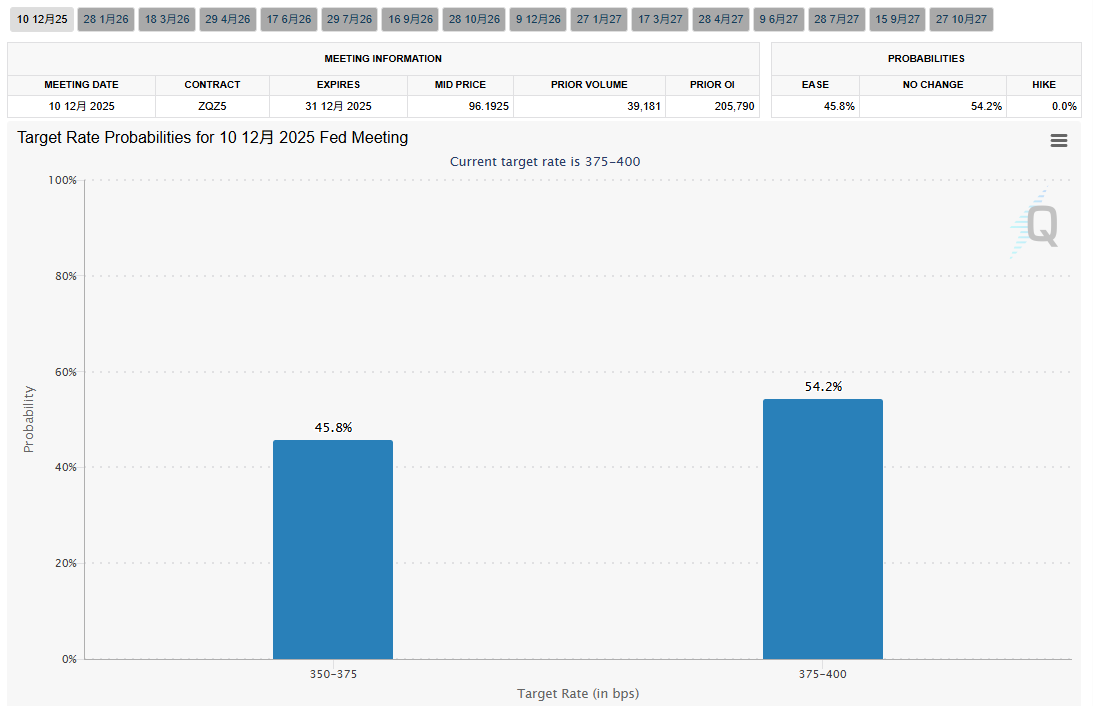
The repricing was immediate in leveraged markets. Coinglass data cited in the source showed that between November 14 and 15, total liquidations across the market reached $1.7 billion. Of that amount, about $1.62 billion, or 95%, came from long positions, with more than 404,000 traders liquidated. By November 16, CME FedWatch showed the market had moved from near-consensus to a split view: 45.8% probability for a cut versus 54.2% probability of rates staying unchanged.
That shift matters because crypto had been benefiting not just from the possibility of easier policy, but from the perception that easier policy was becoming increasingly likely. Once that narrative moved from a high-conviction setup to a coin flip, the support it provided to speculative positioning weakened substantially.
Bessent clarifies the $2,000 plan, weakening fiscal stimulus hopes
The second blow came from the fiscal side. Some market participants had been treating the widely discussed $2,000 “dividend” as a possible source of direct liquidity for households, especially when combined with expectations around Treasury General Account dynamics. That interpretation fed a broader thesis that fresh fiscal support could reinforce risk assets.
According to the source, U.S. Treasury Secretary Scott Bessent publicly clarified on November 17 that the proposal should not be understood as helicopter money or a direct liquidity injection. Instead, he described it as a form of “tariff dividend” that could appear in multiple forms, including tax cuts, targeted rebates, or measures such as “No Tax on Tips.” The article also referenced income thresholds, including households earning less than $100,000.
Timing was another key issue. Bessent reportedly said the plan would require congressional approval, would not be distributed before Christmas, and was targeted for 2026. That sharply contrasted with the more immediate stimulus expectations some traders had priced in. In practical terms, the market’s hoped-for replay of a direct fiscal cash-injection cycle was not confirmed.
For crypto, the difference is significant. A near-term transfer to consumers can quickly feed into broad liquidity and risk-taking behavior, while tax policy or delayed rebates operate through a slower and more uncertain channel. The source interprets Bitcoin’s move below $94,000 as a second-stage response to that fiscal disappointment, following the first-stage shock caused by hawkish Fed remarks.
Nvidia earnings become the next major test for risk appetite
With both monetary and fiscal optimism fading, attention has shifted to the AI narrative. Nvidia is scheduled to report fiscal 2025 third-quarter earnings after the close on November 20, and the report is widely seen as a major catalyst not only for U.S. equities but also for broader cross-asset sentiment.
The original article outlined three broad scenarios. In the first, Nvidia delivers a strong beat and upbeat guidance, potentially far above Wall Street expectations including the cited $48.94 billion consensus for data center revenue. Under that scenario, AI enthusiasm could intensify further. While that might appear positive for speculative assets in general, the article argues it would likely be negative for crypto in the short term because capital would continue to flow into AI-related equities rather than digital assets, especially altcoins.
That view aligns with comments previously made by Galaxy Digital head of research Alex Thorn, who has argued that one reason for Bitcoin’s weaker performance is capital rotation into other dominant investment narratives, especially AI and gold. A major Nvidia upside surprise could reinforce that rotation and keep crypto in a relative funding deficit.
In the second scenario, Nvidia merely meets expectations or offers slightly softer guidance. In that case, the AI trade could lose some of its momentum, prompting investors to look for alternative high-growth narratives. The source suggests that part of that capital could rotate into crypto, with AI-linked tokens such as ICP and PHA among potential beneficiaries. In the third scenario, Nvidia badly misses on both earnings and guidance. That outcome would likely pressure the Nasdaq 100 and the broader tech complex, and because crypto often trades as a high-beta expression of tech risk sentiment, digital assets could fall alongside equities rather than benefit from rotation.
Market enters a broader macro stress test
Taken together, the recent move lower reflects a broader repricing rather than a single-event shock. On Friday, hawkish Fed rhetoric weakened confidence in a December cut. On Monday, Bessent’s clarification reduced expectations for a direct fiscal liquidity boost. With those two macro pillars diminished, the market is leaning more heavily on the AI narrative at exactly the moment when that narrative faces a decisive earnings catalyst.
Price action in AI-related crypto tokens already reflects that uncertainty. The source notes that ICP was down 37.2% over seven days, while PHA fell 9.6% in 24 hours. That suggests traders are not just reassessing the path of rates and fiscal policy, but also the probability distribution around whether capital stays in AI, rotates back into crypto, or exits both at once.
The article also referenced on-chain analyst Willy Woo, who has argued that the earlier bull-market framework driven by the overlap of the halving cycle and broad M2 liquidity expansion may no longer be sufficient on its own. Whether or not market participants fully agree with that view, the trading between November 14 and 17 highlights how sensitive crypto has become to macro shifts. In the near term, pricing is likely to remain anchored to three questions: whether the Fed pauses or cuts in December, whether fiscal measures become direct or delayed, and whether AI continues to dominate global risk allocation after Nvidia’s report.