
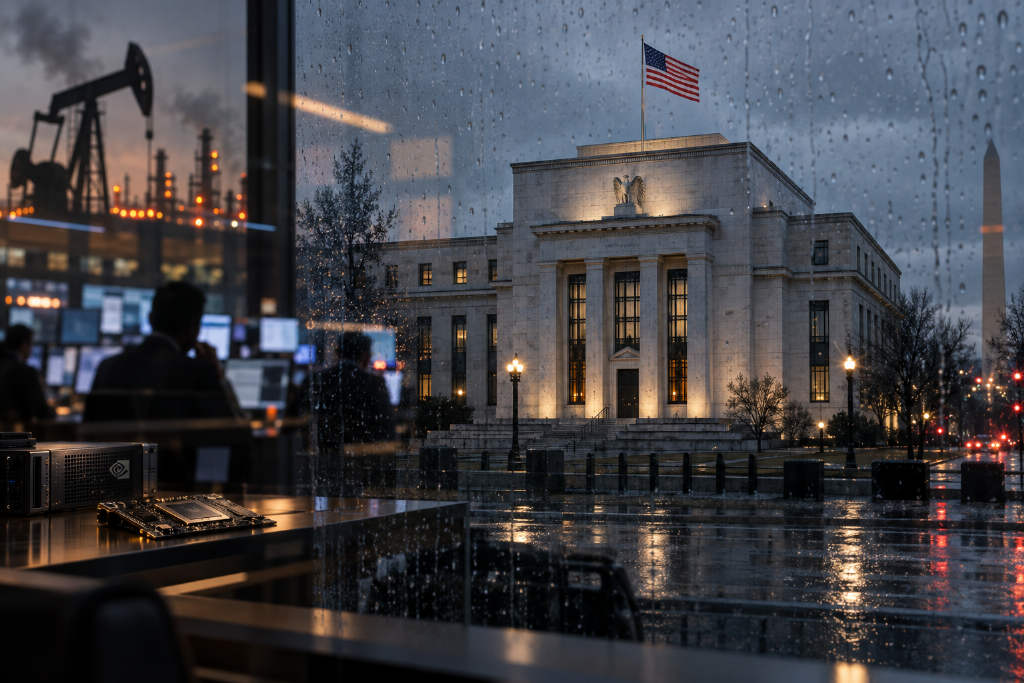
The week opens with one question hanging over U.S. markets: after a Federal Reserve hike has been priced as close to certain, can investors still hold together the AI growth story and the pressure from higher rates?
Wall Street rebounded on Friday after four straight down sessions. The S&P 500 rose 0.86% to 7,656.98, the Dow Jones Industrial Average added 0.98% to 52,573.29, and the Nasdaq gained 0.96% to 26,333.040. For the week, though, the S&P 500 still fell 0.8%, the Nasdaq lost 0.7%, and the Dow slipped 0.3%. The VIX stood at 16.89, down about 2.3%. The 10-year Treasury yield eased to around 4.82%, while the 2-year yield was near 4.43%.
Three factors drove Friday’s rebound. Core CPI rose 0.3% month over month and came in above expectations, lifting the probability of a Fed rate increase this week to nearly 90%. Signs of easing tension in the Middle East pulled Brent crude back from a high of $107. Oracle’s earnings also reinforced expectations for AI computing demand, helping Dell jump 12% to a record high.
That rebound did not carry cleanly into the new week. In early Asian trading on Monday, U.S. stock futures moved lower and Nasdaq 100 futures fell 1%. At the same time, three leading AI figures called for a slowdown in frontier model development, and OpenAI said it would not pursue an IPO this year, forcing investors to reassess the near-term pace of the AI trade.
Core CPI beat expectations and rate hike bets climbed
August CPI data was the most important macro release for markets on Friday. Core CPI increased 0.3% from a month earlier, above market expectations, while the year-over-year core reading held at 3.4%.
After the release, traders put the odds of a Fed hike this week at about 90%. Goldman Sachs economists expect the central bank to raise rates by 25 basis points when its two-day meeting that begins on Sept. 16 concludes.
Fiscal strain is building at the same time. In the first 11 months of the current fiscal year, the U.S. federal budget deficit reached $1.97 trillion. Net interest expense hit $1 trillion, the first time the interest bill has crossed that threshold. With the deficit nearing $2 trillion and interest expense above $1 trillion, the long end of the Treasury market is increasingly pricing debt-spiral pressure, and supply concerns in Treasuries have not eased even as rate-hike expectations rise.
Kevin Hassett, director of the White House National Economic Council, said that both he and Trump see no reason to raise rates. That put the split between the White House and the Fed on the rate path in clearer public view. Market pricing, however, still shows a hike is being treated as a near-certain event.
AI leaders call for caution, and OpenAI delays IPO plans
Outside the macro story, the AI sector delivered one of the weekend’s biggest shifts.
OpenAI CEO Sam Altman said OpenAI and other leading artificial intelligence companies may be close to reaching an agreement to slow the pace of AI development and jointly address safety risks. Anthropic CEO Dario Amodei also urged AI companies to move more carefully in model development and said the pace of improving AI model capabilities should slow.
Both Elon Musk and Altman backed Amodei’s call for a “global slowdown in AI.”
Altman also said OpenAI will not go public this year, adding that if AI threatens human survival, he would rather destroy the IPO. With three major AI voices sending the same signal on slowing development, and with OpenAI pushing back its IPO, the market’s assumptions about the short-term rhythm of the AI narrative are being reset. Nasdaq 100 futures falling 1% in early Asian trading on Monday underscored that pressure.
Even so, the AI chain is not moving in one direction. Oracle’s earnings strengthened expectations for AI computing demand, and Dell’s 12% gain on Friday pushed the stock to a record high, extending the order-driven logic around AI servers. For now, the AI narrative is splitting into two lines: growth in hardware and computing orders on one side, and the pace and regulatory handling of frontier model development on the other.
Middle East signals pulled oil lower, then higher again
Energy markets remain unstable.
According to the report, inventories at Yanbu can only sustain exports for five to seven days. If the Saudi pipeline disruption continues after an attack, the world could face a 4% crude supply gap. At the same time, the situation in Yemen escalated sharply, with Houthi forces and Saudi Arabia attacking each other. Iran, however, said it is “not in a state of war” with Saudi Arabia, wording that left room for de-escalation.
International crude prices retreated from more than four-month highs on Friday. The November Brent contract fell 2% to $103.72 a barrel, and the October WTI contract dropped 2% to $100.26 a barrel. Signs of easing tension in the Middle East were the main driver.
By early Asian trading on Monday, crude turned higher again. WTI futures rose more than 2% after reports about the shutdown of an important Saudi oil pipeline and a delay to a Strait of Hormuz meeting renewed supply concerns. Oil is still being pulled between hopes for easing tensions and the reality of disrupted supply, and pricing in the energy sector has yet to settle.
Gold and crypto prices
Spot gold fell 0.51% to $4,399.20 an ounce. In crypto, Bitcoin traded around $78,342, up 0.26% over 24 hours, while Ether changed hands near $2,478, up 0.62%.
What markets are watching this week
1. The Federal Reserve’s September meeting
The meeting runs from Sept. 16 to Sept. 17. The probability of a hike has climbed to nearly 90%, and markets appear to have largely priced in the move itself. The more important variable is the Fed’s guidance on what comes next. If the dot plot points to a second hike later this year, longer-dated yields could face fresh pressure. If the language turns dovish, markets may get some relief. The White House’s public opposition to another hike also puts extra attention on the independence narrative around this meeting.
2. Whether the AI slowdown call turns into action
It is rare to see three major AI figures align on slowing frontier model development. Whether that turns into actual changes in development pace, or into a regulatory framework, is still unclear. If model iteration does slow, short-term demand expectations for AI hardware could be revised down. If this remains mostly a statement of principle, trading may move back toward order books and hardware demand fairly quickly.
3. Treasury supply and debt sustainability
With the deficit nearing $2 trillion and interest costs above $1 trillion, pricing in long-dated Treasuries is shifting from rate expectations alone toward debt sustainability. Once this week’s rate decision lands, whether long-end yields can stabilize will directly shape the valuation anchor for high-multiple assets.
