
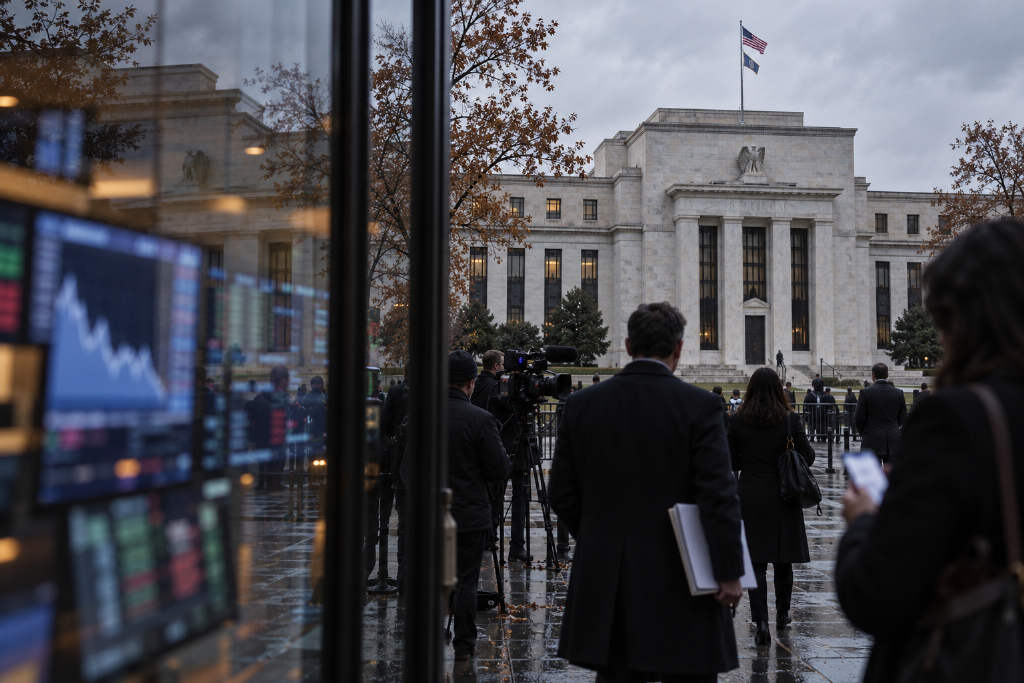
The Federal Reserve did not raise rates on Oct. 28. Markets, however, moved on quickly from the question of whether the Fed would hike at this meeting to a more consequential one: how long interest rates may need to stay high.
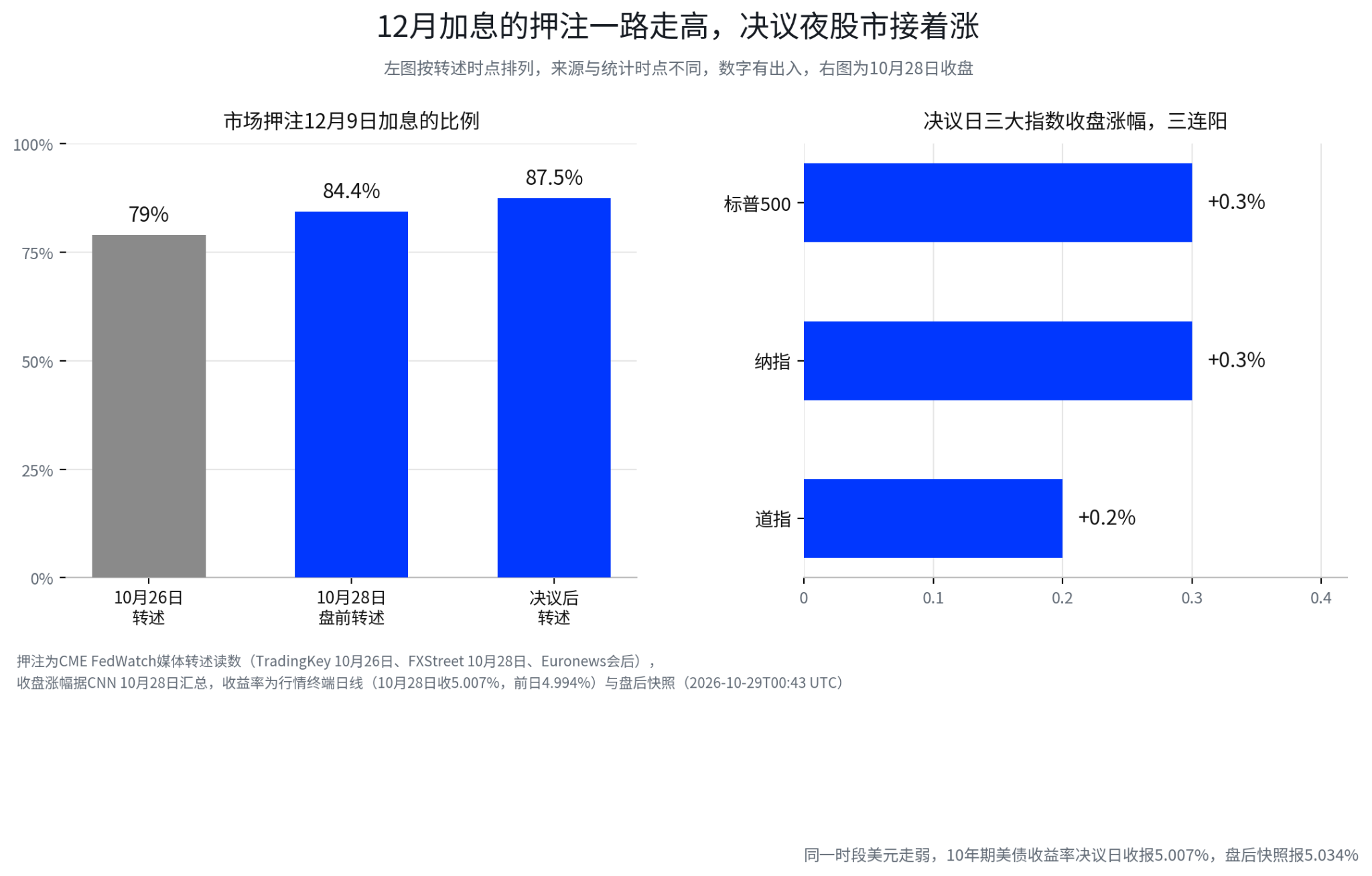
By the end of the meeting, investors had largely shifted toward pricing in a December increase. Yet the immediate market reaction was not straightforward. U.S. stocks closed higher, the dollar weakened during the decision and press conference, and Treasury moves were more nuanced. The next real test comes from the data due later: the advance estimate of third-quarter GDP and September PCE, both scheduled for Oct. 29.
A 10-2 vote made the pause look more hawkish
The Federal Open Market Committee kept the target range at 3.75% to 4.00% in a 10-2 vote. Cook and Hammack dissented, favoring an immediate 25-basis-point increase. As cited in the source material from CNBC and Reuters, the split showed that officials were not fully aligned on how persistent inflation risks remain.
The decision itself was not the surprise. The weight of the meeting sat in those two dissenting votes. Most policymakers chose to wait, while a minority judged inflation risks large enough to justify another move right away. For markets, that distinction mattered. Waiting is not the same as turning dovish, and as long as inflation has not clearly cooled, the case for keeping rates elevated remains intact.
The statement also carried a firmer tone. The Fed upgraded its description of economic activity from “solid” to “strong,” while retaining language that inflation remains elevated. Reuters, as cited in the source, said the committee still needs more data to judge the next step and has not ruled out additional tightening.
That left the policy path open in both directions, but not loose. The Fed did not signal an imminent hike, and it did not signal a pivot to easing either. If the economy is still resilient, there is less reason to cut rates to support growth. If inflation has not clearly moved lower, easing too early risks undoing earlier progress.
Waller’s press conference followed the same pattern. According to the source material, he did not offer a timetable. His remarks centered on inflation still being too high, policy already working through the economy, and the need for more information. Investors therefore cannot infer a full policy path from one meeting alone. Each inflation, labor, and spending report remains a potential turning point.
The meeting calendar adjustment also drew attention. Waller said there will be one meeting in 2027 and two in 2028 dedicated to long-run monetary policy strategy. Those meetings will not include rate votes and will not produce standard policy statements, according to CNBC as cited in the source. In practical terms, some meetings will be reserved for framework discussions rather than rate decisions, which means markets will need to distinguish between the two.
Taken together, the decision, statement, and press conference point to the same conclusion: policy remains data-dependent, and the direction is still open.
Why stocks rose even as December hike odds increased
The market reaction on the night of the decision looked contradictory at first glance. According to CNN’s roundup cited in the source, the S&P 500 and Nasdaq each rose about 0.3%, while the Dow added about 0.2%, extending all three major indexes to a third straight gain. Reuters reported that the dollar weakened during the decision and press conference. Bloomberg’s market summary, also cited in the source, said shorter-dated Treasuries outperformed.
If a December hike is already seen as highly likely, why did equities not fall?
One reason is timing. The October meeting did not deliver fresh tightening on the day. Even if December odds were already high, holding steady in October meant financial conditions did not tighten further at that moment. Investors who had worried about a more aggressive surprise got some immediate relief.
Another reason is that strong growth cuts both ways. It raises inflation risk, but it also supports earnings. Higher rates pressure valuations, while resilient consumption and business investment can keep profit expectations from falling right away. As long as earnings assumptions hold, stocks do not have to decline in lockstep with rate-hike pricing.
There is also the issue of expectations. Market reactions need to be measured against what was already priced in before the meeting. If hawkish language had already been anticipated, and the Fed did not come in more hawkish than expected, some assets could still rebound in the short term. The weaker dollar should not be read mechanically as a drop in hike expectations either, because exchange rates also reflect relative central bank policy, capital flows, and positioning.
It is more useful to read each asset class as signaling something different. Equities reflect growth and earnings. The dollar reflects relative policy and capital flows. Bonds reflect the expected path of rates. Positioning and the wording of the press conference can distort all of them in the short run. On that basis, the source argues that the decision-night moves alone are not enough to conclude that markets see a December hike as unimportant.
As for the roughly 87.5% probability attached to Dec. 9 after the meeting, the source treats it as a thermometer rather than a verdict. It can move with PCE, labor data, and official remarks. What matters more than the level at one moment is the direction and magnitude of the move after the next data releases.
Higher for longer forces a repricing across four asset groups
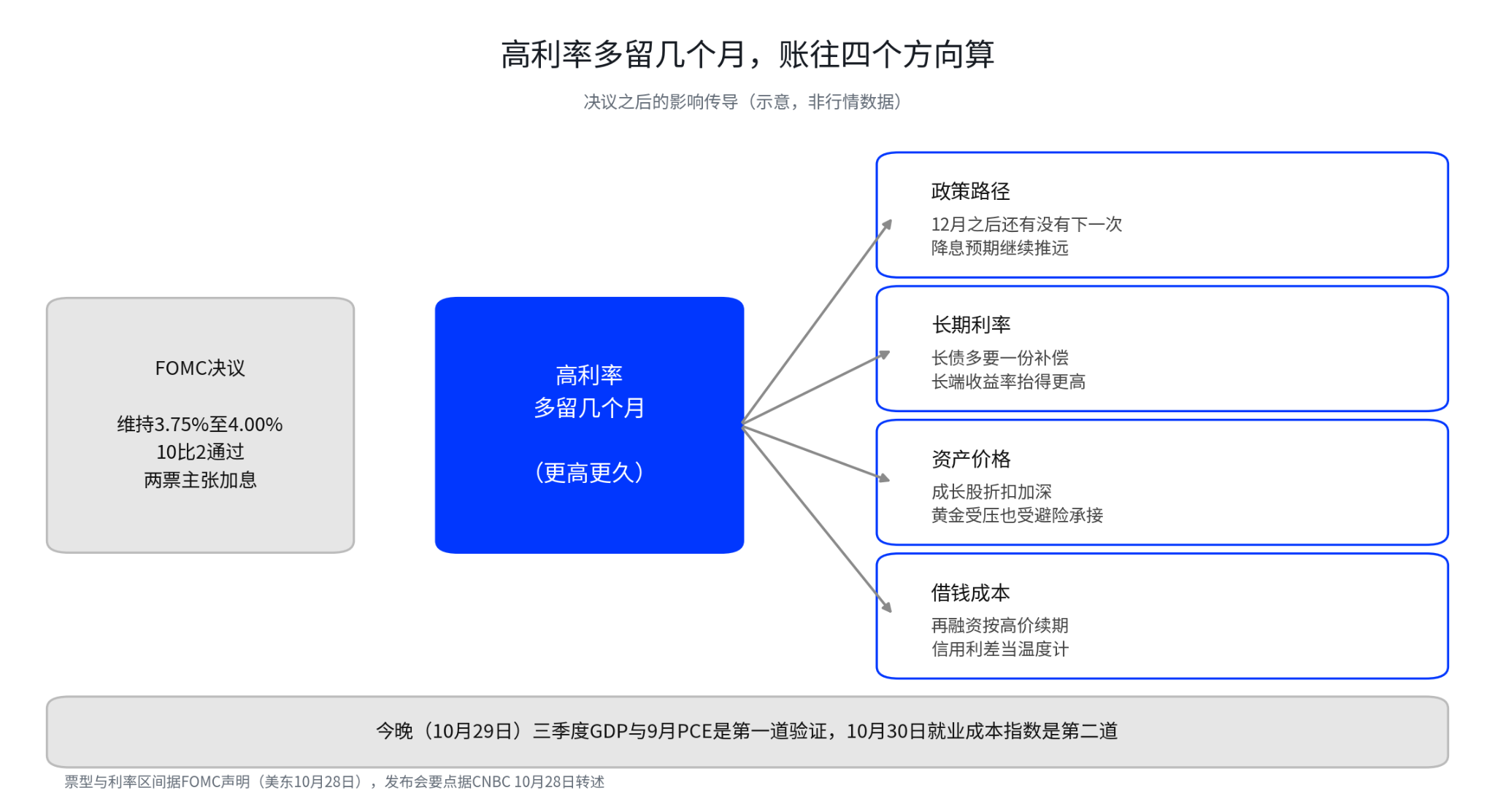
Bonds: the front end and long end are not pricing the same thing
Short-dated Treasury yields track expectations for the next few Fed meetings most closely, with the 2-year note especially sensitive to the policy path. The 10-year yield has to absorb more than the expected policy rate. It also reflects inflation, growth, fiscal supply, and the term premium specific to longer maturities.
The more investors believe rates will stay high for longer, the more compensation the long end may demand. That relationship is not absolute. If growth expectations weaken sharply, safe-haven demand can push long-end yields lower instead.
According to the terminal data cited in the source, the 10-year Treasury yield closed at 5.007% on Oct. 28, about 1 basis point above 4.994% on the prior trading day and about 2 basis points above 4.988% on Oct. 26. An after-hours snapshot showed 5.034% at 00:43 UTC on Oct. 29, 2026. The source notes that long-end moves on the decision day itself were limited, and that much of the repricing for a longer period of high rates had built gradually over the prior week.
Growth stocks: valuation pressure meets earnings support
Growth companies derive a larger share of their value from profits expected years into the future. When long-term rates rise, those future profits are discounted more heavily. But growth stocks are not one uniform group. Companies with stable cash flow, pricing power, and less dependence on external financing tend to hold up better than firms that still rely on repeated funding and have not yet delivered profits.
The key question for investors is how much current valuations depend on distant growth assumptions, and how credible those assumptions remain under a higher-rate backdrop.
Gold: rate pressure on one side, safe-haven demand on the other
Gold is being pulled by two opposing forces. Higher rates raise the opportunity cost of holding a non-yielding asset. That is the pressure side. At the same time, the longer rates stay high, the less room policymakers may have for error. If growth or credit conditions deteriorate, safe-haven buying and central bank purchases could absorb selling pressure.
The source says spot gold was fluctuating around $4,050 to $4,060 ahead of the decision, based on reports from Oct. 28. The next directional move, it argues, will depend on inflation data, real yields, and the dollar together rather than any one variable alone.
Corporate financing: refinancing stress builds month by month
Every extra month that rates remain elevated extends the period of expensive refinancing for companies that depend on market funding. Firms with stable cash flow and longer debt maturities have more cushion. Highly leveraged companies with weaker cash generation and ongoing financing needs are likely to feel the strain first.
Credit spreads are one way to watch that process. If risk-free rates move sideways while spreads continue to widen, markets may be starting to demand more compensation for financing fragility. In that case, pressure would be moving from the rates market into risk assets.
The source also links this framework to growth assets in Hong Kong and mainland China. Long-dated U.S. Treasury yields serve as a valuation reference for growth assets globally, while Hong Kong dollar assets also absorb rate transmission through the currency peg, though not instantly and not always to the same degree. For Hong Kong-listed AI names, the source says investors need to watch both the valuation effect from long-end U.S. yields and whether company earnings and cash flow can withstand it.
GDP and PCE are the next test of the market’s repricing
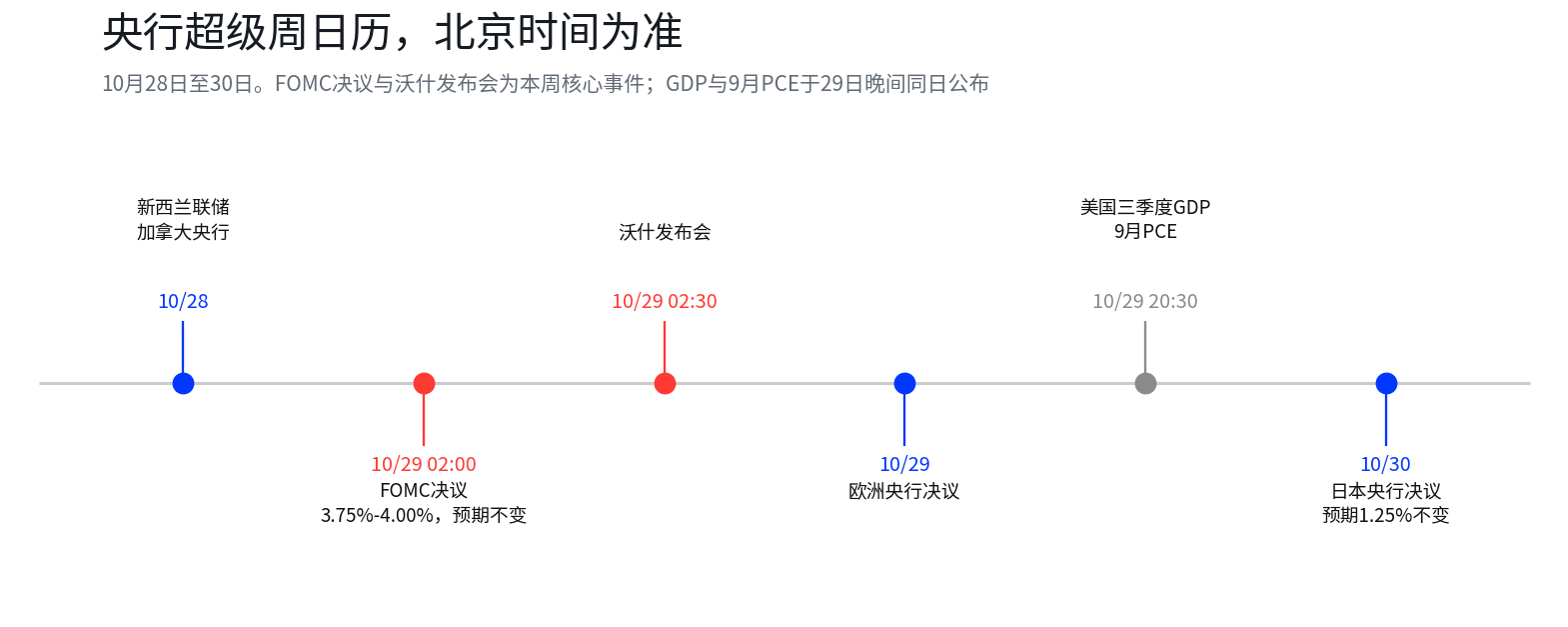
At 20:30 Beijing time on Oct. 29, the U.S. is set to release the advance estimate of third-quarter GDP and September PCE. GDP addresses how much resilience remains in growth. PCE addresses whether inflation is cooling. Put together, they form the policy mix the Fed is now confronting.
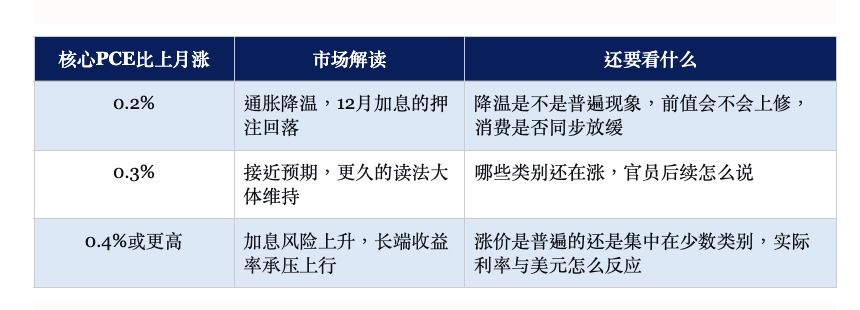
The source stresses that this is not a mechanical trading template. Monthly inflation data can be distorted by category swings, seasonality, and revisions. A 0.2%, 0.3%, or 0.4% reading cannot be mapped directly onto cuts, a hold, or hikes. What markets care about is whether the data change the view of inflation over the next several months.
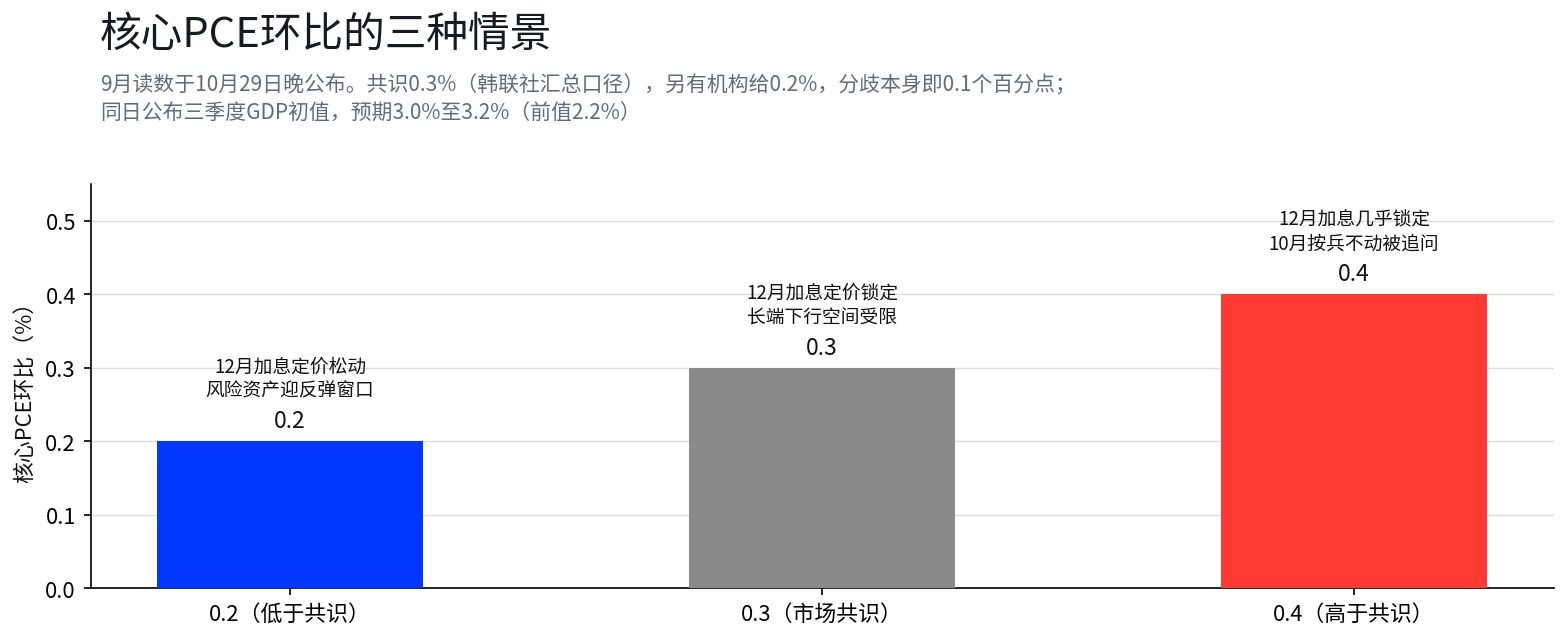
On GDP, the source gives a consensus range of 3.0% to 3.2%, up from a prior reading of 2.2%. The focus is on real consumption and private domestic final purchases. If growth stays strong and inflation remains sticky, the case for a restrictive stance becomes stronger, and “higher for longer” could shift toward “higher again if needed.” If growth weakens while inflation stays stubborn, markets would have to price both tightening risk and recession risk at the same time, making the reaction in stocks, bonds, and the dollar more complicated.
A second check comes from the Employment Cost Index due at 20:30 Beijing time on Oct. 30. The source lists expectations for a 0.8% quarter-on-quarter increase, down from 0.9% previously. Labor costs help gauge whether wage pressure is still feeding into services inflation, but the index alone cannot determine the policy path. PCE, GDP, and the Employment Cost Index need to be read together to judge whether the Fed still has room to wait.
Four signals markets are watching next
- December hike pricing: whether the probability rises further or falls back after PCE, helping distinguish a temporary move from a broader repricing.
- The yield curve: if the front end rises and the long end follows, markets may be reinforcing tighter policy expectations; if the front end stays high while the long end falls, growth concerns or safe-haven demand may be taking over.
- Credit spreads: whether high financing costs are beginning to turn into broader credit stress.
- Valuation transmission: how sensitive growth stocks and Hong Kong AI assets remain to long-term rates, and whether earnings expectations can offset valuation pressure.
The source argues these indicators need to be read together. If inflation surprises to the upside, front-end yields rise, and the dollar strengthens at the same time, that would look more like markets pricing a tighter policy path. If inflation surprises higher but the long end falls and credit spreads widen, growth and credit concerns may also be building. Getting one indicator right is less important than identifying the scenario markets are actually trading.
Other central bank meetings this week are treated as secondary signals. Reuters reported that the Reserve Bank of New Zealand unexpectedly held rates steady on Oct. 28, sending the New Zealand dollar lower. The source also lists decisions from the Bank of Canada on Oct. 28, the European Central Bank on Oct. 29, and the Bank of Japan on Oct. 30, with the BOJ expected to keep rates unchanged at 1.25%, according to a roundup cited from Eastmoney. Those decisions can affect relative rate differentials and currencies, but they do not replace U.S. inflation and growth data in setting the direction for the dollar, gold, and global risk assets.
A pause is not a pivot
The Fed did not hike at this meeting, and it did not declare victory over inflation. The 10-2 vote, the stronger description of economic activity, and Waller’s refusal to provide a timetable all point to a policy path that remains open.
Even with December hike pricing near 90% after the meeting, that number is still a market reading that can change with the data. It is not a decision already made. The immediate question now is whether GDP and PCE can alter the market’s view of the rate path.
If growth remains strong and inflation stays sticky, there is a clearer case for keeping rates high for longer. If inflation cools and growth slows, markets will have more reason to reassess how much additional restraint is still needed. Rates did not move on Oct. 28, but asset pricing did not stop. The real dividing line is when markets become convinced that the high-rate phase can end, and what evidence they require before making that call.
Data points cited in the source
The source states that the FOMC held rates at 3.75% to 4.00% in a 10-2 vote on Oct. 28, with Cook and Hammack dissenting in favor of a 25-basis-point hike, citing CNBC and Reuters.
On the statement language, the source says the Fed upgraded economic activity from “solid” to “strong” while keeping the phrase that inflation remains elevated, citing Reuters and CNBC.
On the meeting schedule, the source says one meeting in 2027 and two in 2028 will be dedicated to long-run monetary policy strategy, without rate votes or standard statements, citing CNBC.
On the press conference, the source summarizes the message as inflation still too high, policy working through the economy, and more information needed, without a preference for forward guidance, citing CNBC.
On December pricing, the source lists about 87.5% after the meeting from Euronews, versus 79% to 84% before the meeting from TradingKey and FXStreet, while noting that the original CME page was not obtained.
On market reaction, the source attributes stock index closes and the dollar move to CNN and Reuters, and short-end outperformance to Bloomberg and investingLive.
On the 10-year Treasury yield, the source lists 4.994% on Oct. 23, 4.988% on Oct. 26, 4.994% on Oct. 27, and a 5.007% close on Oct. 28, with 5.034% after hours at 2026-10-29T00:43 UTC.
On the data calendar, the source says the Bureau of Economic Analysis will release the advance estimate of third-quarter GDP and September personal income and outlays at 8:30 on Oct. 29, and the Bureau of Labor Statistics will release the Employment Cost Index at 8:30 on Oct. 30. It gives a GDP expectation range of 3.0% to 3.2% and a core PCE expectation of 0.3% based on multiple surveys.
On the central bank calendar, the source says the Reserve Bank of New Zealand unexpectedly held rates steady on Oct. 28, citing Reuters, while the Bank of Canada, European Central Bank, and Bank of Japan were scheduled for Oct. 28, Oct. 29, and Oct. 30 respectively, with the BOJ expected to keep rates unchanged at 1.25%, according to an Eastmoney roundup.
On commodities, the source lists WTI at about $102 and spot gold around $4,050 to $4,060, both based on reports from Oct. 28.



