
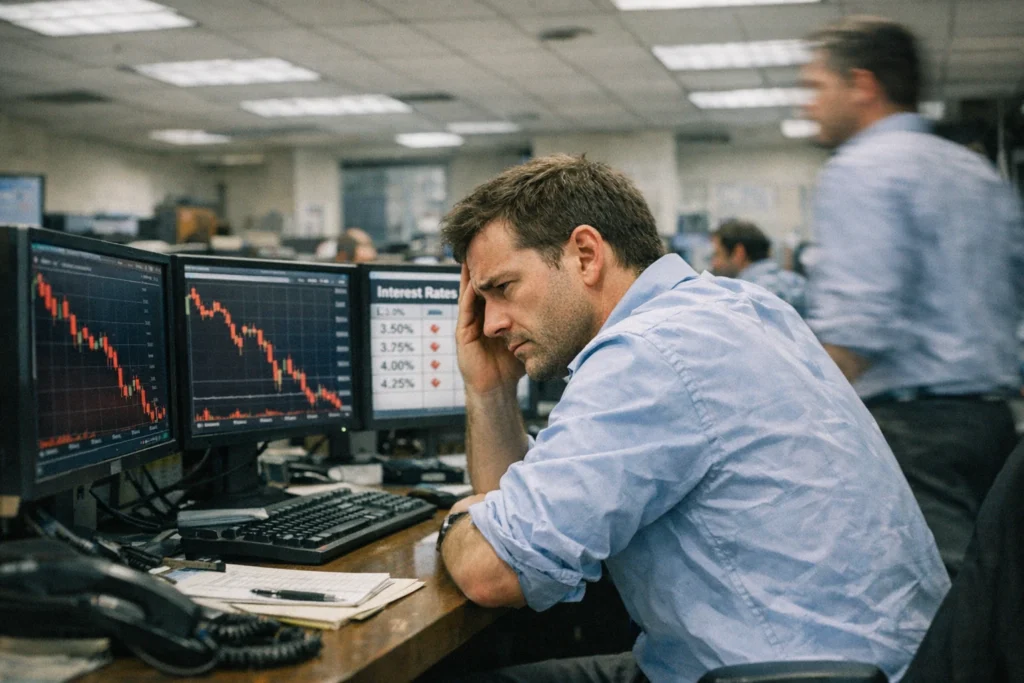
The Federal Reserve will release its interest-rate decision at 2 p.m. ET on July 29, followed by a press conference at 2:30 p.m. The federal funds target range currently sits at 3.50% to 3.75%.
What looked unlikely just two weeks ago is now being treated as a real possibility. CME FedWatch data cited in the source showed the odds of a July rate hike at 10.7% on July 15. By July 22, that figure had climbed to 34.7%, more than tripling in a week, and it briefly approached 40% intraday last Thursday. As of July 28, the probability had eased back to roughly one-third, but the market was no longer dismissing a move outright.
Silence from officials has become part of the story
According to the source, the rise in rate-hike expectations was not driven by fresh hints from Fed officials. It was the absence of clear hints that pushed uncertainty higher.
New Fed Chair Kevin Warsh has pressed for changes to the central bank’s communications approach since taking office. The source said he has advocated fewer public remarks, an end to policy signaling among committee members, and even considered scrapping post-FOMC press conferences in favor of a more rules-based framework.
During congressional testimony on July 14, Warsh announced a dedicated working group to review communication practices. The group includes Peter Fisher, Arminio Fraga and Mervyn King. In the source’s telling, markets are now paying the price for that quieter approach.
Three views from Wall Street
Goldman Sachs: “Unusually uncertain,” but still leaning toward a hold
Goldman Sachs chief U.S. economist David Mericle and his team described this week’s meeting as “unusually uncertain.” They pointed to Warsh’s different style from his predecessor, the lack of clarity around his own preferences, wider divisions inside the FOMC, and renewed tension involving Iran during the blackout period. By historical standards, the source said, either a hike or no change would now count as a surprise.
Even so, Goldman’s base case remains unchanged rates. Softer June inflation data reduced the case for immediate action, and this meeting does not include a Summary of Economic Projections. A surprise hike in that setting, the bank argued, could easily be interpreted as the start of an entire tightening cycle. Mericle also raised a broader point: modest rate hikes rarely prove very effective in research, “mainly because businesses and consumers do not pay as much attention to central banks as financial market participants do.”
The source also noted that Goldman had already dropped its forecast for two rate cuts in 2026. It now expects 25-basis-point cuts in June and December 2027.
JPMorgan: communication reform is unlikely to change the near-term path
JPMorgan chief U.S. economist Michael Feroli took a more restrained view. He said Warsh’s efforts to reshape the Fed’s framework and communication system are unlikely to alter the rate path in the short term. JPMorgan expects no rate move for the rest of 2026, with the next step being a 25-basis-point hike in the third quarter of 2027. Softer CPI data bought the FOMC some time, in the bank’s view, but did not remove its tightening bias.
Renaissance Macro: hike now
On the other side is Renaissance Macro chief economist Neil Dutta. In a July 22 client note titled Why not a hike now?, he argued that the Fed should move immediately. His reasons were stable employment, demand lifted by AI investment, elevated oil and services inflation, and tariff pressure that has yet to fade.
“You have to pick your moments to go against consensus, and I think this may be one of them,” Dutta said in the source. He added a second, more tactical point: if only one month of inflation data looks favorable, while the next two months are likely to look difficult, then acting now may make more sense.
The split between major banks is sharp. Goldman is looking for cuts in 2027, while JPMorgan sees a hike in the third quarter of 2027. The fact that the two houses do not even agree on direction is itself part of what makes this week’s meeting so uncertain.
South Korea’s market sell-off adds to the pressure
Rates are only one side of this week’s test for risk assets. The other side showed up early in Asia.
South Korea’s KOSPI triggered its eighth trading curb of the year at 10:13 a.m. on July 28. The index fell 542.24 points, or 8.02%, to 6,213.51, and trading across the market was halted for 20 minutes.
The source said the immediate trigger was selling pressure in U.S. semiconductor stocks. SK Hynix fell as much as 13% intraday, while Samsung Electronics dropped 10%. Both companies posted guidance below market expectations, and even Samsung’s record second-quarter profit failed to support the stock.
SMH, the semiconductor ETF tracking 25 of the largest U.S. chip companies, has fallen 9.5% over the past month. Nvidia closed down 2.2% last Friday. The central question behind the sell-off, according to the source, is simple: when will the money poured into AI infrastructure begin to generate returns?
That question will stay in focus on July 29, when Microsoft and Meta report earnings on the same day as the FOMC decision. Microsoft is set to release results for the fourth quarter of fiscal 2026, while Meta will report second-quarter earnings. Apple and Amazon are scheduled for July 30.
Bitcoin trades with other risk assets
U.S. stocks had already shown signs of divergence by the July 27 close. The Dow Jones Industrial Average rose 0.51% to 52,210.08. The S&P 500 was nearly flat at 7,413.18. The Nasdaq Composite slipped 0.18% to 24,932.08.
WTI crude fell nearly 7% the same day to $83.15 a barrel. The source identified that drop as one of the main reasons July hike odds retreated from nearly 40% to about one-third.
Crypto did not escape the pressure. Bitcoin fell about 2.7% on July 28 to around $63,200, while total global crypto market capitalization declined to $2.26 trillion, down 1.6% over 24 hours. When macro and rate pressure rise at the same time, the source said, Bitcoin’s correlation with equities tends to strengthen.
What the market is watching now
The timing is straightforward. The Fed decision is due at 2 p.m. ET on July 29, with the press conference at 2:30 p.m. The target rate range remains 3.50% to 3.75%.
The setup is less straightforward. Rate-hike odds are well above where they were two weeks ago, even after pulling back from their recent high. At the same time, the KOSPI’s sharp drop, weakness in semiconductor shares, and earnings from Microsoft and Meta landing on the same day as the Fed decision have left markets facing a concentrated test across macro policy and risk assets.