
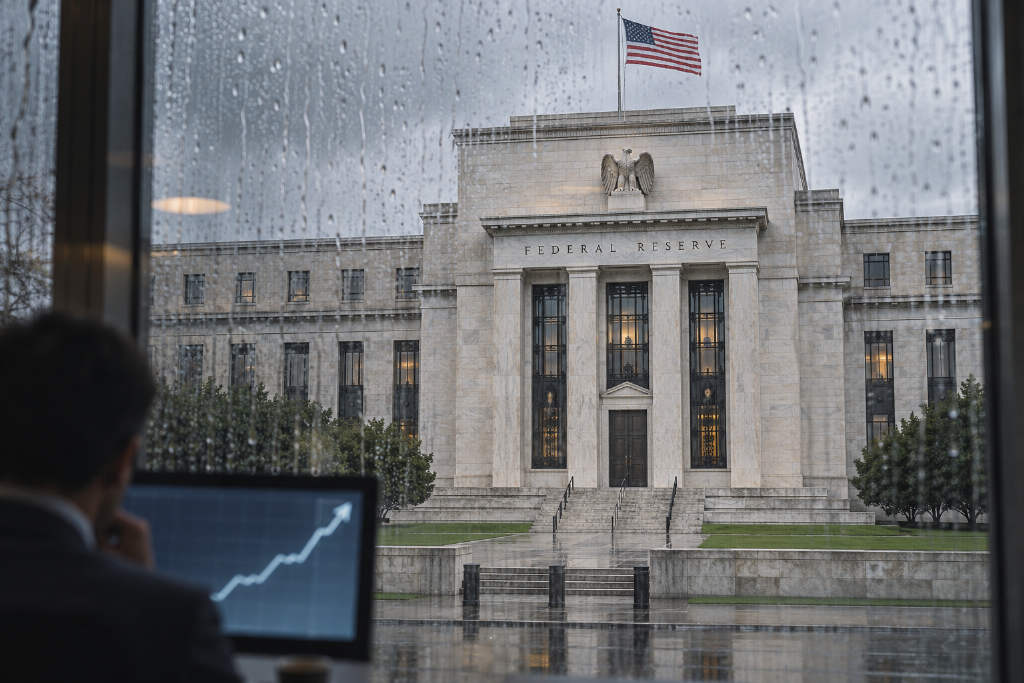
Employment strength raises the risk of excessive tightening
As investors continue to focus on whether artificial-intelligence trading can last, another risk is drawing attention: Federal Reserve policy could become too restrictive as the central bank tries to contain inflation. That risk may become a major threat to U.S. stocks in 2027.
Neil Dutta, head of economic research at Renaissance Macro Research, told MarketWatch on Tuesday that the labor market was strengthening and unemployment was falling, while inflation was moving farther away from the Federal Reserve’s 2% target. The combination is raising the risk that monetary policy could become excessively tight.
「I do think excessive tightening is a major risk,」 Dutta said.
Waller signals that another rate increase is possible
Federal Reserve Governor Christopher Waller signaled that the central bank could raise rates further in remarks delivered in London on Tuesday.
Waller said that if the October Consumer Price Index data looked similar to the figures from the previous two months, with core CPI rising 0.3% or more on a monthly basis, the Fed might need to take tougher policy action. He said officials should consider a 50-basis-point increase at the December meeting.
Data released afterward showed that October core CPI rose 0.3% month over month. Treasury yields climbed rapidly after the release, and the 10-year Treasury yield returned to 5%.
Housing costs complicate the inflation outlook
Dutta said it remained unclear whether Waller’s position had the backing of other Federal Reserve governors. The latest economic data, however, indicated that current interest rates might still be insufficient to restrain price increases effectively.
Oil prices have fallen since the U.S. midterm elections, but prices for refined products such as diesel remain high. Housing costs have also started to accelerate, making it harder for inflation to move lower.
Dutta said Tuesday’s October inflation data suggested that rental housing costs could be accelerating again. If the pace of housing-price increases does not slow, it will be difficult for the Fed to bring overall inflation back to its 2% target.
In a report sent to clients on Tuesday, Dutta wrote: 「In short, the Fed remains too optimistic about inflation, and the market is too complacent about the amount of tightening required to reach the inflation target.」
Treasury yields jump as markets reprice the rate path
The bond market has already begun to reflect expectations for a tougher monetary-policy stance. Data from Dow Jones Market Data showed that the two-year Treasury yield, which is particularly sensitive to expectations for Fed rates, rose 19 basis points on Tuesday to 4.75%. It was the largest one-day increase since April 2025, when Trump announced tariff policies that disrupted global markets.
The widening gap between the two-year Treasury yield and the Federal Reserve’s policy rate also indicates that bond investors are sending a message to the central bank: markets expect larger rate increases in the future.
Investors currently expect the Fed to deliver a cumulative 50 basis points of additional increases over the coming months. That matches the latest forecast released by senior Fed officials in September. Under that expectation, the 75 basis points of 「insurance cuts」 delivered by the Federal Reserve in 2025 would be fully reversed.
Dutta believes that simply taking back the earlier cuts may not be enough. In his report, he wrote: 「At this point, reversing last year’s insurance cuts is merely the minimum requirement.」
Author: Wu Yu, Jin10 Data



