Top stories
Federal Reserve leaves rates unchanged, two officials back a hike
The Federal Reserve kept the target range for the federal funds rate at 3.75% to 4.00% in a 10-2 vote. Its statement said economic activity was expanding strongly, capital investment remained solid, and inflation was still elevated. Cook and Hammack favored a 25-basis-point rate increase.
The pause did not remove the possibility of further tightening. Policy expectations remain tied to inflation, and the GDP and PCE data due later today are expected to help markets reassess growth resilience and the likely path for rates.
Microsoft and Alphabet split after earnings, with cash flow in focus
Microsoft and Alphabet reported results after the U.S. close on Oct. 28. In early post-earnings trading, Microsoft rose more than 4% at one point, while Alphabet fell more than 7%, a move that differed from their regular-session closes.
The market reaction suggested cloud growth alone was no longer enough to explain price action. Investors are weighing revenue realization, equipment spending and cash recovery together, and financial differences inside the AI supply chain are becoming more important.
U.S. crude inventories fall, but refined product demand still needs a separate read
EIA data showed U.S. commercial crude inventories fell by about 1.9 million barrels in the week ended Oct. 23 to 410.6 million barrels, roughly 4% below the five-year seasonal average. Gasoline inventories rose by about 3.9 million barrels over the same period.
Lower crude inventories support the supply-demand picture, but the gasoline build means the crude draw should not be read as broad-based strength in end demand. Refinery runs, product consumption and supply disruptions still need to be tracked before drawing conclusions on oil price durability.
Market review
Commodities and foreign exchange
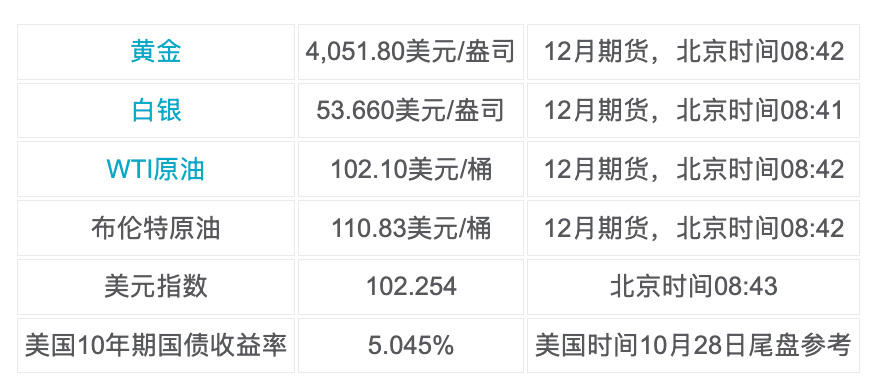
The 10-year U.S. Treasury yield moved above 5%, keeping pressure on growth-stock valuations through a higher discount rate. Oil stayed elevated, leaving energy costs as an important variable for inflation and corporate margins. For gold, the next read depends on real rates and the U.S. dollar. The commodity quotes cited in the report were not intended as same-day performance measures.
Crypto market performance
BTC traded at about 81,156.84 USDT, up 0.47% over 24 hours. ETH traded at about 2,356.59 USDT, up 0.41%. Total crypto market capitalization stood at about $2.74 trillion, down 2.31% over 24 hours, with that figure updated at 08:45 Beijing time.
BTC liquidation zones
The more visible potential short liquidation cluster above the market was around $81,800 to $82,500, or about 0.89% to 1.75% from spot. The potential long liquidation cluster below was around $79,700 to $80,500, or about 0.72% to 1.70% away. Price was closer to the lower zone, so any further decline would put focus on volatility tied to long leverage unwinding.
ETH liquidation zones
The more visible potential short liquidation cluster above ETH was around $2,380 to $2,410, about 1.09% to 2.36% away. The potential long liquidation cluster below sat around $2,290 to $2,315, about 1.67% to 2.74% away. The nearer level was on the upside. If ETH moves toward that area, short-covering pressure could become relevant, though the zone alone does not indicate breakout direction.
Institutional cost basis reference for BTC
Glassnode said on Oct. 28 that its estimated aggregate cost basis for U.S. spot BTC ETFs was about $81,500, placing the current BTC price roughly 0.51% below that reference. Strategy disclosed on Oct. 26 that it held 848,517 BTC as of Oct. 25, with an average cost including fees of about $75,446. That put the current BTC price about 7.47% above its cost basis. The report noted that these differences only reflect unlevered changes in price relative to holding cost.
One-line market view
For BTC, the report highlighted the $81,500 ETF cost reference and the $81,800 to $82,500 liquidation zone above, noting that the two sit close together. If price recovers, traders can watch both a reclaim of the cost reference and short leverage unwinding. On the downside, the first nearby level to watch is around $80,500. For ETH, attention is on the area near $2,380. The nearer liquidation direction differs between the two assets, so the report said they should not be read through a single framework.
U.S. equity indexes and the Magnificent Seven
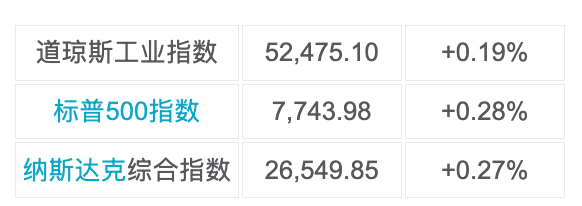
The three major U.S. stock indexes closed modestly higher as markets absorbed the Fed’s decision to leave rates unchanged. Gains at the index level were limited, while earnings and supply-chain performance at the single-stock level showed clearer divergence. The report cautioned against reading the index move as broad strength across large-cap tech.
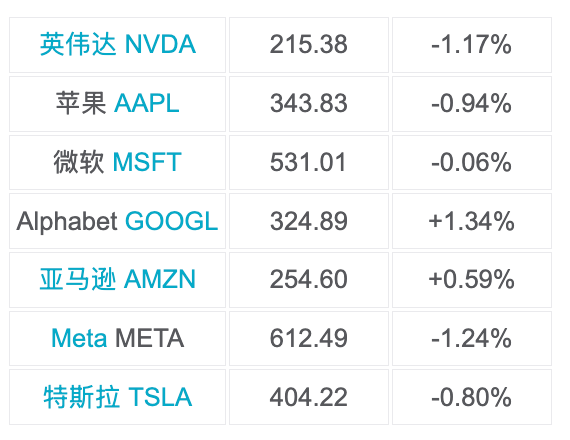
Within the Magnificent Seven, two stocks rose and five fell. Alphabet and Amazon advanced, while the rest declined. Because Microsoft and Alphabet released earnings after the close, the table cited in the report did not capture the full post-earnings reaction.
Sector moves
In data center infrastructure, Vertiv rose 16.48% and Oracle gained 10.73%, with attention centered on quarterly results and investor day guidance. Markets are still testing the scale of AI buildout demand, but the path from spending to cash generation differs between equipment suppliers and cloud platforms.
In memory chips, Micron rose 5.86%, while SK Hynix’s results also drew market attention. The next step is to watch how demand, pricing and new supply interact in shaping profits, rather than extending a single quarter’s strength too far.
Among crypto-linked stocks, Coinbase rose 0.76%, Strategy gained 2.66%, and Robinhood fell 3.31%. Robinhood’s previously disclosed weakness in crypto business remained in focus, while Coinbase is due to report after the U.S. close on Oct. 29.
Deep dive on key U.S. stocks
Microsoft: strong cloud growth, cash recovery supports AI spending
Microsoft closed the regular session at $531.01, down 0.06%, and then reported results for the first quarter of fiscal 2027. Revenue came in at $92.3 billion, up 19% year over year. Azure revenue grew 48%, and Microsoft Cloud revenue reached $63.9 billion, up 30%.
Operating cash flow for the quarter was $58.0 billion, while cash purchases of property and equipment totaled $39.367 billion, leaving a positive gap of $18.633 billion. The report used a cash-outflow measure here and said it should not be mixed with capital expenditure figures that include finance leases. In that reading, cloud growth and cash generation together supported the company’s AI investment pace.
The next questions are whether Azure can sustain its growth and how depreciation, margins and cash recovery change as new capacity comes online. The timing gap between revenue recognition and equipment spending will shape how much cash AI growth ultimately leaves behind.
Alphabet: cloud revenue doubles, quarterly free cash flow turns negative
Alphabet closed the regular session at $324.89, up 1.34%, and then reported third-quarter results. Total revenue was about $127.6 billion, up 25% year over year. Google Cloud revenue was about $30.709 billion, up 103%.
Operating cash flow for the quarter was $42.290 billion, while capital expenditures were $51.355 billion, leaving free cash flow negative by $9.065 billion. The report said cloud growth and cash-flow pressure were showing up at the same time. It also noted that Cloud revenue includes TPU system sales, so not all of the increase should be treated as recurring cloud-service revenue.
What matters next is when capital spending starts producing durable cash returns, how cloud growth is composed, and what happens to margins as investment expands. Negative quarterly free cash flow does not mean operations failed to generate cash, but it does raise the bar for expected returns on investment.
Vertiv: orders and profit rise together, full-year guidance lifted
Vertiv closed at $242.94, up 16.48%. Third-quarter net sales reached $4.313 billion, up 61% year over year. Organic orders grew by more than 100%, and adjusted earnings per share came in at $2.21, up 78%.
Adjusted operating margin reached 25.2%, and the company raised the midpoint of its full-year net sales guidance to $14.65 billion. Better orders, sales and margins together improved visibility on demand for power and thermal infrastructure.

The next checkpoints are order conversion, delivery capacity and working-capital usage. After the sharp move in the stock, execution against guidance may matter more than the guidance itself.
Market and project updates
Oracle sets out a long-term revenue and cash-flow timeline
At its investor day on Oct. 28, Oracle said it was targeting at least $225 billion in revenue in fiscal 2030. It also said free cash flow is expected to turn positive in the second half of fiscal 2028, with a goal of at least $30 billion in free cash flow in fiscal 2029.
These are management’s forward-looking targets. Delivery will depend on orders converting into revenue, lower capital spending and financing arrangements. For investors, the timing and conditions for positive free cash flow matter as much as the revenue target.
Ripple and Coinbase expand RLUSD distribution
The two companies said on Oct. 28 that RLUSD would be integrated with Coinbase Prime, Coinbase Exchange and the retail app, with deposits and withdrawals supported on XRPL, Base and Ethereum. Support for Coinbase Global Exchange and collateral use will be added later.
The partnership expands trading, custody and settlement access for the stablecoin, but actual impact still depends on usage and liquidity. The report drew a clear line between what is already live and what remains planned.
Stellar ecosystem launches a pilot for private-asset liquidity pools
Pontoro and Archax launched the first automated liquidity pool pilot on Stellar, combining more liquid money market assets with private funds and using rules-based pricing to manage liquidity.
The pilot is an attempt to improve liquidity mechanics for private assets, but tokenization by itself does not guarantee redemption at any time. Real trading activity, redemption arrangements and investor suitability requirements remain the key points to watch.
Today’s calendar and market view
On the macro side, GDP and PCE are set to test both growth resilience and inflation pressure, and could affect expectations for the Fed’s next steps. Earnings from Amazon and Coinbase are expected to add evidence on cloud investment payback, crypto trading and stablecoin-related business.
Ryan Detrick, chief market strategist at Carson Group, said on Oct. 28 that the decision to leave rates unchanged was broadly in line with expectations and that markets were still focused on whether AI spending could be sustained. Set against the latest earnings split, he said the more useful comparison now is how quickly companies can turn investment into revenue and cash flow.
This report provides market information and research observations only and does not constitute investment advice.
Disclaimer: Markets involve risk and investing requires caution. This article does not constitute investment advice. Readers should consider whether any opinions, views or conclusions in this article fit their own circumstances. Any investment decisions made on that basis are at their own risk.