
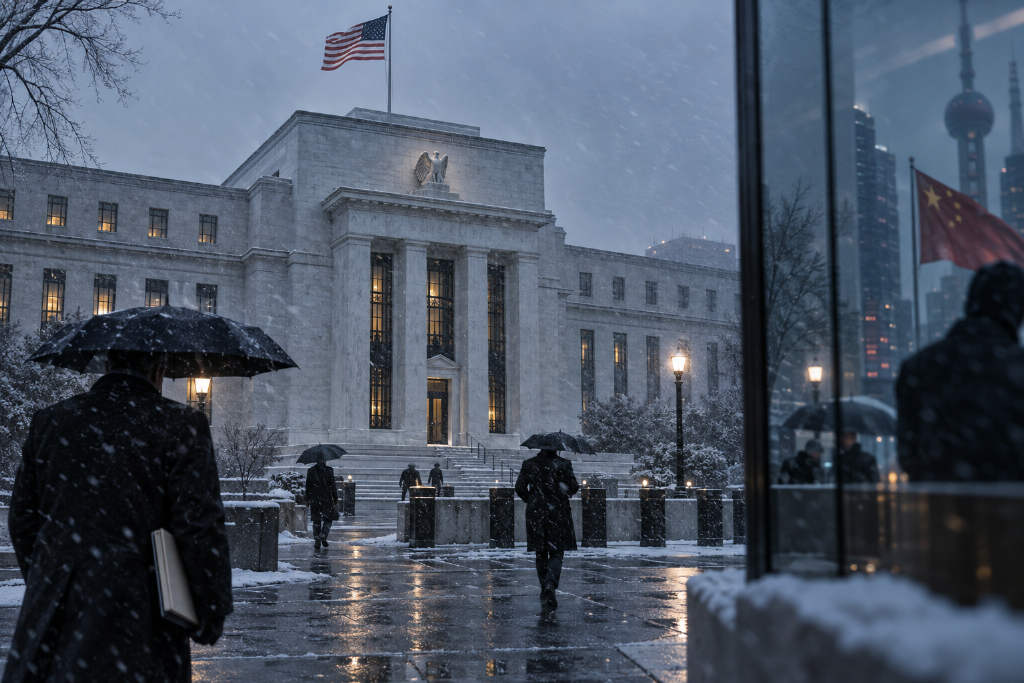
TechFlowPost said the market’s real fear is not this 25-basis-point rate hike itself, but a change in the Federal Reserve’s reaction function.
According to the article, the latest meeting did not simply tell investors that rates are a bit higher. It challenged a broader trading framework built on the idea that the easing cycle had already started, inflation would drift lower in a stable way, and funding costs would keep falling.
Why the path matters more than a single move
The article argues that financial assets are priced on future cash flows and discount rates, not on a single number in a headline. If the policy rate moves from 3.50%-3.75% to 3.75%-4.00%, the immediate change is only 25 basis points. For institutions holding 10-year assets, relying on long-term financing, or owning long-duration equities, three questions matter more: how long rates stay high, how many more hikes may follow, and whether the Fed’s tolerance for inflation and employment has changed.
That is why dot plots, policy statement language, and the chair’s press conference often move markets more than the rate decision itself, the article said. It added that classic research on Fed announcements shows policy shocks contain at least two dimensions: the current rate action and the future policy path. Markets may fully absorb a 25-basis-point move in advance, yet still be caught off guard by a more hawkish path.
In the author’s framing, what may be priced in is an action, not necessarily a regime.
U.S. stocks may take a valuation hit first, then an earnings hit later
The article says the first-round effect of rate hikes on equities is mechanical. A higher risk-free rate lowers the present value of future profits, and companies whose valuations depend on distant cash flows are more sensitive. High-price-to-earnings technology stocks, unprofitable growth names, and business models that depend on continued financing usually face more pressure than companies with stable cash flow and shorter duration.
It cites research by Ben Bernanke and Kenneth Kuttner on unexpected Fed policy changes, saying U.S. equities react strongly to unanticipated monetary shocks. The key word is unexpected. If the market had already fully priced the hike, indexes may not plunge on the day. But if investors had been positioned for a sequence of rate cuts and now have to shift to a higher-for-longer setting, or even more hikes, the valuation center has to move lower.
The second-round effect is slower and more painful, the article says. Corporate refinancing costs rise. Demand for housing, autos, and durable goods comes under pressure. Banks tighten lending standards. Risk premiums widen in leveraged buyouts, commercial real estate, and lower-rated credit. At that stage, markets are no longer trading only discount rates. They are trading margins, default rates, and balance sheets.
The article stresses that these two rounds should not be mixed together. The first can happen within minutes. The second may take several quarters to show up in earnings reports. A muted short-term move in U.S. stocks, in that view, does not mean the hike is costless. It only means the information in the announcement did not exceed what prices had already reflected by much.
Treasuries do not move in one straight line after a hike
The article calls it an overly lazy judgment to assume that a Fed hike means all Treasury yields rise together. In practice, short-end yields are usually tied more closely to expectations for the next few policy moves. If markets believe more hikes are coming, the 2-year yield is more likely to face upward pressure. Long-end yields also reflect long-term inflation, real growth, term premium, and fiscal supply. They may rise as well, or they may fall if investors think tighter policy will weaken future growth.
It lays out three very different interpretations. If short-end and long-end yields both jump, markets may be raising both the expected policy path and long-term inflation compensation. If the short end rises more and the curve inverts further, investors may be betting that the Fed will keep pressing the brakes and eventually slow the economy. If the long end rises on its own, the article says investors should watch term premium, fiscal financing pressure, or damage to inflation credibility rather than blame everything on one rate hike.
What is truly dangerous, the article argues, is not one yield level by itself but a simultaneous rise in the risk-free rate and credit spreads. The first lifts the pricing floor for all assets. The second signals that investors are starting to question borrowers’ repayment capacity. Together, they tighten financing conditions far more aggressively than 25 basis points alone.
Rate hikes cannot produce oil, but they can try to stop second-round inflation
On energy prices, the article makes a clear distinction. The Fed cannot produce crude oil or repair pipelines. An energy supply shock caused by geopolitical conflict does not disappear because the federal funds rate is 25 basis points higher.
What rate hikes can do, it says, is suppress aggregate demand, reduce companies’ ability to pass costs through broadly to consumers, and stop higher energy and food prices from feeding into wages, services inflation, and inflation expectations. If a central bank believes a supply shock is turning into persistent second-round inflation, it has a case for tightening.
The cost is also clear, the article says: monetary policy hits households and businesses that did not create the energy shock in the first place. That is not automatic proof of a policy mistake. But it does mean the reasonableness of the hike cannot be judged on oil prices alone. The article says investors need to look at core services inflation, wage growth, inflation expectations, and demand strength together. If the move is only a short-term energy spike without broader price diffusion, continued hikes would amount to using a blunt tool to chase a flexible variable.
The dollar and global markets: direction is clearer than magnitude
The article says that if the U.S. rate path is revised higher relative to other economies, dollar assets usually become more attractive on a yield basis. A stronger dollar can then transmit pressure abroad. Dollar borrowers face higher debt-servicing costs. Commodities priced in dollars become more expensive for non-dollar buyers. Some emerging markets may see capital outflows, currency depreciation, and forced tightening in financial conditions.
It also references work by Hélène Rey and Silvia Miranda-Agrippino on the global financial cycle, saying U.S. monetary policy shocks can spread outward through global asset prices, risk appetite, and credit conditions.
Still, the article says the formula of "Fed hike equals stronger dollar" is too simple. Exchange rates trade on relative paths. If the European Central Bank, the Bank of England, or other central banks turn more hawkish than the Fed, the dollar may not rise. If a U.S. hike is read as a policy mistake that sharply raises recession odds, safe-haven demand, growth expectations, and rate differentials can pull in different directions. The article’s point is that direction may allow a baseline view, but magnitude cannot be forecast with slogans.
It applies the same logic to gold. Higher real rates usually raise the opportunity cost of holding a non-yielding asset. But if rate hikes also expose inflation credibility problems, fiscal risk, or geopolitical risk, safe-haven buying can offset that pressure. In the article’s words, saying simply that rate hikes are bearish for gold compresses four variables into one button.
For China, the first thing to watch is not the next day’s A-share move
The article says Chinese investors often make the mistake of translating a Fed decision directly into the color of the next day’s stock index. A more useful approach is to watch the transmission chain: how the China-U.S. rate gap changes, how USD/CNY reacts, whether offshore dollar funding tightens, whether foreign investors’ risk appetite weakens, and how much room remains for domestic monetary policy.
If the dollar strengthens and long-end U.S. yields rise, the article says the renminbi exchange rate and cross-border capital flows will face greater external constraints. In Hong Kong, longer-duration assets and assets more sensitive to overseas liquidity usually feel changes in the global discount rate more directly than assets tied mainly to domestic cash flow.
The article also says exporters should not be treated as automatic beneficiaries. Currency translation may help, but weaker overseas demand under high rates and dollar-priced imported inputs can offset that benefit.
Its practical conclusion is not to label everything as either bearish for China or bullish for exporters. Instead, investors should break each asset down by revenue currency, liability currency, financing tenor, and demand source. Assets with high dollar liabilities, distant cash flows, and near-term refinancing needs are the most fragile. Assets with stable cash flow, long-dated liabilities, and stronger pricing power are better positioned to absorb the pressure.
Four sets of indicators to watch next
The article says investors can judge whether this hike turns into a larger market event by checking four groups of evidence on an ongoing basis.
- First, rate expectations: whether markets keep revising up the future policy path rather than focusing only on this 25-basis-point move.
- Second, the yield curve: whether the short end, the long end, or term premium is doing the moving.
- Third, credit conditions: whether spreads between investment-grade and high-yield debt, bank lending standards, and refinancing activity are deteriorating.
- Fourth, inflation composition: whether the energy shock is feeding into core services, wages, and medium- to long-term inflation expectations.
If only short-end rates are being repriced while credit spreads stay stable and corporate financing remains normal, the article says the main effect is likely a valuation adjustment. If long-end yields, the dollar, and credit spreads all rise together, the situation changes. That would no longer look like an ordinary rate hike. It would look like a synchronized tightening in global financial conditions.
The article’s conclusion is direct: the 25 basis points alone are not the part that deserves panic. What deserves attention is the market’s shift from thinking rate cuts were only a matter of time to thinking recurring inflation could force central banks back into tightening. The first environment rewards duration and leverage. The second punishes them.
Author Daii added that the harder question sits one layer deeper: whether the Fed is repairing inflation credibility or using weaker demand to compensate for a failed energy supply response. Those two explanations would point to very different next steps. For now, the article says, the financial-conditions side of the equation can be assessed, while the economic bill may still come later.