
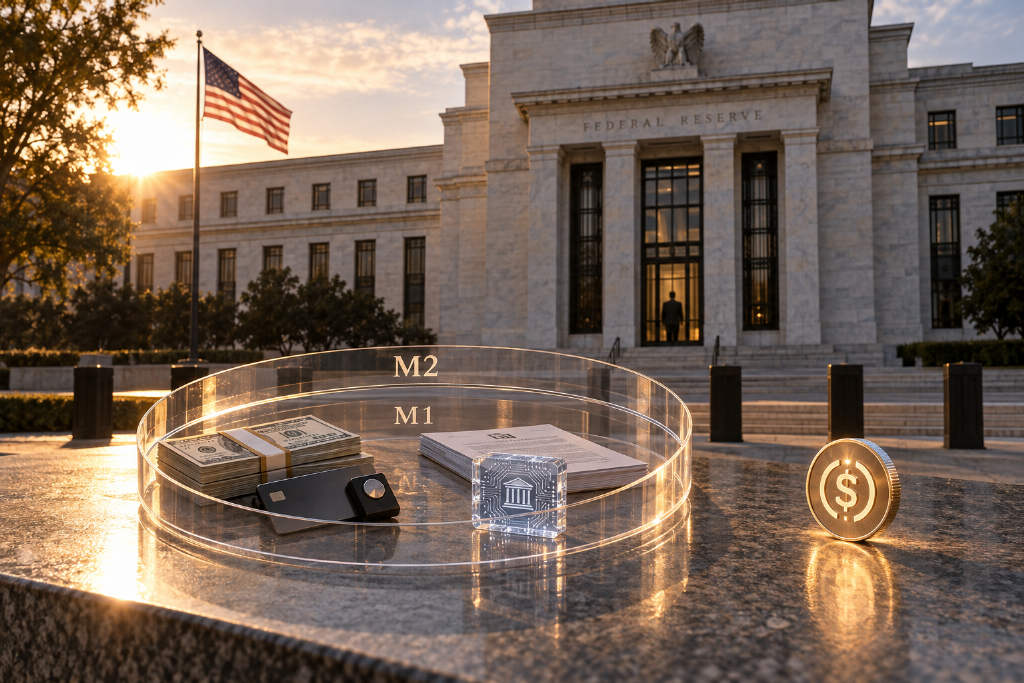
Federal Reserve Board economists Kristen Payne and Mary-Frances Styczynski published a FEDS Notes paper on Sept. 4 titled “New Forms of Money and U.S. Monetary Aggregates,” laying out how three blockchain-based assets — tokenized deposits, tokenized money market funds, and payment stablecoins — fit, or do not fit, within M1 and M2.
The paper reaches three separate conclusions. Tokenized deposits are already counted in existing monetary aggregates. Tokenized money market funds are also already included. Payment stablecoins are not currently counted, and the authors say three practical issues would need to be addressed before that could change.
FEDS Notes is a series for staff analysis published by Board personnel. The paper says the views are those of the authors and are not part of the policy process.
How the paper approaches M1 and M2
The note starts with the standard definitions of monetary aggregates. M1 is the narrowest and most liquid measure of the money supply. M2 includes M1 plus less liquid assets.
The authors use a two-layer framework. First comes function. Assets used mainly as a medium of exchange, available for immediate payment, and offering little or no return are closer to M1. Assets used mainly as short-term stores of value and carrying market-rate returns are closer to M2 outside M1. The second layer is practical measurement: whether reporting data and infrastructure exist, whether adding the asset would create double counting with current measures, and whether the asset circulates within the United States or across global markets.
How the three asset types are classified
| Asset | Currently included? | Classification in the paper | Open issues |
|---|---|---|---|
| Tokenized deposits | Yes, within standard bank-reported deposit data | Falls into M1 or M2 depending on deposit type | The authors suggest separate tracking to gauge adoption in blockchain-based banking activity |
| Tokenized money market funds | Yes, under retail money market funds | M2 outside M1; could move toward M1 if payment use expands | Some double counting because the funds hold bank deposits |
| Payment stablecoins | No | Could belong in M1 or M2 outside M1 depending on use | Supply data, reserve double counting, and difficulty separating domestic from foreign circulation |
Tokenized deposits are already inside the aggregates
The authors say tokenized deposits are simply another recording form for bank deposits. “In data reported by banks to the Federal Reserve, they are commingled with traditional deposits,” the paper says. On that basis, they are already part of monetary aggregates, and no definitional change is needed.
The note adds that institutional customers use tokenized deposits much like checking accounts, including for settlement and cash management. Their placement in M1 or M2 depends on the type of deposit involved. The authors also suggest that the Fed separately track the size of tokenized deposits as an indicator of how widely blockchain-based banking activity is spreading.
Tokenized money market funds are already captured
The paper takes a similar view of tokenized money market funds. It says they are “currently included in M2 excluding M1 under retail money market funds,” reflecting their role as a store-of-value instrument.
That classification may not be permanent. The authors write that, as decentralized finance develops, tokenized money market funds could be used for payments and may then take on features associated with M1 assets. If usage shifts, classification may need to shift as well. The note also says a small amount of double counting exists because bank deposits held by the funds are themselves already included in monetary aggregates.
Why payment stablecoins are still excluded
Payment stablecoins are the only category the paper says should not currently be included. The authors write that “payment stablecoins could be included in M1 or M2 excluding M1 depending on their use,” and cite Circle’s USDC as the closest example, but they list three practical barriers.
The first is data. The paper says inclusion would require “reliable and timely data on stablecoin circulation,” and there is not yet a standardized reporting structure linked to Federal Reserve systems.
The second is double counting. According to the authors, payment stablecoins may be backed by several asset types, including Treasury securities, bank deposits, and Federal Reserve reserves. Some of those assets are already reflected in monetary aggregates, so a direct addition could count the same money twice.
The third is geographic scope. Stablecoins can circulate globally on public blockchains, while U.S. monetary aggregates are intended to measure money held within the United States. The paper says holders on-chain cannot be easily separated into domestic and foreign categories.
GENIUS Act cited as a possible future data foundation
The paper points to the GENIUS Act, passed in July 2025, as a possible foundation for future data collection. As described by the authors, the law requires issuers to back stablecoins with 1:1 reserve assets, report reserve holdings monthly, and refrain from paying interest directly to token holders. The paper adds that “indirect compensation may still exist.”
Even under that framework, the note says it remains unclear whether payment stablecoins governed by the GENIUS Act will provide users with the same benefits. Their eventual use case, the authors say, will depend on how the market develops in practice.
No timetable for inclusion
The paper concludes that the Federal Reserve should continue monitoring these developments, prepare to update data-collection systems, revise aggregate definitions as the digital asset environment matures, and work with other federal regulators to standardize reporting requirements.
The note does not provide any size estimates for the assets discussed, and it does not set out a timetable for bringing payment stablecoins into U.S. monetary aggregates.