
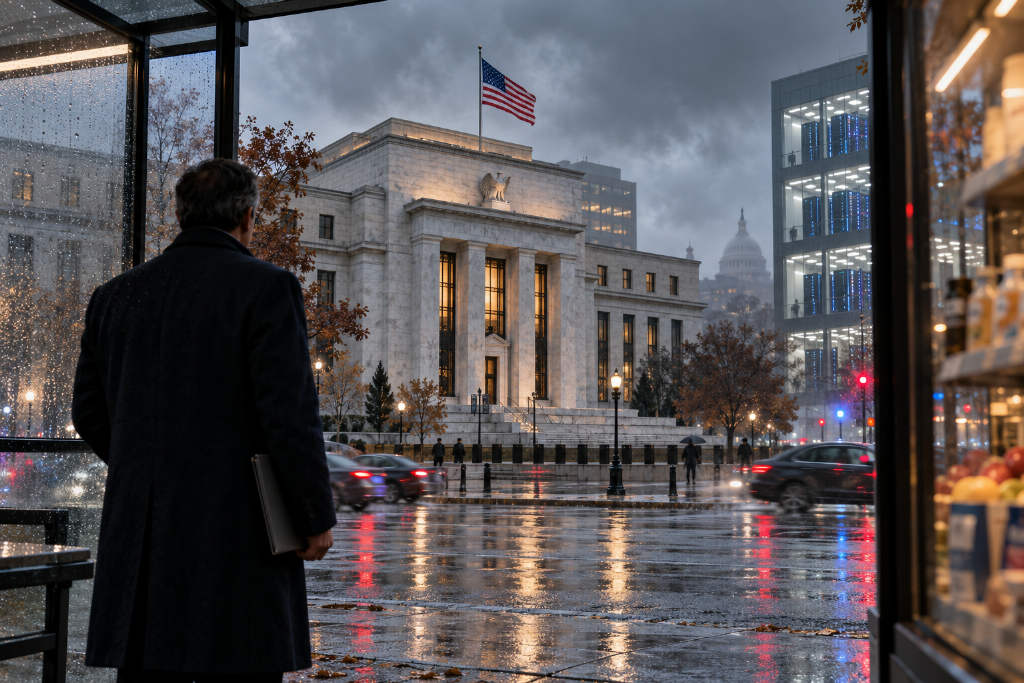
The U.S. Federal Reserve kept interest rates unchanged on Oct. 28. After the decision, Fed Chair Kevin Warsh said U.S. economic activity was still expanding at a strong pace, with business investment likely rising at a double-digit rate, while inflation remained too high and the central bank still had a duty to bring price growth back to its 2% target.
ABMedia said the Federal Open Market Committee decision came just six days before the Nov. 3 U.S. midterm elections. With prices and living costs still a major issue for voters, the Fed is dealing not only with the question of whether to raise rates again, but also with how to preserve central bank independence under political pressure from the Trump administration.
Warsh says business investment is still strong
Warsh said U.S. economic activity was expanding at a strong pace and that business investment was likely growing at a double-digit rate. He also said inflation was still elevated and that bringing it down remained the Fed’s responsibility.
He added that policymakers needed more information before deciding on the appropriate monetary policy stance. That tension reflects the current shape of the U.S. economy: business investment, consumption, and productivity growth are still supporting activity, but strong demand may also make it harder for inflation to return to the Fed’s 2% goal.
Jackson Hole remarks pointed to AI-led capital spending
ABMedia said Warsh had already highlighted strong U.S. capital expenditure trends at the Jackson Hole global central banking conference in August. At that time, he said four-quarter growth in equipment and intangible investment was about 9%, the highest since 2021, and that more than half of this year’s capital spending growth likely came from AI-related infrastructure.
Warsh also said then that earnings growth among S&P 500 companies had exceeded 20% over the past year, while corporate profit margins remained high relative to historical levels, a sign that the U.S. corporate sector still had substantial earning power.
AI spending may become a new inflation variable
Warsh’s focus on AI is not limited to whether the technology sector can keep growing. The bigger question is how this wave of capital spending could affect inflation across the broader U.S. economy. ABMedia said that at an International Monetary Fund-related meeting in Thailand, Warsh acknowledged that AI investment may create wealth and productivity gains over the long run, but is already affecting prices and demand now.
He said central bankers charged with maintaining price stability and full employment could not ignore that shock. One reason is the structure of AI capital spending itself. Large technology companies have deep cash flow and broad access to financing. Even with rates staying high, those firms may still spend hundreds of billions of dollars on data centers, GPUs, memory, networking equipment, and power infrastructure.
Demand can rise quickly, while supply may not catch up right away. That can push up prices for specific goods and services. What remains disputed, though, is whether those increases are only relative price shifts inside the AI sector or whether they could spread into broader inflation across the economy.
In his Jackson Hole speech, Warsh raised another question as well: whether AI can deliver sustained and meaningful productivity gains, and if so, when those gains would actually appear.
For monetary policy, AI may create two forces moving in opposite directions. In the short term, massive capital spending can stimulate demand and add inflation pressure. Over the longer term, stronger productivity could expand supply and allow the U.S. economy to grow faster without the same degree of inflation pressure.
High-rate pressure may land on other sectors
ABMedia also said Warsh had previously linked the rise in long-dated U.S. Treasury yields in part to intensifying competition for capital among companies. At the September FOMC press conference, he said hyperscale cloud providers were raising funds in the market, that the capital spending boom was real, and that competition for capital was one reason yields had moved higher.
That dynamic could deepen a new split in the economy. On one side, Microsoft, Alphabet, Amazon, and Meta continue to expand AI capital spending, supporting growth in semiconductors, memory, optical communications, and data center industries. On the other, high rates may leave real estate, construction, small businesses, and companies that depend heavily on bank loans facing higher financing costs.
As ABMedia framed it, inflation pressure tied to AI investment could force the Fed to keep monetary policy tighter for longer, while the actual cost of high rates may be borne not by the technology giants driving the spending boom, but by companies outside the AI sector and by ordinary consumers.



