
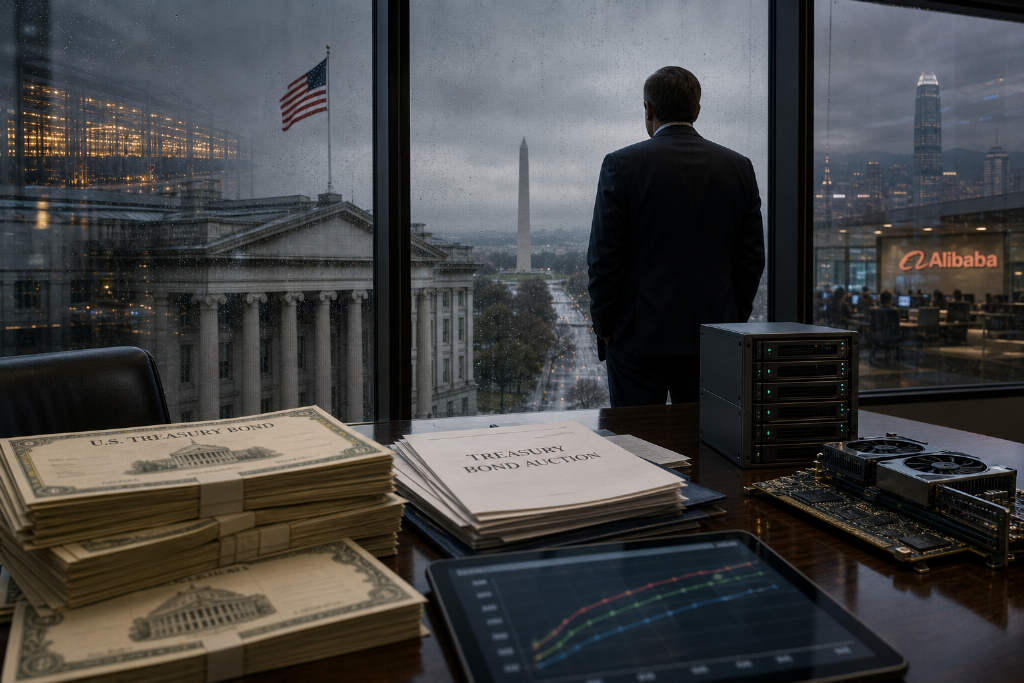
MarsBit has published a new 168X War Room interview that links Federal Reserve policy, U.S. Treasury funding pressure, and AI capital spending into a single macro discussion. In the program, guest commentator Tiezhu said AI capex and heavy Treasury issuance are now competing for the same pool of long-term liquidity, and under those conditions he sees no path for rate hikes by year-end. His stated probability for a cut is 60%.
The piece, written by Mr. Z for 168X War Room, opens with a scene set at 6 p.m. on Monday, Aug. 24, 2026. It describes a weak start to the week, long-end yields that remain difficult to push lower, and what it calls two active “pumps” pulling on liquidity at the same time: aggressive AI capex from major technology companies and aggressive debt issuance from the U.S. Treasury. The article frames the issue as a competition for the same money and asks whether the Treasury’s expanded buybacks are aimed at easing liquidity conditions or extending the life of the Treasury market itself.
Fed independence still exists, but the room around it has shrunk, the guest says
Mr. Z began by asking what Federal Reserve independence really means in practice, using Warsh as the point of reference. Tiezhu answered that Fed independence is a legal and institutional arrangement. In that framework, the central bank can conduct monetary policy without direct interference from the White House or Congress, with price stability and employment as its stated objectives.
He then drew a distinction between formal independence and practical decision-making. In his words, a person may be independent in a legal sense, but the act of making a decision is never fully independent because it is shaped by constraints and trade-offs. His point was that legal safeguards exist precisely because real-world pressures run in the opposite direction.
That led to a broader claim: the Fed is still independent, but the practical constraints on how it uses that independence are much stronger than before. He said the amount of spare room left in the system is now very small.
Mr. Z added historical context, saying the Fed was created in the early 1900s in part to limit excessive presidential interference. He also referenced the 1970s, when Arthur Burns came under pressure from Nixon, an episode he said fed into the inflation era that followed, when the federal funds rate later climbed to 18% and 19%.
Tiezhu’s response was that, from an accounting perspective, the Treasury and the Fed cannot truly operate as separate worlds.
TGA, reserves, and Treasury funding tie the two sides together
Tiezhu said the Treasury General Account, or TGA, is an asset on the Treasury side and a liability on the Fed side, and that it fluctuates between $700 billion and $1 trillion. If $200 billion to $300 billion were to flow out in one move, he said, Warsh would have to adjust the Fed’s balance sheet to absorb that shift.
He also argued that the Treasury depends on bill issuance and the repo market for funding, while the Fed depends on reserve management to sustain the cash available for Treasury buyers. Large banks and institutions buy Treasury debt, and those funding channels remain closely tied to reserves. For that reason, he said, both institutions are changing the market’s debt supply and liquidity structure together, making the idea of zero coordination unrealistic.
He contrasted the U.S. approach with China’s explicit policy language that fiscal and monetary policy should work in coordination. The U.S. does not say it that way, he noted, but in substance he believes it is moving in that direction as growth slows and competition for limited resources becomes more intense.
The guest’s core view: preserving Treasuries matters more than the official dual mandate
One of the sharpest parts of the interview came when Tiezhu said the Fed’s visible mandate may be inflation and employment, but its ultimate objective is to preserve the Treasury market. He framed it as a question of priority under stress: if the U.S. cannot service debt and cannot pay interest, then inflation and employment lose their meaning in policy terms.
His argument was that sovereign debt had not always been large enough to materially change the weighting of Fed decision factors. At this stage, he said, that has changed. Treasury debt now has to carry more weight in the central bank’s thinking.
The interview also revisited the Treasury’s recent expansion of buybacks. Tiezhu described it as something that would not happen casually. Looking at it from Bessent’s angle, he said the move can be read as a response to pressure at the long end. Looking at it from Warsh’s angle, he said it offers a way to test whether buybacks alone can keep long-dated yields under control and whether the market accepts that support over time.
Rate hikes can cut peaks, not the baseline of inflation, he argued
On inflation, Tiezhu dismissed Bank of America’s discussion of three rate hikes and said he had already rejected that view in internal discussions. His core claim was simple: higher rates can reduce the peak of inflation, but not its average level.
He said the underlying level of inflation is driven by fiscal spending and money being distributed through the fiscal side, not by interest rates alone. In his telling, if rates rise while the Treasury keeps pushing money into the system, the policy mix will not be effective at lowering the inflation base.
To explain why, he described the U.S. as a K-shaped society. He said lower-income groups can remain relatively insensitive to inflation, while the wealthy are also less affected, leaving the middle class as the group that feels price pressure most directly. That is why, in his view, inflation cannot be solved by rates alone and needs fiscal cooperation.
At the same time, he gave a reason the Fed might still raise rates when the policy impact is limited. Such a move, he said, can serve as a display of institutional resolve. Even if the action has little value in practical terms, it signals the central bank’s intention to defend its independence.
September on hold, with a 60% chance of a cut by year-end
Tiezhu said his view at the start of the year was that there would be two cuts in 2026. After the Israel-Iran conflict, he revised that to one cut. He said that when he last appeared on the program, he had already pointed to a possible year-end cut, and that position has not changed.
He used a process of elimination to explain why he sees no case for a September hike. Core inflation, he said, remains on a downward path if judged by trend rather than one-off data points. He also pointed to two policy markers between September and October: the Treasury’s new fiscal-year budget and the Fed’s economic projections. Under those conditions, he said, there is no motive and no need to hike, and even if the Fed did, the move would not solve the underlying problem.
His conclusion for September is a hold: no hike and no cut. In that scenario, he expects Warsh to do more talking in defense of Fed independence than actual policy shifting.
For year-end, his reasoning leans more clearly toward easing. Employment is still weakening, he said. Outside coding and agents, other major AI use cases have not fully broken out. Debt levels are already large, and long-end yields moved back up quickly even after expanded Treasury buybacks. In that setting, he said, hiking becomes harder the longer policymakers wait. If the window to tighten has already passed, cutting may become the cleaner choice.
He added that U.S. real estate is also under heavy pressure. While he said that issue is less directly tied to Warsh, he linked it to Bessent and Trump. Put together, his judgment is that hikes are effectively off the table and the probability of a cut by year-end is 60%, though he cautioned that Trump remains a major variable.
Why stronger AI could make cuts more necessary, not less
Mr. Z then asked whether stronger AI might actually increase the case for rate cuts. Tiezhu said yes, and described that as one of his recent conclusions.
His reasoning starts with K-shaped divergence. If AI offers very high returns, capital will crowd into AI across both financial markets and industry. Under those conditions, high rates do little to restrain the sector. AI companies keep expanding, and in his view they can even anchor long-end real rates at elevated levels.
Other sectors do not have that luxury. Real estate, small businesses, and weaker industries end up facing higher financing costs without the same payoff profile. That deepens the split across the economy and, if taken far enough, can produce broad elimination of weaker players or even recession.
He said there is only one clean route back to balance: AI productivity gains would need to spread through the wider economy. Until that happens, the strongest sector remains relatively rate-insensitive while the weakest sectors are already under strain. In his words, the high-return sector cannot be restrained by hikes, while the weak side can be badly damaged by them.
That is why, in his view, stronger AI should push the Fed toward cutting rates. The purpose would not be to inflate an AI bubble further, but to preserve overall economic stability and give other industries more room to operate. If AI needs cooling, he said, the government should use other tools to do that.
AI capex and Treasury issuance are competing for long money
The discussion then turned to long-end yields and the distinction between government debt and technology-sector borrowing. Mr. Z noted that both the Treasury and large tech companies can issue long-dated debt, but the sources of repayment differ. Governments rely on tax revenue and fiscal capacity. Tech companies rely on growth and future cash flow.
Tiezhu said the competition for liquidity is real. If overall liquidity is not expanding meaningfully, investors are still deploying existing capital. In fixed income, that means deciding between Treasuries and credit. More important, he said, both are competing for scarce long-duration money.
He pointed to rapid growth in long-end Treasury supply in the second and third quarters, while technology companies have also been issuing long-dated credit. In his view, the steepening of the yield curve in this cycle has been driven in part by that supply-demand mismatch.
He broke the market’s capital base into short-, medium-, and long-term money. Bank funding is short money because it comes from deposits and savings. True long money comes from insurers, sovereign wealth funds, and pensions, and that pool has always been limited. Long-dated issuance has to be matched with long-duration capital. Otherwise, maturity mismatch can create unpredictable liquidity stress.
He also flagged a non-financial form of crowding out: real resources. Data centers need engineers, construction capacity, transformers, and power. Housing needs some of the same inputs. AI giants can absorb higher costs because their cash flows are stronger. Other businesses may not be able to do the same.
“Tech debt is not Treasury debt” and AI looks like a new rate-insensitive property cycle
Tiezhu made a clear distinction between sovereign debt and tech credit. The U.S. government, he said, is backed by tax revenue and by the broader intangible force of state credit, with debt rolled over through repeated refinancing. Corporate borrowers face a different test. Creditors look at cash-flow coverage, leverage ratios, and whether future revenue growth can cover interest expense.
He added a simple rule from a lender’s perspective: if a company is highly sensitive to interest rates, it is not an attractive borrower in the first place.
To illustrate the point, he compared the current AI boom to the property cycle of two decades ago. In that period, he said, real estate was not very sensitive to rates. Borrowers were willing to take loans at 13% or 15%, and banks were willing to lend because expected returns were high enough to justify it. He sees a similar pattern today in AI, calling it a new property-like sector that is relatively insensitive to rates.
From the investor side, he said that is exactly why buyers hold corporate credit at all: to capture extra yield over Treasuries.
SPVs, project finance, and GPU loans mark the start of credit expansion in AI
The interview then moved deeper into financing structures. Mr. Z said AI capex initially relied on the balance sheets and cash flow of major technology companies, but is becoming more market-driven. One example is project finance through a special purpose vehicle, or SPV, where equity and debt are placed into the same project entity and lenders evaluate the revenue stream of that specific buildout.
He said private credit groups are being pulled into the game as tech firms rely more on project-based funding.
Tiezhu’s answer was that capital markets usually move one phase ahead of the underlying industry. A sector may still be at an early industrial stage while capital markets have already advanced into a middle phase where bubbles begin to form.
He compared current AI structures to the old property playbook, where local project companies were set up as separate financing entities. The difference, he said, is that property developers mainly borrowed from banks, while AI now leans more on private credit, corporate bonds, and off-balance-sheet channels.
On GPU financing, he recalled that while working in a traditional institution he had already seen people bring batches of A100 chips to seek funding. The problem, he said, is depreciation. If a borrower defaults, a bank may have little idea how to value or dispose of the collateral. That makes GPUs a poor fit for traditional bank lending. Private credit, backed by long-term capital willing to take duration risk, is a more natural home.
He divided industrial financing into two stages. First, companies borrow against corporate credit, revenue, and cash flow. Second, once expansion accelerates, they raise more through project structures and SPVs. In his view, the appearance of project finance shows that AI has formally entered a credit-expansion phase.
He also stressed that credit expansion is not the same thing as a bubble. It means capital is highly confident in industrial expansion and more money is being directed into the sector, while risk rises with it. The actual bubble phase, he said, is still some distance away.
Demand has not topped out yet, according to the interview
On the demand side, Tiezhu said he tracks OpenRouter token consumption closely. It does not represent every call made across the global AI market, he said, but it is still a useful gauge of whether token use remains on a growth curve.
He noted that there was a period when that growth curve slowed. That was also the period when bearish commentary on AI started to spread more visibly.
He then shared a company survey he conducted over the weekend. He said one small, unlisted company was spending more than $1 million a month on tokens, with just one back-office department burning $1,000 a month. He asked whether that spend could be converted into actual business returns. The answer he got was that many companies remain uncertain, but they still feel they have to get on board.
He tied that behavior to a generational wealth dynamic. In his telling, people born in the 1960s and 1970s still control large pools of capital. They may not fully understand how to use AI, but their operating logic is to fund experimentation first and judge results later.
He acknowledged that outside coding, the market has not yet found a second path with the same level of clarity. Even so, exploration is under way. He cited XPeng in Guangzhou as an example of a company that is turning historical enterprise data into platforms, knowledge bases, and AI-enabled systems.
He also used the spread of the internet as a reference point. The internet emerged in the era of one generation, but reached broad industrial adoption when younger cohorts entered the workforce. By the same logic, he said the major explosion in AI, and possibly its eventual peak, may come when people born in the 2000s and 2010s become the main workforce across industries. He put that window at three to five years.
China section: Alibaba financing, open-source competition, and policy pressure
The conversation then shifted back to China. Mr. Z said Alibaba announced over the weekend that it plans to raise HK$80 billion, or more than $10 billion, for AI capex. He asked whether Tencent and Xiaomi might soon follow with their own funding plans.
Tiezhu said the probability was 99%. He said that from his policy research background, the signal from recent State Council executive meetings and economic meetings is that China’s top leadership has formed a strong consensus around technology and AI, with both urgency and anxiety behind it.
He argued that this year’s weak consumption backdrop has not reduced that emphasis. If anything, references to technology, AI, and investment have become more prominent in official material. In his reading, real estate is no longer able to carry the load, so technology has to produce results.
He added that the banking sector and capital markets are reaching a similar conclusion: traditional industries and assets have become harder to deploy capital into, leaving AI and adjacent technology as the main destination for funds.
He repeated an earlier line of his own to describe the dynamic: the best way to eliminate capital is to force capital to fight within one track. In his telling, that means some capital gets destroyed through competition while the rest survives in the form policy wants.
He also pointed to China’s deep engineer base as a structural strength, while saying the U.S. tends to produce more singular top-end talent.
On competition with U.S. AI systems, he used semiconductors as a benchmark. He said China is the only country that can truly contend with the U.S. at that level. The path, as he described it, comes in three steps: break down the lower layers through methods such as distillation and sheer engineering effort; cut prices and win through price competition; then move into a phase shaped by restrictions and technology barriers, similar to what happened in chips. He said the recent flow of related domestic news is not rumor but fact because AI is a strategic industry.
Apple, CXMT, YMTC, and Nvidia H200 were also discussed
Mr. Z also raised a separate set of questions: whether Apple can buy memory from ChangXin Memory Technologies, whether a possible September U.S. visit by Xi Jinping would count as a gesture from both sides while memory remains in short supply, and whether Tencent and Alibaba could openly purchase first-line Nvidia H200 chips.
Tiezhu said his judgment is that Apple has definitely been in contact and held discussions with CXMT and Yangtze Memory Technologies, though he said nothing has been finalized yet. He described the issue as a bargaining chip in wider negotiations, but added that U.S. technology companies remain rational about cost and competition. If they can buy lower-end products to cut costs and strengthen their own position, he said, it would be all benefit and no harm to Apple. He even suggested those companies may be lobbying the White House to allow such purchases.
For investors, he said there is room for 60% optimism on that question. The broader endgame, in his view, is continued bargaining within competition. He compared it to Nvidia: restrictions tighten, then loosen a bit once rivals catch up, then tighten again. He added that the competitive and confrontational relationship between China and the U.S. will not disappear even after Trump leaves office.
Embodied AI may not repeat the electric-vehicle playbook
The interview also touched on embodied AI. Tiezhu said there is interest in developing the field, but practical constraints are much stronger than they were in the electric-vehicle era.
He said automobiles succeeded in part because they were labor-intensive and could deliver jobs, tax revenue, and GDP to local governments, matching local official incentive structures. Today, local fiscal conditions are tighter and central oversight is stronger, which makes large-scale expansion harder to execute.
He also said China’s financing structure still relies heavily on indirect bank lending, and bank risk appetite remains anchored in government-backed credit. In that environment, he said, relying on private capital alone is not realistic. He cited Unitree as a standout example, but said that once real funding needs are involved, the sector still looks stretched. At valuation levels of 100 to 200 times earnings, he said he is not convinced that these companies can yet lead an entire industry through the kind of giant cash flow once seen in internet giants.
His final advice to investors: policy, position sizing, and AI research
At the end of the interview, Mr. Z asked whether Tiezhu had any closing message for investors. Tiezhu said he had three points to share.
First, investors need to stop romanticizing the U.S. He argued that large states eventually move toward stronger forms of capital management, closer to a state-capitalist or quasi-mobilization model, and that Europe has shown similar tendencies. For that reason, he said investors in both Chinese and U.S. equities need to pay close attention to industrial policy and to what top policymakers support or oppose.
Second, position sizing matters more than analysis. He said a friend had asked why a seemingly simple strategy — buying favored assets in panic selloffs and selling when the cycle turns — is so difficult in practice. His answer was that the gap between understanding a trade and executing it often comes down to position size. When positions are small, rationality returns easily. When positions are too large, stress rises and mistakes become easier to make.
He then pushed the point further by saying AI has flattened one thing in markets: analysis itself. Many of the conclusions discussed in the interview, he said, can now be generated with AI and may not differ much from the work of major institutions such as Goldman Sachs. If analytical conclusions are becoming widely available, then the real difference between winners and losers lies in mindset and position management.
Third, he said he still does not believe AI is in a bubble today. Credit expansion has only just begun, and the bubble phase has not arrived yet. That leaves a large field for investors willing to study AI and the surrounding supply chain. He added that investors should not fear missing a single opportunity because new chances are likely to come back.
He explained that he has started dollar-cost averaging into stocks he likes over the long term because, on a three- to five-year view, the trend has not disappeared. Supply is still expanding, OpenRouter token consumption is still growing, and enterprise demand is still rising.
Program notes at the end of the piece
The article closes by saying the discussion ranged from Warsh’s independence to an AI era shaped by younger generations, and from the TGA account to Evergrande-style credit expansion. Mr. Z also described 168X as a talk-format program focused on crypto, AI, and U.S. equities, and noted that the show had previously hosted conversations with Rick, Chen Guilin, and an AI industry researcher.
He added that Mr. Beig will appear on Wednesday to talk about Bitcoin, and said his own house view is that Bitcoin may be coming back.