
A September Federal Reserve rate hike may now be the least bad option available, according to a Sept. 8 report from Shenyin Wanguo Research, after a stronger-than-expected U.S. nonfarm payrolls report pushed market pricing for a hike back to about 60%.
The report, republished by MarsBit and written by Zhao Ying for Wallstreetcn, says the Fed faces a difficult tradeoff. If it does not hike, term premium could rise sharply and markets could turn on that decision. If it does hike, the blow to asset prices may stay contained as long as the expected path of future tightening is not revised up materially.
Payroll surprise lifts September hike pricing
On Sept. 4, the August nonfarm payrolls report showed 162,000 jobs added, far above the market consensus of 55,000. Shenyin Wanguo said that result directly triggered a sharp repricing of expectations for the Fed’s September meeting.
The firm noted that on Sept. 3, after remarks from Federal Reserve Governor Christopher Waller, the probability of a September hike had briefly fallen to 50%. After the payrolls release, that probability climbed back to roughly 60%.
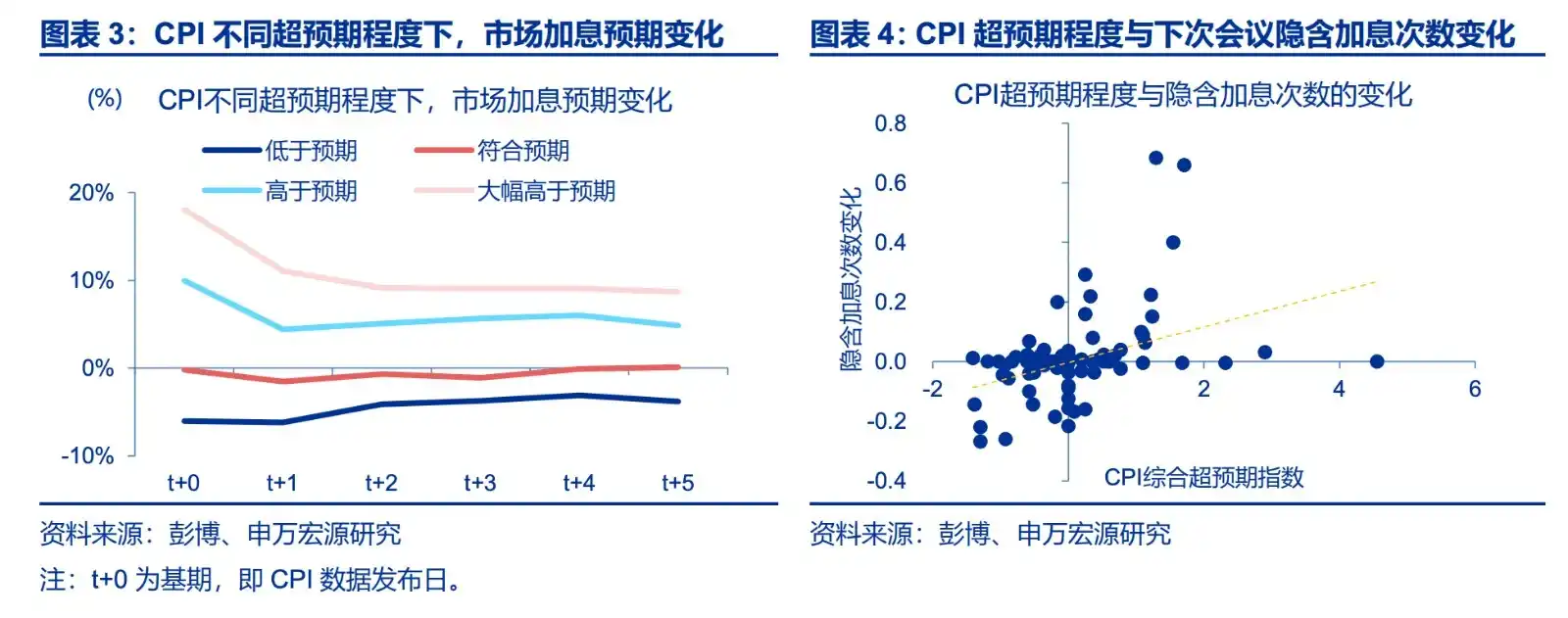
August CPI is now the last major variable before the September policy meeting. Based on the firm’s historical review, only a CPI print that comes in clearly below expectations would be enough to drive a meaningful decline in rate-hike pricing.
Since 2015, when inflation has undershot expectations, market pricing for the next meeting’s hike has fallen by an average of just 6 percentage points on the day of the CPI release, according to the report. There have been only 13 cases in which that pricing dropped by more than 10 percentage points in a single day after CPI. Only three of those happened when inflation was flat versus expectations or slightly above them, and each came with an outside shock such as the pandemic, an unexpectedly dovish turn from Fed officials, or a banking-sector crisis.
Report puts odds of a soft CPI surprise at 10.6%
Shenyin Wanguo said August CPI is facing pressure from both energy and structural inflation.
The report cites an escalation in the U.S.-Iran conflict that has disrupted traffic through the Strait of Hormuz, helping push oil prices higher. It also said the U.S. Gulf Coast crack spread rose to $67.9 per barrel. At the same time, prices for AI-related services are showing a structural upward trend.
Using four institutional forecasts, the firm ran 10,000 Monte Carlo simulations and concluded that the probability of August CPI coming in meaningfully below expectations is only about 10.6%.
That leaves limited room for the market’s current high rate-hike expectations to unwind sharply after the inflation report.
Hike odds above 40% have never missed since 2015
The report argues that history gives Fed Chair Warsh a clear warning.
Inside the Fed, divisions remain pronounced. After a 9-3 vote at the July meeting, the split became more visible. In recent remarks, Beth Hammack, Neel Kashkari and Lorie Logan have taken relatively hawkish positions and continued to call for a hike. Christopher Waller and John Williams have sounded relatively dovish. Warsh himself said on Aug. 28 that if core inflation does not improve clearly, there is still "work to do," which the report describes as a sign of a hawkish shift.
Shenyin Wanguo said that across 92 Federal Open Market Committee meetings since 2015, whenever market pricing for a hike exceeded 40% within the last 10 trading days before a meeting, a hike always followed. That happened 20 times, with the outcome either in line with expectations or more hawkish than expected.
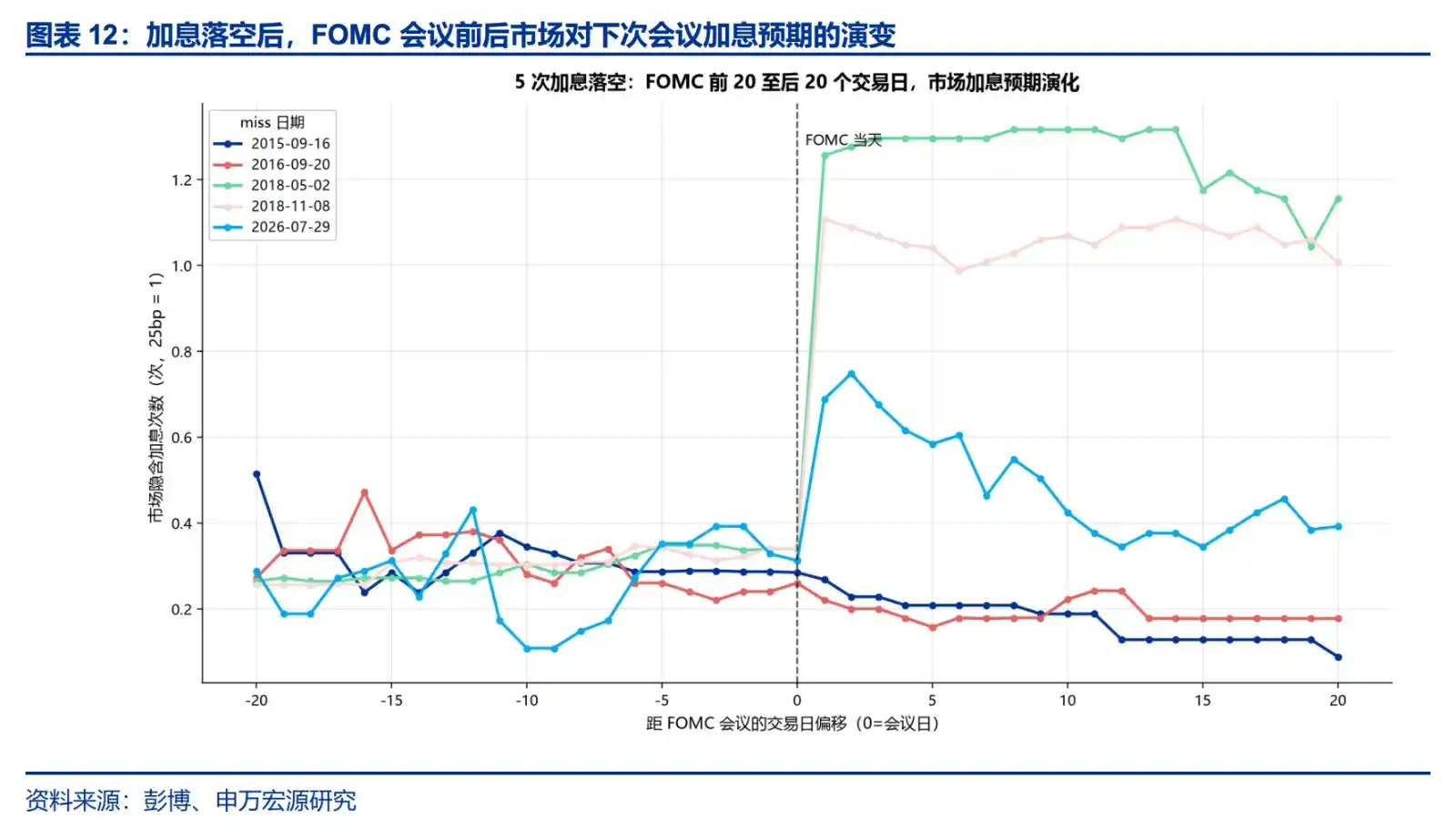
There were only five cases where hike odds were between 30% and 40% and the hike still failed to arrive: September 2015, September 2016, May 2018, November 2018 and July 2026.
Among those five, the 2015 and 2016 cases were accepted by the market because of global risk and weak economic data. The report flags May 2018 and July 2026 as more important comparisons because both came early in the tenure of Jerome Powell and Warsh, when each was still establishing a policy framework. In both episodes, failed hike expectations were followed by a sharp backlash in the long end. Over the 10 trading days after the expected hike did not happen, the 10-year term premium rose by 5.0 basis points and 6.2 basis points, respectively.
Political pressure matters, but history does not rule out a hike
The report also points to pressure from Donald Trump. As of Sept. 3, Polymarket data showed Democrats had a 51% chance of taking control of the Senate, with both Democrats and Republicans projected at 50 seats. The report says Trump is facing heavy pressure tied to the risk of a midterm election setback.
Even so, Shenyin Wanguo said historical data do not support the idea that September hikes disappear in politically sensitive years. Since 1983, there have been three September hikes in either midterm election years or years when an incumbent president sought re-election, a frequency the report says is not lower than in years without the same political sensitivity. It also points to 2018, when Powell, newly appointed by Trump, continued raising rates despite political pressure.
On that basis, the firm says market pressure may be tilting Warsh toward hiking rather than standing pat.
The key question is the path after the move
If the Fed does raise rates in September, Shenyin Wanguo says the lasting effect on asset prices may be limited. Looking back at 51 rate hikes since 1990, the report says U.S. equities have typically shown a pattern of short-term pullback followed by a medium-term recovery, with cyclical stocks tending to lag. The 10-year Treasury yield has generally moved higher in a choppy fashion, while term premium has fallen noticeably.
The post-hike market split depends mainly on two things: whether the move itself is above expectations, and whether the forward path is revised upward after the decision.
Using the 10-year Treasury as an example, the report says yields fell by an average of 9 basis points over the following 20 trading days when a hike came in above expectations. When the hike was smaller than expected, yields rose by an average of 28 basis points. When the projected path of future hikes moved meaningfully higher, the 10-year yield rose by an average of 35 basis points over the next 20 trading days. When that path was broadly unchanged, yields fell by an average of 5 basis points.
If the dot plot is not revised up sharply, the shock may stay contained
Shenyin Wanguo said a slightly more hawkish-than-expected September hike might be treated by the market as bringing forward tightening over the next year rather than signaling a materially steeper hiking cycle.
The report gives two reasons. First, it says the August payrolls figure was heavily affected by seasonal adjustment. With low hiring, low layoffs and low labor-force participation, the U.S. labor market is still in what it calls a "weak balance." Second, wage growth has not shown a clear acceleration, and inflation pressure appears more structural than broad-based, leaving the need for repeated hikes open to question.
If September’s dot plot does not imply a major upward revision to the rate path, the report says the impact of a hike on markets could remain limited. It also says the effect on the short end of the Treasury curve may be modest, while term premium could even edge lower.
The article was written by Zhao Ying for Wallstreetcn and republished by MarsBit.