

On Sept. 24, 2026, the Federal Reserve released two stablecoin proposals at the same time. One turns reserve assets, redemption, capital, custody and ongoing reporting into operational rules. The other sets out how banks supervised by the Fed can apply to establish stablecoin issuance subsidiaries. A year after the GENIUS Act passed, the congressional framework for U.S. payment stablecoins is moving into the daily mechanics issuers would have to run.

The proposals are still in the comment stage. The comment period will run for 60 days after publication in the Federal Register. The rules would apply directly to payment stablecoin issuers supervised by the Federal Reserve and to related banks. They are also likely to become a reference point for banks, custodians and institutional clients assessing stablecoin businesses. Issuers would need to rework reserve accounting, redemption handling, risk measurement and regulatory reporting, making compliance part of routine operations.
1:1 backing becomes a daily operating requirement
The GENIUS Act already requires payment stablecoins to be backed 1:1 by qualifying assets. The Fed proposal goes further by spelling out how that ratio would be calculated and checked in ordinary business operations. Under proposed 12 CFR §247.11, an issuer would need to record reserves at fair value at least once each day, using 5 p.m. in the supervising Reserve Bank’s time zone, and ensure reserve value is no less than the redemption amount of stablecoins in circulation.
The reserve pool would be tightly defined. Eligible assets mainly include cash, balances held at a Federal Reserve Bank, qualifying bank deposits, U.S. Treasuries with remaining maturities of no more than 93 days, qualifying overnight repo and reverse repo transactions, and certain money market funds. The logic is straightforward: stablecoin holders may ask to exit at par at any time, so reserves need to convert into cash quickly and reduce the chance that an issuer would have to sell assets at a discount to meet redemptions.
Each reserve instrument would come with its own operating conditions. Bank deposits would need to meet the institutional and account requirements listed in the proposal. Repo transactions would need qualifying collateral and qualifying counterparties. Money market funds could invest only in short-term assets that are themselves allowed in the reserve pool. That means issuers would need look-through visibility into where funds are ultimately placed. Even if an item is labeled a cash management product on the books, it would not count as legal reserves if the underlying maturity, counterparty profile or liquidity does not meet the rule.
Reserve management would shift from an asset-allocation exercise to a continuous funding operation. When issuance rises, the issuer would need to add qualifying assets at the same time. When redemptions cluster, it would need to manage cash and maturity structure. When rates move, it would also need to handle valuation changes in short-dated Treasuries and other reserve instruments. Excess reserves above the legal requirement could not simply be pulled out at will. The proposal would allow an issuer to withdraw the excess portion monthly after a month-end report has been reviewed and certified. That would reduce flexibility in treasury management, while also limiting room to top up reserves only around reporting dates.
The draft also addresses custody in detail. Institutions holding reserves for issuers would need to keep those reserves separate from their own assets and maintain books sufficient to identify each issuer’s interest. Omnibus accounts would be allowed, meaning a custodian could hold assets for multiple clients in a pooled account, but internal records would need to identify each client’s share on an ongoing basis. If an issuer needs to access reserves to meet redemptions, the custody setup would also need to support timely release of assets. For issuers, choosing a firm that can hold Treasuries would not be enough; account structure, reconciliation frequency and the operational path for retrieving assets would all need to be built into contracts and systems.
Two-business-day redemption turns a liquidity promise into a service standard
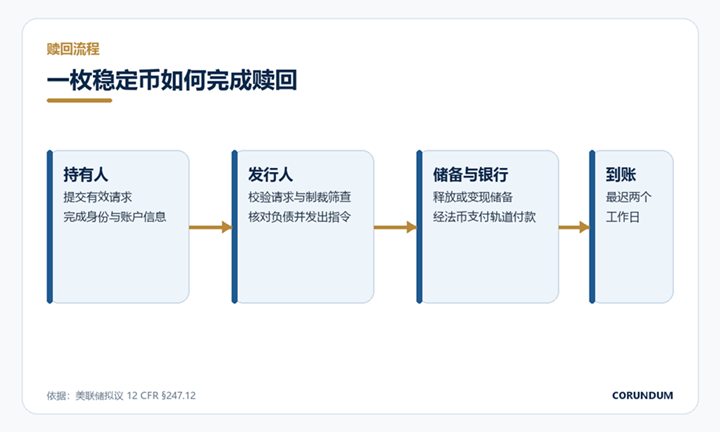
Proposed §247.12 would require issuers to publish redemption policies and complete payment no later than two business days after receiving a valid redemption request. The public disclosure would need to explain how requests are submitted, what conditions apply and how the process works, with the information kept available through channels such as the issuer’s website. Redemption at par would then have a defined time frame that users could measure against the issuer’s stated commitment.
Two business days may look slow next to the instant transfer experience of many onchain assets, but issuers are dealing with a chain of offchain steps that includes bank accounts, reserve liquidation, identity checks and sanctions screening. Stablecoins can move around the clock on blockchains. The redemption leg still depends on bank operating hours and fiat payment rails. If an issuer wants to move faster, it would need cash pre-positioning, automated compliance checks and operating arrangements with banks and custodians for nights and weekends.
The rule would also shift the basis of competition. The market has often compared issuance size, trading depth and the number of supported blockchains. Once a common redemption deadline is in place, institutional clients are likely to keep asking about average settlement time in normal periods, queueing arrangements in stress periods, thresholds for direct redemption and fees charged by intermediaries. Reserve quality answers where the money is. Redemption process answers when holders can get it back. Together, those two elements shape whether a stablecoin can function as a payment instrument.
The proposal would allow regulators to restrict redemptions in specific circumstances, but it does not leave issuers broad discretion to suspend them on their own. In a statement released the same day, Federal Reserve Governor Michael Barr said the final rule should make the general right of redemption sufficiently clear. Redemption capacity under stress, interest-rate risk and foreign-exchange risk are expected to be among the most heavily debated issues during the comment period.
Capital rules extend to credit exposure and technical failure
Payment stablecoin balance sheets are centered on short-term, highly liquid instruments, but issuer losses can also come from system outages, private-key management, cyberattacks, third-party service failures and operational mistakes. Those events can create compensation costs, recovery expenses and legal liabilities. For that reason, the Fed in proposed §247.15 splits capital requirements into credit risk and operational risk, with different calculation frequencies.
Credit-risk capital would be calculated daily, while operational-risk capital would be calculated quarterly. New issuers would also face a minimum capital floor of $5 million, with the amount adjusted in line with U.S. nominal GDP. Regulators could require more capital depending on business scale and risk conditions. For a newly launched bank subsidiary, that means having enough own funds to absorb failures and disputes before the product generates stable revenue.
The capital framework would pull technical architecture directly into financial decision-making. If an issuer depends on a single cloud provider, a single custodian or only a small number of blockchains, business continuity risk could show up in supervisory assessments. The more cross-chain issuance there is, the more complex the node, contract and reconciliation paths become. Bank-affiliated issuers have an advantage in existing risk governance and funding capacity, but they also face the cost of integrating traditional core systems with blockchain infrastructure. Non-bank technology firms still bring product experience, yet entering a regulated issuance framework would often require them to connect that capability through bank partnerships, outsourcing arrangements or capital structures.
The proposal also restricts misleading names and marketing. Issuers could not imply that a stablecoin is backed by the U.S. government, federal deposit insurance or any other public credit support. They also could not pay compensation solely because a user holds, uses or keeps the stablecoin. That second point lines up with the GENIUS Act’s limits on stablecoin yield. How it would apply to exchange rewards, affiliate subsidies and bundled products would still matter for customer acquisition models.
Weekly and quarterly reporting would give supervisors a view into operations
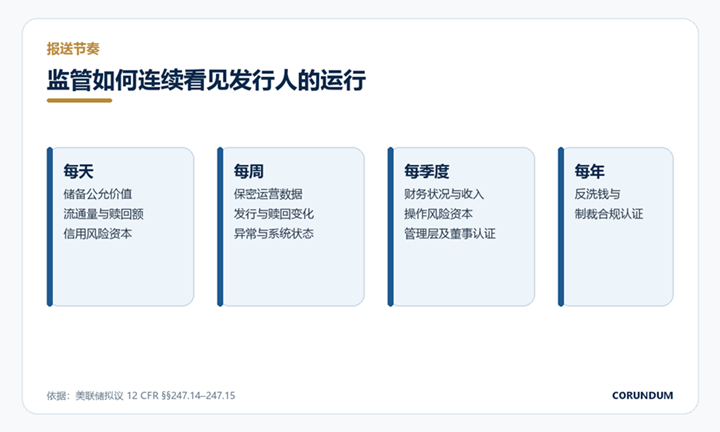
Stablecoin oversight has long relied on monthly reserve disclosures, which usually show the asset mix only at a single point in time. Proposed §247.14 would move reporting to a higher frequency. Issuers would need to submit confidential operating data every week, provide quarterly reports on financial condition and revenue, and obtain certification from the chief financial officer and directors. AML and sanctions compliance would also require annual certification.
The point of weekly reporting is that supervisors could observe issuance, redemptions, reserve changes and operational anomalies on a continuing basis rather than waiting until month-end. Finance systems, onchain monitoring, customer systems and custody accounts would need to use the same data definitions. If onchain circulating supply cannot be reconciled promptly with the issuer’s internal liability ledger, the mismatch would surface quickly in weekly filings. Data engineering at stablecoin firms would become part of compliance infrastructure.
More frequent reporting would also raise the accountability burden on boards and senior management. Once quarterly reports are certified by management, data discrepancies would be harder to dismiss as technical noise. Issuers would need to define which system produces the legal reporting record, who reviews reserves and circulating supply, how exceptions are escalated and how delays in third-party data are handled. For projects issuing across multiple chains, a unified ledger for minting, burning and cross-chain movement would become a starting point for supervision.
Barr also said that a proposed standard under which certain supervisory or enforcement actions would be triggered only when AML deficiencies are “material or systemic” could weaken the effectiveness of day-to-day oversight. The dispute is a reminder that reserve and capital rules address the financial safety of stablecoins, while customer identification, transaction monitoring and sanctions screening govern whether funds enter and leave the system lawfully. Both sets of controls would need to work on the same operating path.
Bank applications would run on a 120-day supervisory clock
The second proposal is designed specifically for banks supervised by the Federal Reserve that want to set up stablecoin issuance subsidiaries. Application materials would include a business plan, financial information, governance arrangements, risk management, and reserve and redemption plans. After receiving the filing, the Fed would have 30 days to determine whether the application is substantially complete. Once complete, it would in principle make a decision within 120 days. If no decision is made by then, the law provides a deemed-approval mechanism.
A defined timetable reduces one source of uncertainty for banks evaluating a project. In the past, banks entering stablecoin activity often started with custody, reserve banking or technical partnerships, while a decision to issue directly depended on regulatory discussions and internal risk appetite. Now they can organize capital, technology and counterparties around a public checklist of materials and build the approval timeline into product planning.
The 120-day clock starts only after the filing is complete, so the preparation phase still determines the overall speed of a project. Banks would need to explain target customers, expected issuance size, the blockchains to be used, smart-contract management, reserve custody, redemption channels and exit plans, then fit those arrangements into existing risk governance. If technology is provided by an outside company, the application would also need to describe subcontracting relationships, data access, recovery arrangements and the control rights retained by the bank. A stablecoin project would therefore be reviewed like a full banking product, not as a standalone blockchain software purchase.
That process does not mean every bank will build its own stablecoin. Issuance carries the cost of reserve operations, redemption support, onchain security, compliance monitoring and multi-party connectivity. Some banks are more likely to join shared issuance networks. Others may continue to provide reserves, custody and fiat rails to existing issuers. Large payment companies and technology platforms may seek bank subsidiaries or regulated partners to combine their distribution networks with a bank’s compliance capabilities.
Competition in stablecoins shifts toward operating capacity
The most important change in the Fed’s proposals is that “safety and soundness” is broken down into observable, reportable and accountable daily actions. Short-dated Treasuries remain the core reserve asset, but the gap between issuers is more likely to show up in cash management, redemption speed, system resilience, data consistency and bank partnership networks. The larger the scale, the harder those functions are to manage through temporary manual work.
The rules would also affect the division of labor across the stablecoin market. Banks bring capital, accounts and compliance systems. Technology firms know blockchains, wallets and developer interfaces. Payment companies control merchant and cross-border networks. A full issuance framework would need to connect all three. The market could end up with a small number of direct issuers and a broader group of service providers focused on reserve custody, compliance technology, onchain monitoring and distribution.
Competition among those service providers would also become more concrete. Custodians would need to offer daily valuation, asset identification and rapid release capability. Onchain monitoring firms would need to turn address activity into account-level data that issuers and supervisors can use. Payment channels would need to shorten the time it takes for redeemed stablecoins to reach bank accounts. Even when an issuer outsources one part of the chain, it would still need to explain the final data in weekly reports and quarterly certifications. Systems that can connect onchain circulation, reserve accounts and customer redemption records are likely to become core infrastructure for stablecoin operations.