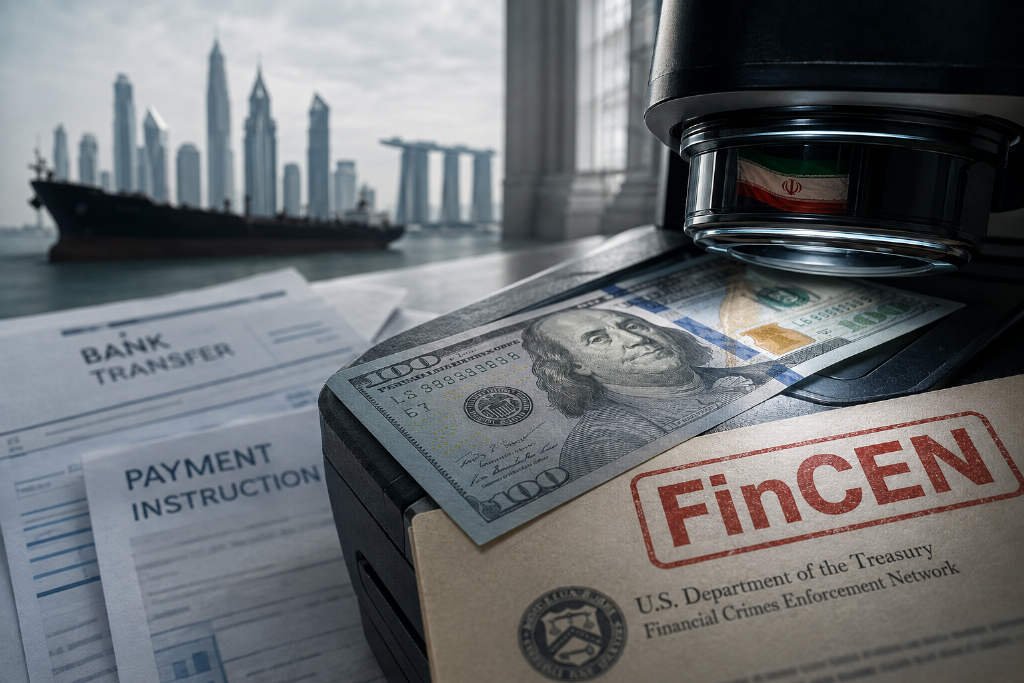
The U.S. Treasury’s Financial Crimes Enforcement Network, or FinCEN, said in a recent analysis that about $9 billion in suspected Iran-linked "shadow banking" activity moved through U.S. correspondent banking accounts in 2024. Of that total, roughly $5 billion was tied to foreign shell companies, while another $4 billion involved foreign oil firms connected to suspected Iranian front companies. FinCEN said Iran-linked entities did not need to hold accounts directly at U.S. banks to access the dollar system. Instead, they could route transactions through intermediaries and correspondent banks in financial hubs including the United Arab Emirates, Hong Kong, and Singapore. The report said the network used shell companies, exchange houses, and layers of transfers through oil, shipping, investment, and technology firms to obscure ties to Iran. Beyond traditional finance, the report noted that Iran has been relying more heavily on cryptocurrency to evade sanctions. Reuters had previously estimated that Iran-related crypto activity could reach $8 billion to $10 billion in 2025. The U.S. government has also recently widened the scope of its secondary sanctions on Iran to cover digital assets, gold, technology, aviation, and shipping.
BlockBeats said on Sept. 7 that a fresh analysis from the U.S. Treasury Department’s Financial Crimes Enforcement Network (FinCEN) estimated about $9 billion in suspected Iran-linked "shadow banking" activity passed through U.S. correspondent banking accounts in 2024.
About $5 billion of that sum came from foreign shell companies. The other $4 billion involved foreign oil companies linked to suspected Iranian front companies.
The report said Iran-linked entities were still able to get into the U.S. dollar system without directly holding accounts at American banks. Instead, they used intermediaries and correspondent banks in financial hubs like the United Arab Emirates, Hong Kong, and Singapore.
The network leaned on shell companies, exchange houses, and layered transfers running through oil, shipping, investment, and technology businesses to mask any tie between the funds and Iran.
And outside traditional finance, Iran has been leaning harder on cryptocurrency to get around sanctions. Reuters had earlier estimated that Iran-related cryptocurrency activity would hit $8 billion to $10 billion in 2025.
The U.S. government has lately widened its secondary sanctions on Iran, bringing digital assets, gold, technology, aviation, and shipping into the covered sectors.
This article was originally published by Bit.Fan. For more cryptocurrency news and market insights, visit www.bit.fan. Disclaimer:
The market information, project data, and third-party content displayed on this platform are for industry information sharing only and do not constitute any form of investment advice or return commitment.
Cryptocurrency trading carries high risks. Users should fully assess their risk tolerance and make independent decisions. All profits, losses, and legal responsibilities are borne by the users themselves.