
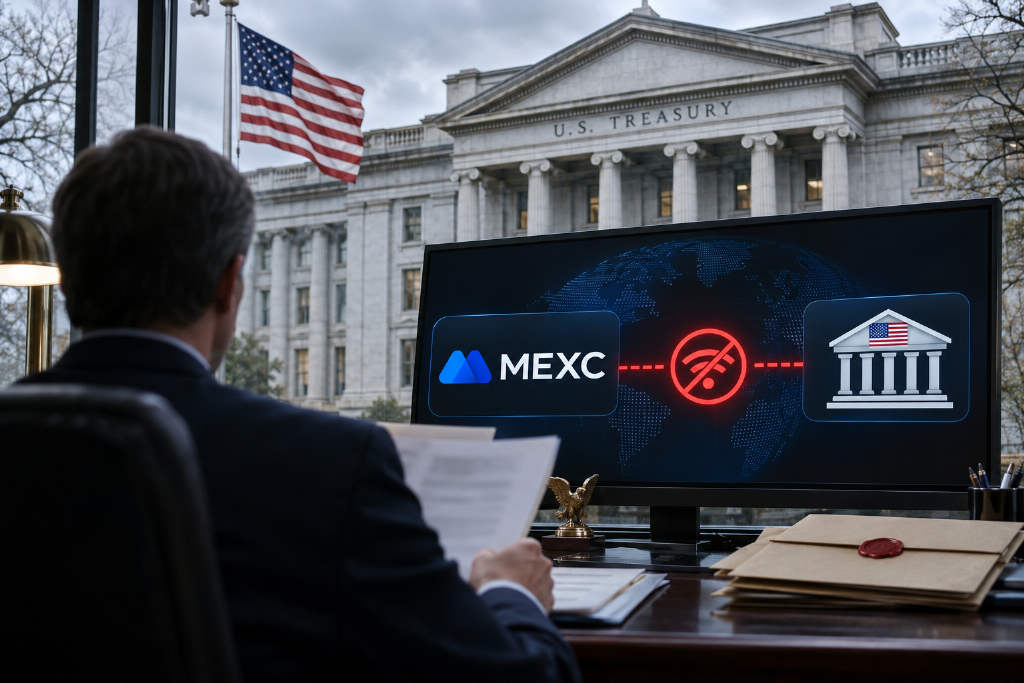
The U.S. Treasury Department’s Financial Crimes Enforcement Network (FinCEN) has ordered a cutoff of funds between U.S. financial institutions and cryptocurrency exchange MEXC Global, effectively excluding the exchange from the U.S. financial system. The order was issued on Nov. 6. It will take effect 30 days after publication in the Federal Register and does not include an end date.
FinCEN cites $16.7 billion in related flows
FinCEN said MEXC processed $16.7 billion between May 2021 and May 2026 in funds connected to illicit Russian finance, sanctions evasion and cybercrime. The agency also identified transactions linked to Iran and North Korea.
According to the order, MEXC was founded in 2018 and is registered in Seychelles. Its business reaches more than 170 countries, but it does not hold a virtual asset service provider license. As of June 2026, the exchange handled more than $1 billion in daily trading volume and held about $5 billion in reserves, putting it among the world’s 20 largest cryptocurrency exchanges by trading volume. FinCEN said financial regulators in several countries had issued notices alleging that MEXC operated without authorization. South Korea placed MEXC on its blocked list in October.
Russian transactions named in the order
After analyzing blockchain data, FinCEN estimated that nearly $1.5 billion in MEXC’s direct and indirect transactions over the five-year period were connected to evasion of sanctions on Russia.
The order specifically cited the Russian exchange Garantex and its successor, Grinex. After the United States sanctioned both exchanges, MEXC still conducted about $129 million in direct transactions with Garantex and about $4.1 million with Grinex. The most recent transaction took place in June 2026.
Iranian and North Korean links
MEXC’s terms of use state that individuals and entities in Iran may not use the platform. FinCEN nevertheless estimated that nearly $2 billion processed by MEXC was connected to Iran or terrorist organizations. More than $1 billion of that amount involved direct transactions with more than 40 Iranian exchanges.
Another $22 million was linked to Iran’s central bank, the Islamic Revolutionary Guard Corps and its Quds Force.
On North Korea, FinCEN said the United States had published the wallet address of money launderer Sim Hyon Sop when it sanctioned him in April 2023. Between June and September 2025, he still received about $350,000 through MEXC.
FinCEN estimated that at least $1.99 billion in illicit funds connected to cybercrime flowed through MEXC, averaging more than $1 million per day. From January 2022 through July 2024, the exchange received more than $37.9 million in suspected ransomware proceeds.
MEXC says operations continue
In a statement posted on X, MEXC said it was aware of FinCEN’s order and was reviewing it with its legal and compliance teams. The exchange said its operations remained normal and customer assets were safe. It also said it would communicate constructively with FinCEN and regulators in different jurisdictions, while launching an independent review of its anti-money-laundering and sanctions controls.
FinCEN withdraws travel-rule proposal
On the same day, FinCEN and the Federal Reserve announced the withdrawal of a 2020 proposal to revise the travel rule. The proposal would have lowered the threshold for cross-border transfers requiring identifying information from $3,000 to $250 and would have explicitly applied the rule to cryptocurrency.
FinCEN said more than five years had passed since the proposal was issued and that conditions in the cryptocurrency industry had changed, requiring a new request for public comment. Last month, FinCEN also withdrew proposals concerning non-custodial wallets and mixer monitoring.



