
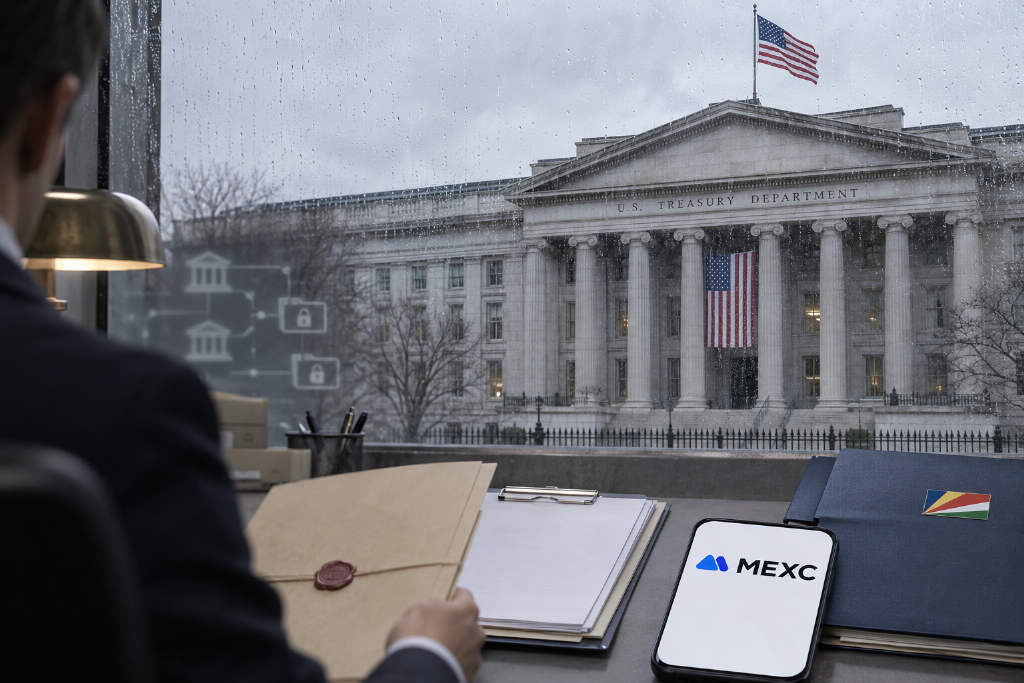
The U.S. Treasury Department’s Financial Crimes Enforcement Network (FinCEN) has issued Order 9714 designating MEXC Global as a foreign financial institution of primary money laundering concern. The Seychelles-registered crypto exchange will be cut off from the U.S. financial system under the order, which bars U.S. financial institutions from initiating or receiving transfers involving MEXC and the entities named in the filing.
The restriction will take effect 30 days after the order is published in the Federal Register. FinCEN issued the measure under authority provided by the Countering Russian Money Laundering Act. Treasury said the action is intended to sever the Iranian regime’s economic lifelines. Its press release described at least $16 billion in illicit funds connected to MEXC, while the order gives a more precise figure: at least $16.7 billion in suspicious flows linked to sanctions evasion and cybercrime between May 2021 and May 2026.
The order reaches beyond MEXC’s parent company
FinCEN Deputy Director Jimmy L. Kirby signed the order. Its scope covers more than the MEXC parent entity. The named entities include MEXC Global Ltd and MX Global Ltd in Seychelles, MEXC Estonia OÜ in Estonia, GIDA Technology AG in Switzerland, MXC Global Ltd in the United Kingdom, two predecessor companies in Singapore and any successor entities.
U.S. financial institutions may not send or receive transfers involving those entities. Violations can trigger civil and criminal penalties. The ban is not effective immediately; publication in the Federal Register starts the 30-day clock.
Russian sanctions evasion accounted for about $1.5 billion
FinCEN’s order attributes about $1.5 billion in MEXC-related flows to Russian sanctions evasion. Of that amount, $232 million involved entities sanctioned by the United States, the European Union and the United Kingdom.
Garantex and its successor, Grinex, receive specific attention in the filing. After both were designated by the U.S. Office of Foreign Assets Control, MEXC still transacted about $129 million with one and $4.1 million with the other. The order says those dealings continued through June 2026. OFAC had designated Garantex in April 2022.
FinCEN notes that the amounts listed in its breakdown represent selected categories cited in the order. The categories may overlap and should not be added together as a single total.
Links to A7 and U.K.-sanctioned exchanges
The filing also describes MEXC’s dealings with the A7 network. The payment network is jointly owned by Moldovan oligarch Ilan Shor and Russia’s Promsvyazbank. MEXC allegedly transacted at least $26 million with the network and processed nearly $200 million in A7A5 stablecoin payments.
A7A5 is ruble-pegged and operates on Tron and Ethereum. Its issuer, Old Vector, and Shor himself have both been sanctioned. In October, FinCEN proposed special measures targeting an agency operating under the A7 network.
From May 2018 through July 2026, MEXC also transacted more than $13 billion with at least four high-risk exchanges sanctioned by the United Kingdom.
Iran, North Korea and cybercrime flows
Between May 2021 and May 2026, MEXC directly transacted about $1 billion with more than 40 Iranian crypto exchanges. Around $22 million flowed to Iran’s central bank, the Islamic Revolutionary Guard Corps and its Quds Force, all of which are sanctioned by OFAC and the European Union.
In the North Korean case, the order says sanctioned money launderer Sim Hyon Sop received about $350,000 through MEXC between June and September 2025. OFAC had designated Sim and his crypto wallet addresses in April 2023.
FinCEN separately assessed that at least $1.99 billion in flows during the same five-year period came from or went to illicit cyber actors, averaging more than $1 million per day. From January 2022 through July 2024, MEXC received more than $37.9 million in suspected ransomware payments connected to exposure involving more than 125 ransomware groups.
A major exchange without a Seychelles virtual-asset license
The order describes MEXC as an exchange founded in 2018 and registered in Seychelles, but says the platform did not hold a local virtual-asset service provider license. On May 26 of this year, the Seychelles Financial Services Authority took enforcement action against MX Global Ltd for operating virtual-asset services without a license.
MEXC operates in more than 170 countries. In June 2026, its daily trading volume exceeded $1 billion and its reserve assets stood at about $5 billion. By trading volume, the platform ranked among the world’s top 20 exchanges. Its market share was about 9% in December 2025, while the two largest global exchanges together held 47.4%. MEXC offered more than 50 fiat currencies and more than 3,000 crypto and tokenized assets.
FinCEN cites serious deficiencies in MEXC’s controls
MEXC has publicly said that it maintains anti-money-laundering and customer-verification policies. Its user agreement also expressly prohibits users from Iran, North Korea and other restricted jurisdictions. FinCEN’s conclusion, however, was that those controls had serious deficiencies. Individuals and entities in prohibited jurisdictions were still able to operate on the platform, turning it into a channel for illicit funds, according to the order.
MEXC announced on Oct. 20 that it would stop serving users in Russia and Belarus, describing the move as part of its global compliance work. Its Dutch operations were scheduled to wind down on Nov. 16. The conduct described in FinCEN’s order continued through June 2026, creating a gap between the exchange’s public announcements and the timeline cited by the U.S. agency. MEXC had not responded to media requests for comment by publication time.
The action follows Treasury’s Iran-focused sanctions campaign
The MEXC measure is part of Operation Economic Outcast, a campaign launched by the Treasury Department in August. In June, the United States sanctioned Nobitex, described by Treasury as Iran’s largest crypto exchange. The department said Nobitex processed more than half of Iran’s crypto inflows in 2025.
In September, the United States added another Iranian exchange, BitBank, to its sanctions list over allegations that it moved bitcoin for the Islamic Revolutionary Guard Corps. The latest order shifts the focus to a larger offshore platform. Its operative provision is specific: the restrictions begin 30 days after publication in the Federal Register.



