
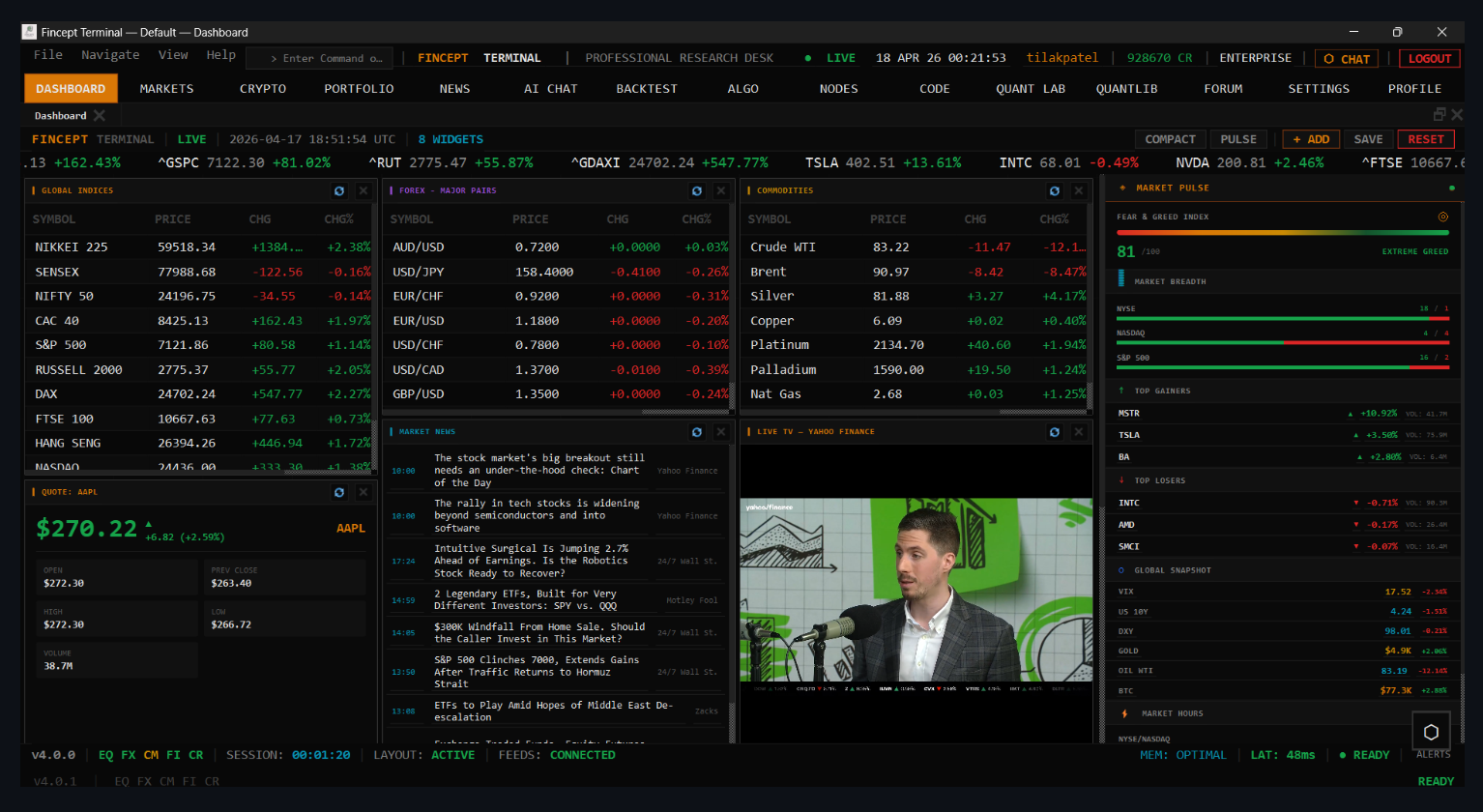
FinceptTerminal, an open-source financial terminal, packages 37 AI analyst agents, more than 100 data connectors, and 16 broker integrations into a single executable, taking direct aim at Bloomberg Terminal’s annual subscription cost of about $24,000. The latest release is v4.0.2, developed by Fincept Corporation under a dual AGPL-3.0 licensing model. Personal and academic use is free, while commercial use requires a separate arrangement.
A native desktop build instead of a browser shell
Rather than using Electron or a browser-based interface, FinceptTerminal is built as a native desktop application with C++20 and Qt6, while Python is embedded for analytical workloads. That design choice is central to its pitch. Startup speed and memory usage are intended to resemble traditional professional software instead of a wrapped web app. The team has explicitly said it is targeting “Bloomberg Terminal-level” performance.
AI agents modeled on well-known investing styles
The product’s clearest point of differentiation is its AI Agent system. It includes 37 built-in agents aligned with the styles of Buffett, Graham, Lynch, Munger, Klarman, and Marks, along with separate frameworks for macroeconomics and geopolitics. Model support covers OpenAI, Anthropic, Gemini, Groq, DeepSeek, MiniMax, and OpenRouter, and also extends to local open-source models run through Ollama. Users can choose cloud or local deployment depending on their workflow and privacy preferences.
Quant tools span pricing, factor research, and backtesting
The second major module is the combination of AI Quant Lab and QuantLib Suite. QuantLib offers 18 quantitative modules covering derivatives pricing, stochastic processes, volatility, and fixed income. Quant Lab adds machine learning modeling, factor discovery, high-frequency trading backtesting, and reinforcement-learning trading strategies. Based on the published feature list, the scope overlaps heavily with tools used inside Wall Street sell-side research teams.
On the data side, the terminal lists more than 100 sources, including DBnomics, Polygon, Kraken, Yahoo Finance, FRED, the IMF, the World Bank, AkShare, and government APIs from multiple countries, while also leaving room for alternative data interfaces. For live trading, it supports WebSocket streams from Kraken and HyperLiquid, allowing crypto, equities, and algorithmic trading to run from the same application.
Community token launched, with roadmap set for 2026
The team has also issued a community token on pump.fun for crypto users. According to the project’s own statement, the token has no product utility, no governance rights, no revenue sharing, and no expected return, and is only meant as an expression of support for the project. Its roadmap says Q2 2026 will bring an options strategy builder, multi-portfolio management, and more than 50 AI agents, while Q3 2026 is scheduled for a programmable API and machine-learning training interfaces.