


Many people are already using crypto wallets without realizing it, according to Itai Turbahn, VP of Embedded Wallets at Fireblocks.
Turbahn made the remarks on Unchained Premium in a conversation with Laura. He is also the co-founder of Dynamic, a wallet infrastructure company that is now part of Fireblocks.
Embedded wallets are showing up inside familiar products
Turbahn said Dynamic originally set out to give developers wallet functionality without seed phrases, logins, or direct key management. That infrastructure now sits within Fireblocks.
He said users have likely interacted with Dynamic in places such as Magic Eden, Circle’s bridge, and Fiserv’s bank-to-bank infrastructure, even if they did not recognize those experiences as crypto wallet usage.
Security remains central to Fireblocks
According to Turbahn, Fireblocks moves about $8 trillion a year and touches roughly 15% of stablecoin flows. He said that scale is why the company treats security as its core business.
He also explained how multi-party computation, or MPC, splits keys into shares so that no single party holds a complete key. Controls, he said, should scale with transaction size: email approvals may be enough for a $1 transfer, while a $5 million transaction should require a quorum.
Stablecoin rails in payments and payroll
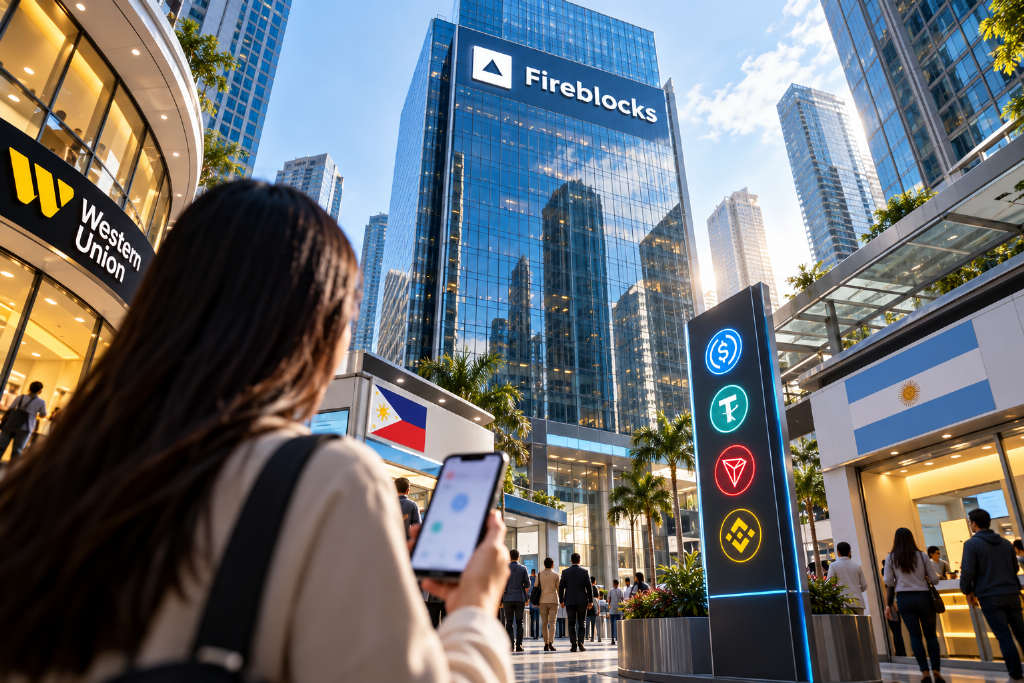
The interview highlighted several payment use cases. Turbahn said a Cash App transfer can reach a Western Union wallet in the Philippines over stablecoins. He also said Papaya Global uses similar rails to pay contractors in Argentina in 10 seconds.
On token preference, he said U.S. companies tend to favor USDC, while other markets lean toward USDT. In South America, USDT on Tron and BNB Chain is dominant. The conversation also noted that companies including Western Union and SoFi are launching their own stablecoins.
What comes after basic transfers
Turbahn said companies are adding more services on top of simple stablecoin transfers. Those include yield products through Morpho and Aave, cards, and tokenized Treasury bills and stocks.
Quantum computing and key security
Turbahn also addressed quantum computing and its potential threat to the one-way relationship between public and private keys. Even so, he said most people should not worry about it, though Fireblocks thinks about the issue every day.
He added that three years ago Fireblocks hoped to win one or two fintech customers. Today, he said, the situation has reversed.