
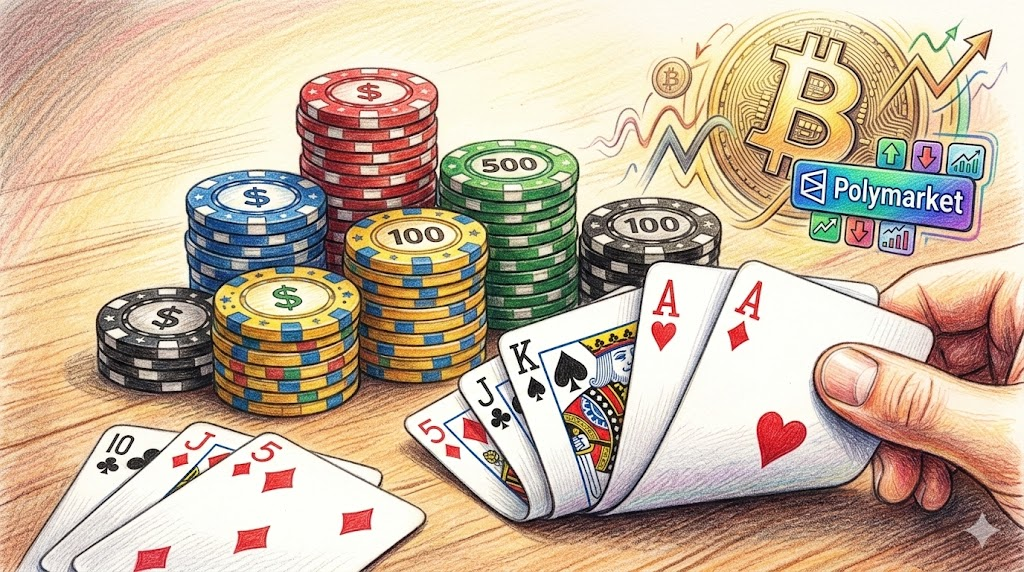
A long post from trading account @GoshawkTrades has been circulating on X, arguing that poker may be one of the most effective training tools for traders. The post points to Susquehanna International Group founder Jeff Yass and says poker has been treated as a core part of trader development. Its main claim is blunt: retail traders usually do not fail because they lack indicators, but because they lack position sizing discipline, probability-based thinking, risk control, and emotional stability.
The comparison rests on structure, not style. Poker and trading both force decisions under uncertainty, both expose participants to loss streaks, and both reward those who can separate decision quality from short-term outcomes. In that sense, the author presents poker as a compact environment for decision training, one that pressures participants to size bets correctly and stay rational when variance hits.
Position sizing comes before confidence
The first lesson is bankroll management, translated directly into trading as position sizing. Even in Texas Hold’em, the post notes, pocket aces can still lose roughly one time in five. A player who shoves all-in every time a premium hand appears will not survive forever. The same framework is applied to markets: even a strong setup can fail, and traders who commit 30%, 40%, or 50% of capital to a single idea leave themselves exposed to account damage that may be difficult to recover from.
The post also repeats a simple number that many traders underestimate: a drawdown of 50% requires a 100% gain just to get back to breakeven. From that angle, the real job is not maximizing what one trade can make, but limiting what one trade can take away. Survival is the first constraint. Without that, no strategy lasts.
Market choice can create the edge
The second lesson uses the poker idea of table selection. A highly skilled player can still struggle at a table full of stronger opponents, while the same player may perform very differently against weaker competition. The post maps that logic onto markets, arguing that what a trader chooses to trade is often as important as how the trade is executed.
It says many retail traders move straight into highly efficient and heavily contested arenas such as foreign exchange or index futures, then wonder why no durable edge appears. By contrast, lower-attention and lower-liquidity areas may function more like “soft tables.” The examples listed include some emerging markets, thinly traded crypto pairs, and prediction markets. The argument is not that these venues guarantee profits, but that large institutions may be less able to deploy capital there because of size, liquidity limits, or compliance constraints.
Size exposure based on conviction
The third point is conviction-adjusted sizing. In poker, stronger hands justify larger bets; weaker hands do not. The post argues that many traders ignore this principle and use the same position size regardless of how strong or weak the setup looks.
Its proposed alternative is straightforward. When the probability distribution looks clearly favorable and the signal is strong, size up. When conditions are unclear or the setup is only marginal, scale down or do nothing. To reinforce the point, the post refers to blackjack card counters, who raise bets when the deck turns favorable and keep bets minimal when it does not. For trading, the message is simple: exposure should track edge, not routine.
Judge the process, not the last outcome
The fourth lesson focuses on process discipline. The post stresses that a correct decision can lose money in the short run, while a poor decision can still make money by chance. Variance does not reward sound thinking every time. Over a larger sample, though, process quality is what matters.
One example in the piece describes a poker player losing with a hand that had a 90% chance to win. That loss does not mean the decision was wrong. The same applies to trading systems that go through difficult weeks or even months despite being followed correctly. The post argues that many traders break down at that stage, abandoning a good framework because they confuse a bad result with a bad process. Professionals evaluate whether the system was executed properly, not whether one trade happened to finish green.
Emotional resilience under variance
The final lesson centers on emotional control. Poker, the author argues, forces players to live with swings and to keep decision-making intact during both winning and losing stretches. Trading demands the same restraint. Euphoria can distort judgment. So can the urge to win losses back quickly.
That is why the post speaks favorably about automated trading systems. The reasoning is practical: if execution is automated, there is less room to freeze at key moments, revenge trade after losses, or hesitate because of what happened on the previous position. Automation does not remove variance itself, the author says, but it can reduce the emotional interference that variance creates.
The thread’s broader point is that trading skill is not limited to finding entries. It is built around a repeatable framework for sizing, market selection, probability assessment, process discipline, and emotional control. In that framing, poker is not just a metaphor. It is a compressed training ground for the same decision habits markets demand.