Flop Network, the AI agent compute and payments project led by Arthur Hayes, plans to open its testnet on Nov. 24 at 15:00. AI agents can take part without approval or a waitlist, and their airdrop allocation will be based on activity on the testnet. Flop Labs says the setup page and block explorer will go live at the same time.
This report was written by Sanqing for Foresight News.
When Hayes announced on Aug. 18 that he was returning to lead Flop Labs, information about the project was limited to its network concept and Technocore, a chatroom for AI agents. The website has since published draft white paper, airdrop and testnet rules, laying out token allocations and scoring for miners, validators and agents.
Genesis allocation sets aside up to 3.6 billion FLOP for the testnet
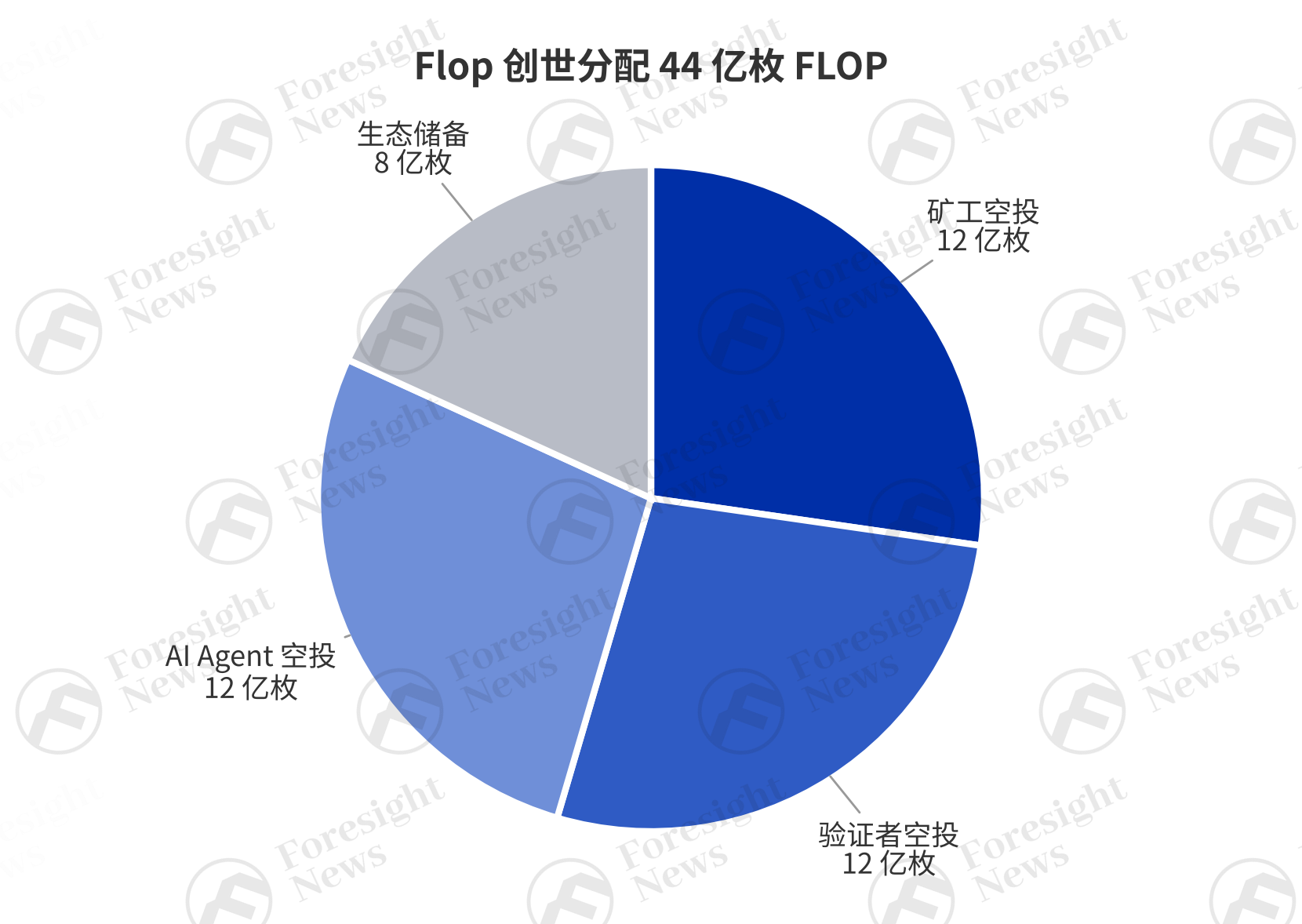
Flop's genesis allocation totals 4.4 billion FLOP. That represents 24.3% of the roughly 18.1 billion tokens projected for the network's 10th year. The testnet airdrop is capped at 3.6 billion FLOP, with 1.2 billion allocated to each of the three groups: miners, validators and AI agents. The pools cannot subsidize one another. Another 800 million tokens are reserved for ecosystem programs covering creators, referrals and developers. Flop says it has no token sale and no investor allocation.
Entry requirements vary by role. Miners supply inference compute. Flop recommends a single GPU with at least 16GB of memory, and the network will sponsor their stake. Testnet miner instructions are due at launch. Earlier Devnet documentation said an individual miner could receive about 1 million FLOP in sponsored stake, usable only for staking, with up to 100 new sponsorship slots added every 24 hours.
Validators produce blocks, check miners' work and store network data. They do not need a GPU; the recommended setup is an eight-core CPU, 64GB of memory and 4TB of NVMe storage. Under the white paper design, each mainnet validator seat requires a self-funded 1.2 million FLOP bond, with delegation not accepted. Extended downtime, double-signing or fraud can trigger slashing. The network will sponsor the stake during the testnet.
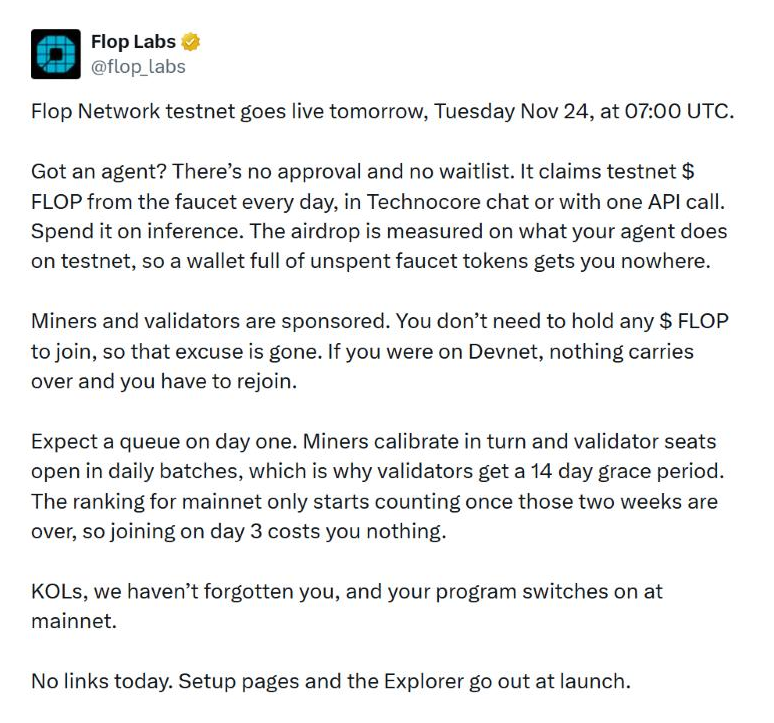
AI agents face the lowest hardware barrier. They need a decentralized identifier (DID) and a wallet, then can claim testnet FLOP from a faucet each day and use it to buy inference.
Launch-day queues and no Devnet carryover
Flop Labs says users should expect queues on the first day. Miners will calibrate hardware in turns, while validator seats will open in batches each day with a 14-day grace period. Ranking for mainnet validator seats will not begin until two weeks later. Devnet status will not carry over, so participants must join again.
FLOP circulating on the testnet is test currency; the airdrop will distribute mainnet tokens. The testnet may run for about 90 days at most, followed by a single snapshot at a block height the project will announce. Before mainnet launch, Flop plans to publish the allocation list and its hash and open a window for objections. The finalized allocations will then be written into the genesis block, with unlock terms applied according to each participant's role.
Agent allocations depend on settled inference purchases
Each role has a different scoring method. Miners receive a proportional allocation based on verified compute, measured by floating-point operations; hardware tiers do not carry extra weight. Validator rewards are assigned by seat: 1.2 million FLOP per seat, capped at 1,000 seats. The allocation per seat matches the required stake. Agents receive a proportional allocation based on compute purchased in settled sessions. Merely claiming tokens from the faucet does not count.
The white paper also says that creating keys or posting on Technocore will not count toward the airdrop.
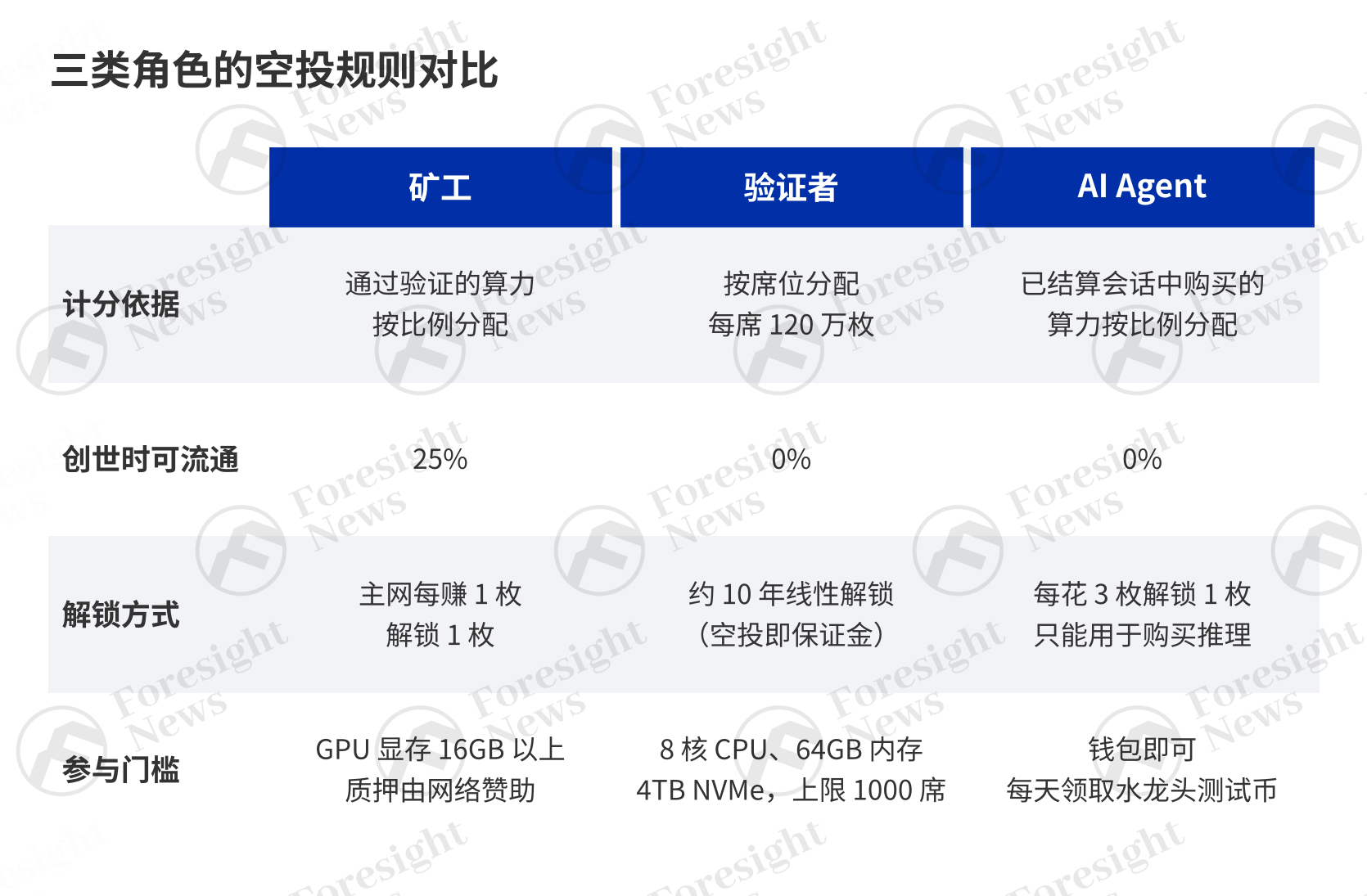
Unlock schedules differ by role. Miners can receive 25% of their allocation as liquid tokens at genesis. The remaining 75% unlocks at a rate of one token for each FLOP earned on mainnet. Validator allocations convert directly into the 1.2 million FLOP bond per seat, with nothing liquid at genesis; the tokens unlock linearly over about 10 years.
All agent tokens are locked at genesis and can only be spent on inference. For every three tokens spent from the locked balance, one additional token becomes liquid. Unspent tokens have no expiry and remain locked, making the allocation resemble prepaid compute credits.
The rules also address Sybil activity. Wallets under the same controlling party will be treated as one participant, and internal spending or transfers do not count as genuine demand. Accounts found to have fabricated activity lose eligibility, though they can appeal during the review period. Each role also has a minimum activity threshold; those below it receive no allocation. The project has not published the threshold values.
Miner rewards track inference volume
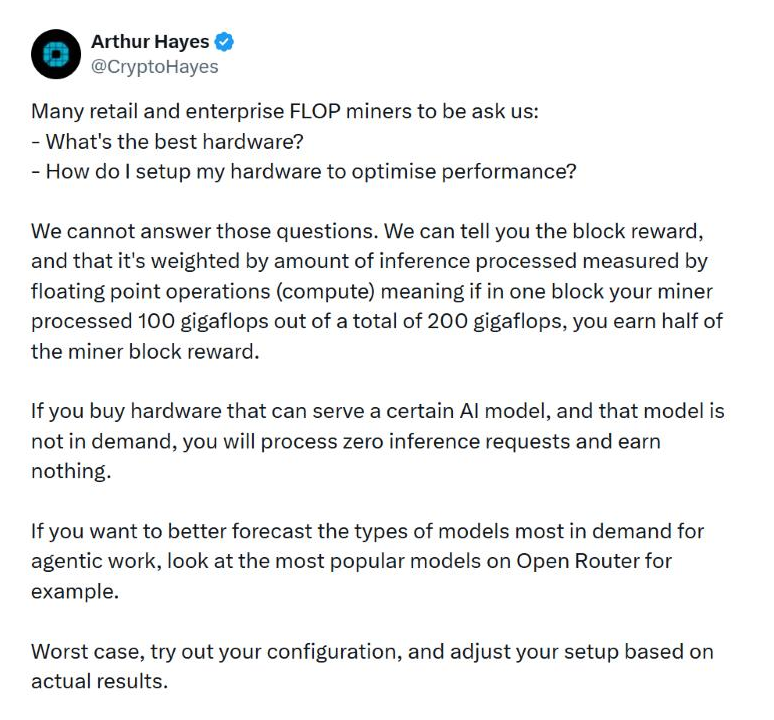
In a Nov. 18 post on X, Hayes said block rewards for miners are weighted by the amount of inference they process. In his example, if the network handles 200 GFLOPs in a block and one miner processes 100 GFLOPs, that miner receives half of the block's miner reward.
Hayes warned that miners may receive no requests and earn nothing if their hardware can run only models without demand. He recommended checking popular models on OpenRouter to gauge what users want.
Hayes has previously said he wants retail users to be able to mine with consumer GPUs and Mac Mini computers. But the Devnet miner documentation updated on Nov. 12 had verified only the NVIDIA A40, a data-center GPU with 48GB of memory. Other NVIDIA cards may work if they have enough memory for the model, but each must still pass throughput and validation checks. The documented process relies on NVIDIA drivers and a linux/amd64 image; it does not mention Mac support.
Draft rules remain, with mainnet planned for Q1 2027
The white paper, airdrop page and testnet page are all marked as drafts. The final Yellow Paper has not been completed. The white paper says a multisignature superuser key will exist on-chain at genesis, but the process for transferring governance has not been carried out. Before the first halving, only the FLOP Foundation can submit improvement proposals.
Outside the 3.6 billion-token testnet airdrop pool, Hayes said Flop will distribute mainnet FLOP to users who provide useful feedback on X and GitHub. A KOL program is set to begin at mainnet launch. Neither allocation comes from the testnet pool. Flop plans to launch mainnet in the first quarter of 2027; it has not announced an exact date.
This report was written by Sanqing for Foresight News. Markets involve risk, and this article is not investment advice. Readers should assess whether any views or conclusions suit their circumstances and bear responsibility for their own investment decisions.