

Top 20 accounts generated $82.3781 million in combined PnL
If the FOMO profit board is read like a scoreboard, the final number tells you who made more money, but not whether those gains came from frequent trading or from a few oversized positions.
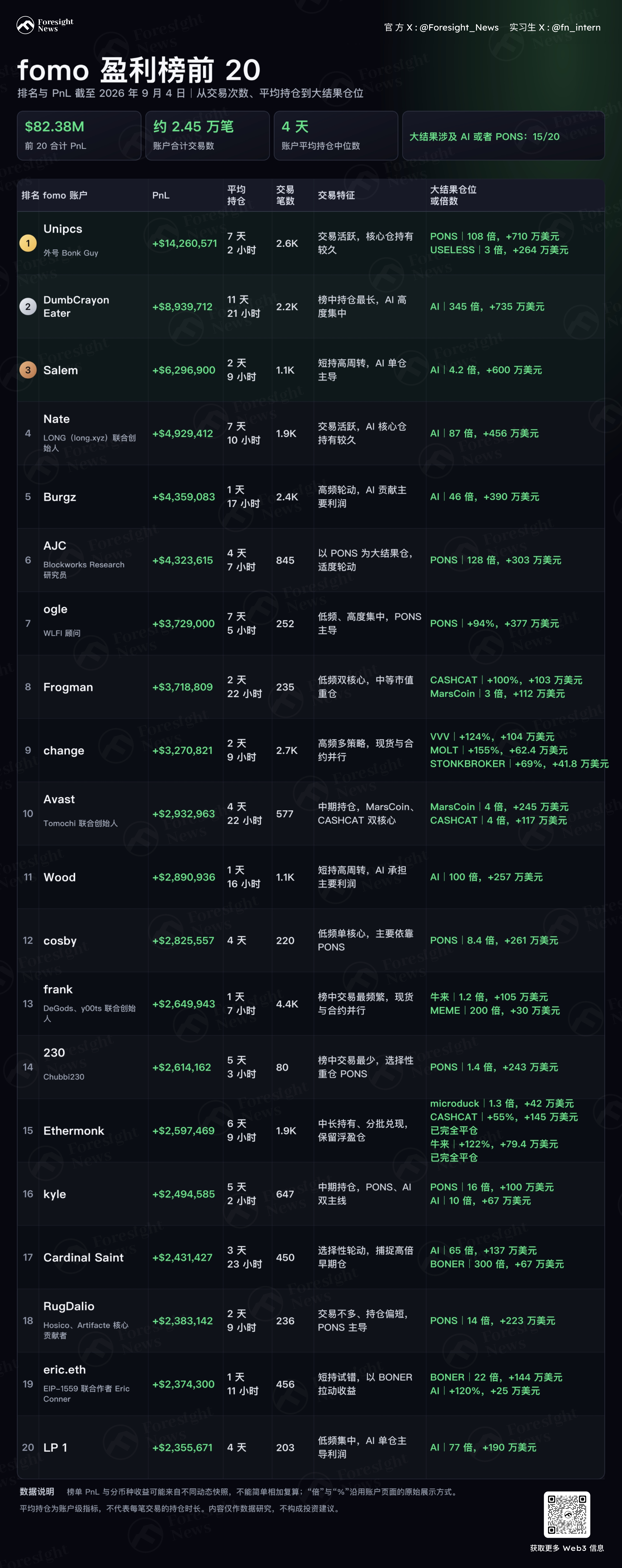
Looking at trade count, average holding time and profit by token side by side reveals three different paths: some traders captured 100x gains by buying early, some used larger capital after tokens had already reached higher market caps to turn that into absolute profit, and others rotated quickly through positions but still had their account rankings defined by one or two core bets.
As of the time of writing on Sept. 4, the top 20 accounts had a combined PnL of $82.3781 million, or $4.1189 million per account on average. The median PnL was $2.912 million. Unipcs, also known as Bonk Guy, ranked first with $14.26 million in profit, close to RMB 100 million, equal to 17.3% of the top-20 total.
One oversized position can dominate an account
The 20 accounts together completed about 24,500 trades, or roughly 1,225 per account on average. The median number of trades was around 746. A simple average of each account’s holding time came out to 4 days and 9 hours, with a median of 4 days. These are account-level averages and are not weighted by the size of each individual trade.
Unipcs is the clearest example. Between July 15 and July 17, he bought about $67,495 of PONS in three separate transactions, at an average entry market cap of about $6.1 million. By the time of writing, that PONS position was worth about $7.43 million, implying a paper gain of roughly 108x. That single core trade alone goes a long way toward explaining why he stayed at the top of the board.
Outside PONS, Unipcs also had more than 10x paper gains on DELTA and microduck. USELESS, MarsCoin, Basecat and BOW (Longbow) also showed paper gains of roughly 1x to 3x. The pattern is not one-token concentration only; it is a large anchor position plus a search for additional trades that can amplify returns.
His average holding time still reached 7 days and 2 hours, showing that active trading and long-held core positions can coexist.
DumbCrayonEater comes close to a “one position changes everything” profile. Total profit reached $8.93 million. The AI position alone generated about $7.35 million, or roughly 345x. His average holding time was 11 days and 21 hours, the longest among the top 20. He also traded about 2,200 times, but the account’s scale was still decided by AI rather than by spreading gains thinly across thousands of trades.
That kind of concentration was not unique. Salem, ranked third, derived about $6 million of profit from AI. Nate, co-founder of LONG, got about $4.56 million from AI. Burgz’s AI position contributed about $3.9 million. Blockworks Research analyst AJC saw a 128x return on PONS and booked about $3.03 million in paper gains. Wood’s AI contributed about $2.57 million. RugDalio’s PONS position contributed about $2.23 million. LP 1 made about $1.9 million from AI. On a rough read of total PnL, these core trades usually accounted for 80% to more than 90% of each account’s profit.
Salem’s total PnL was $6.2969 million. He bought $9,913 of AI when its market cap was around $370,000, and he traded in and out several times early on. Even after AI rose to millions, then tens of millions, and eventually to about $200 million, he kept adding. After those later buys, his average entry market cap rose to about $16.2 million, but AI still generated about $6 million of his profit, or roughly 95% of his total PnL.
Nate’s main gains also came from AI. He first bought about $773 worth of AI when the market cap was below $100,000. Later he added more during the million-dollar and tens-of-millions stages. FOMO account data shows about $50,000 in aggregated capital, an average entry market cap of around $2.7 million, and about $4.56 million in unrealized gains on AI, equal to roughly 92% of total PnL.
WLFI adviser ogle ranked seventh. On July 14, he first bought $4,974 of PONS when the token’s market cap was about $470,000. Transfers out, transfers in, adds and trims followed. Because later activity was much larger than the original buy, his aggregated capital reached about $3.72 million and his average entry market cap about $157 million. By the time of writing, PONS had contributed about $3.77 million of profit, or more than 99% of his total PnL.
Some accounts built results through several mid-sized wins instead of one dominant bet. Frogman’s CASHCAT and MarsCoin contributed about $1.03 million and $1.12 million in paper gains, respectively. Avast’s MarsCoin and CASHCAT contributed about $2.45 million and $1.17 million, respectively. change’s profit came from VVV (124%), MOLT (155%), STONKBROKER (69%) and a derivatives position.
The difference matters: a “super position” does not necessarily mean a single coin. It means most of an account’s profit ends up concentrated in one to three positions that clearly outperformed the rest, rather than being spread evenly across all trades.
The bet is not just on tokens, but on the ecosystem window
Based on the largest profit drivers in the table, at least 15 of the top 20 accounts made major gains from AI or PONS. AI appeared in the largest positions of nine accounts, while PONS appeared in seven.
PONS and AI are closely tied to narratives around Robinhood Chain, launchpads, tokenized asset pairs and fee rebates. Positions such as CASHCAT, MarsCoin and 「牛来」 reflect traders’ bets on fresh narrative heat.
They do not necessarily belong to the same chain, but they share a similar timing profile: each sat inside a period when a new ecosystem was rapidly attracting capital and attention.
The board includes traders who bought extremely early and locked in 100x returns, as well as those who entered only after a token had already reached a mid or even high market cap. Unipcs, DumbCrayonEater, AJC, Wood and Cardinal Saint stand out for the high multiples that came from early entry. Frogman, Avast, cosby and “230” stand out for using larger capital later, once conviction was higher, to turn that into absolute profit.
So “early” does not necessarily mean the first minute or the first day after listing. More important is finishing the research and sizing the position before liquidity, users and attention have fully arrived. Buying very early can increase upside multiples, while buying larger later can increase absolute profit. Both can land on the board, but the risk profile is very different.
High frequency and long holds are not opposites
When the top 20 are sorted by trade count and average holding time, trading frequency and holding patience are clearly not the same axis.
frank is the clearest high-frequency account, with about 4,400 trades and an average holding time of just 1 day and 7 hours. change made about 2,700 trades with a 2 day and 9 hour average hold. Burgz had about 2,400 trades and held for about 1 day and 17 hours on average. These accounts really did rotate quickly.
But many trades do not mean the core position is short-lived. Unipcs made about 2,600 trades but still averaged 7 days and 2 hours per holding period. DumbCrayonEater made about 2,200 trades and held for 11 days and 21 hours on average. Nate made about 1,900 trades and held for 7 days and 10 hours. They likely kept a true conviction position longer while also making many peripheral trades.
At the other end are selective accounts. “230” made only 80 trades, while cosby, LP 1, Frogman, RugDalio and ogle made about 220, 203, 235, 236 and 252 trades, respectively. Low frequency does not always mean long holding periods either: RugDalio averaged only 2 days and 9 hours, while ogle held for 7 days and 5 hours. Trade count, average holding time and concentration all need to be read together.
The data supports descriptions such as high-frequency rotation, low-frequency concentration and long-held core positions, but it does not prove anyone can consistently sell high and buy low.
For these traders, frequency is a tool for finding opportunities or managing risk. The large result positions are what actually decide the ranking.
Most of the gains are still on paper
From the positions that can currently be confirmed, most of the big winners on the board still include unrealized gains and have not been fully cashed out.
Ethermonk is one of the few cases where exits can be clearly observed. CASHCAT has already realized about $1.45 million in profit, with a return of about 55%. 「牛来」 has already realized about $794,000, with a return of about 122%. Both positions were fully closed. At the same time, he still holds a microduck position with about $420,000 in unrealized gains, or roughly 1.3x.
That is a more complete way to manage positions: closed trades lock in profit, while open trades keep the possibility of further upside alive. Compared with total PnL alone, that split shows how much price risk the account is still carrying.
What the board actually tells us
First, check whether the ecosystem can keep creating new value before looking at individual tokens. When a new ecosystem starts, narrative and attention can bring in the first wave of capital, but whether the heat lasts depends on actual revenue, trading volume, liquidity and user growth. Only if those metrics keep improving can the token’s value-capture logic be further tested.
Second, valuation makes more sense when compared with peers. Looking only at whether a token’s market cap is $10 million or $100 million makes it hard to judge whether it is cheap or expensive. A better approach is to compare it with similar launchpads, meme leaders or ecosystem tokens on other chains to see whether it is undervalued.
Third, big results require both low cost and enough size. High multiples usually come from buying early, but large profits also depend on how much capital was put to work.
Fourth, conviction does not mean never selling. An investor can keep a core position that defines the account ceiling while also taking profits in stages and recovering principal on the way up. Ethermonk’s fully closed CASHCAT and 「牛来」 positions, versus the still-open microduck trade, are examples of two different risk sets.
Fifth, concentration among top accounts reflects how consensus forms. The top 20 often built large positions in the same one or two tokens, which shows that narrative and attention really are key clues for finding opportunities. But once that concentration is already visible on the board, later buyers face different entry costs, different upside multiples and different exit liquidity.
Finally, the survivor bias behind the board has to be stated plainly. Early entries, concentrated bets and long holds can produce 100x gains, but they can also lead to losses close to zero. The profit board only shows the accounts that survived and stayed near the top; it does not prove that the same strategy works for most people.