
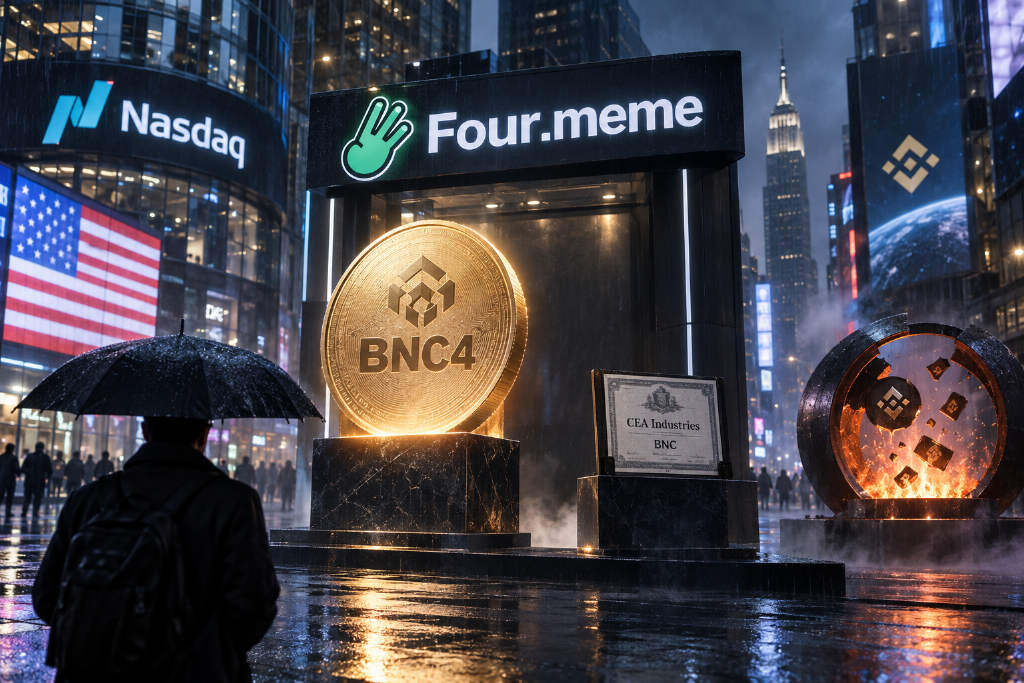
Four.meme’s first 4Stock product, BNC4, produced a sharp split between on-chain pricing and the price of its linked U.S. stock. BNC4 at one point climbed to $35 before retreating to around $6, while CEA Industries, the Nasdaq-listed company behind ticker BNC, was trading near $5 over the same period. At the peak, the on-chain token was valued at roughly seven times the stock price.
The move turned BNC4 into an early test case for a model built around putting stock exposure on-chain before standard tokenized equity products are fully available, then layering meme trading activity on top.
4Stock was launched as a faster route to on-chain stock exposure
According to PANews, the product’s traction came in part from how 4Stock was positioned against bStocks. Rather than copying bStocks directly, Four.meme targeted the gap between rising stock-related narratives and the lack of available on-chain instruments, then introduced a lighter product that could move sooner.
Under Four.meme’s structure, each 4Stock is backed 1:1 by the corresponding stock asset. Users can trade it directly on-chain, and they can also use it as the base asset for what the platform calls a stock meme, meaning meme assets issued and traded around a specific listed company. Once the matching bStocks product is launched, the 4Stock can be converted through the platform into standard bStocks on a 1:1 basis.
The model is aimed at a specific bottleneck in on-chain equities: by the time a stock theme is already gaining traction in traditional markets or on social media, the related compliant on-chain asset often has not yet launched. Four.meme’s answer was to split the process into two steps. First comes fast creation of the 4Stock when a stock has momentum. The trading and meme ecosystem is built around it after that, without waiting for the full bStocks process to finish.
PANews said the meme token sharing the 4Stock name briefly exceeded an $82 million market capitalization, a record high. It has since dropped to about $43 million, while 24-hour trading volume topped $114 million.
A 1:1 reserve did not keep BNC4 aligned with BNC stock
BNC4 was the first product built under that structure, and its linked asset was CEA Industries (BNC). PANews said the company had already shifted into a listed digital asset treasury, or DAT, with a heavy BNB allocation. Company filings showed holdings of 515,544 BNB with a fair value of about $317 million. Digital assets accounted for 94.6% of total assets.
For crypto traders, BNC4 was not treated simply as a tokenized U.S. stock. The report said it combined exposure to the BNB price, the DAT theme, and the narrative of stocks moving on-chain. That mix helped create a valuation premium on-chain.
Even so, 1:1 asset backing did not produce a 1:1 market price. Different trading hours between U.S. equities and the on-chain market, combined with thin early liquidity, pushed BNC4 to more than seven times the stock’s after-hours price at one stage. The gap created room for arbitrage, and it also exposed the frictions in the mechanism.
Crypto KOL 0xShawn laid out one such arbitrage trade publicly. The process started with a USDC deposit sent to a designated Four.meme address to request minting. The platform then used those funds to buy BNC shares and minted BNC4 on a 1:1 basis. With BNC4 trading at more than seven times the stock’s after-hours price on-chain, the newly received tokens were sold into the on-chain market, generating about $230,000 in profit.
The example showed again that a 1:1 reserve is not the same thing as a 1:1 secondary-market price. There is time between minting, trading and redemption. Liquidity conditions differ across the two venues, and so do investor expectations. Price gaps are a natural result. PANews noted that arbitrage should compress the premium over time and pull pricing closer to the underlying asset, but the early stage created a bottleneck: mint requests were processed in order of fund arrival, so new BNC4 could not reach the market quickly enough. Arbitrage supply lagged speculative demand, and the premium was able to persist or even widen.
Four.meme later warned that BNC4 could trade at a premium and that the gradual arrival of newly minted tokens could hit price levels.
Four.meme introduced a daily buyback-and-burn plan tied to BNC4 revenue
As trading activity and community attention accelerated, Four.meme followed with another incentive layer: a daily buyback-and-burn program for BNC4.
Under the rules, from Sept. 9 through Dec. 9, all daily product revenue generated by BNC4 will be used to buy back and burn the top-performing community meme token of the day. To qualify, a project must use BNC as the pool asset, have at least 3,000 token holders, maintain a market capitalization of no less than $500,000, and rank first in daily trading volume. Any tokens repurchased through the mechanism will be 100% burned.
PANews described the structure as a flywheel. BNC4 trading creates fee income. That income is used to buy leading meme tokens. Burning those tokens adds a deflationary element that can support meme trading activity. More trading can then feed back into demand for BNC4 itself.
Four.meme’s aim is to use BNC4 as the base asset for a broader stock meme market and direct trading fees back into the community.
The same design also carries a risk. Projects may try to inflate volume to win the daily buyback slot, which could amplify short-term speculation and create liquidity mismatches. Four.meme has said wash trading and abnormal activity are grounds for exclusion, but PANews noted that the effectiveness of those rules will need to be tested in the market.
On-chain momentum appeared to feed back into the U.S. stock
The episode also produced a second effect: enthusiasm on-chain appeared to spill over into the stock market itself.
At the Sept. 8 U.S. close, BNC shares were up 50.43% at $5.25. Trading volume changed even more dramatically. Over the past 24 hours, turnover in BNC came in near $285 million, about 197 times its usual average daily volume.
PANews said this created an unusual two-way relationship. The stock price in traditional markets gave the on-chain asset a valuation anchor, while the trading intensity and discussion around the on-chain token fed attention back into the listed equity, drew in capital and helped lift the share price.
That effect can be stronger for a small-cap DAT such as BNC. The report said its pricing is no longer driven only by financial metrics. It also reflects the company’s operating and governance fundamentals, the net asset value of its BNB holdings, and a valuation premium tied to the broader BNB ecosystem.
The experiment exposed both the appeal and the limits of early stock tokenization
PANews framed BNC4’s breakout as a stress test for the combination of early on-chain stock issuance and a meme-based trading ecosystem. The experiment points to a lighter and more community-driven way to bring equity exposure on-chain. At the same time, a premium that reached seven times the stock price showed how far on-chain markets can detach from the underlying asset when liquidity is limited, narratives move first and arbitrage channels are not yet working smoothly.
The next question is whether 4Stock can convert this wave of sentiment-driven trading into lasting on-chain stock liquidity once minting, redemption and arbitrage processes become more efficient.
The report also said that putting stocks on-chain earlier improves trading access, but it does not resolve the harder issues around price discovery, liquidity and regulatory compliance. Whether the model can hold up after speculative heat fades is still an open market test.