
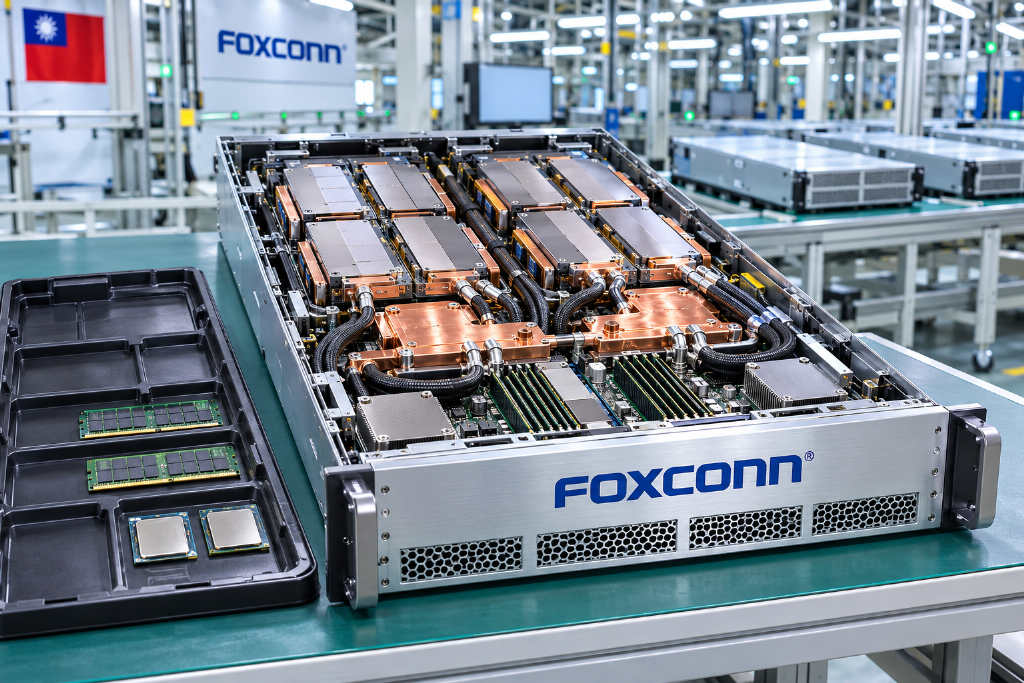
AI server demand lifts cloud network share
Foxconn Chairman Young Liu said at the company’s third-quarter 2026 investor conference that stronger-than-expected AI server demand had lifted cloud network products to 54% of group revenue. The business has become Foxconn’s strongest growth engine. Liu said visibility was better than expected at the company’s August investor conference, leading Foxconn to raise its full-year outlook for all four product lines.

The company expects fourth-quarter revenue to show strong sequential and year-over-year growth as the ICT industry enters its traditional peak season and next-generation AI server racks begin shipping in volume. Foxconn reported earnings per share of NT$13.35 for the first three quarters, a record for the same period. It also expects AI server rack shipments in the fourth quarter and next year to grow at a high-single-digit or double-digit rate.
AI changes the profit mix
Liu identified return on equity, or ROE, as a central measure of AI’s contribution to Foxconn’s actual profitability. During the company’s earlier focus on consumer smart products and computer terminals, ROE was generally below 10%. After cloud network products became Foxconn’s largest revenue source in 2025, ROE moved above 11%. First-three-quarter ROE in 2026 reached 10.44%, up 1.66 percentage points from the same period a year earlier and moving toward the company’s full-year target of 12%.
Liu said the figures show that Foxconn’s AI investment has expanded revenue while also converting into stronger profitability and capital efficiency. He added that internal discussions had begun on the company’s next operating plan, including a possible increase in its ROE target.
Operating margin reaches 3.73%
Foxconn’s core profitability improved as AI server contributions increased and scale effects emerged. Its cumulative operating margin for the first three quarters was 3.73%, up from 3.16% for all of last year and above the company’s 3% floor.
First-three-quarter EBITDA reached NT$369.2 billion, an increase of 50.3% from a year earlier. The figure exceeded the total for all of last year, while its growth also outpaced the 43% increase in capital expenditure over the same period. Liu said the gap between EBITDA and capital expenditure plus cash dividends was widening. He said operating cash generation was sufficient to support future expansion and gave Foxconn financial flexibility to keep raising cash dividends.
Demand may extend into 2027, but supply remains tight
Based on current customer demand, Liu expects the AI growth trend to continue into 2027 as investment in AI infrastructure expands. The outlook comes with supply constraints. Chips, memory and some other critical components remain tight across the industry. Even as new capacity comes online, Foxconn expects total market demand in 2027 to remain above supply for some time.
Global political and economic uncertainty, inflation, interest-rate changes and foreign-exchange volatility are also expected to affect operating conditions. The company said those factors could influence costs across international supply chains and end-consumer demand.
Vertical integration supports AI rack production
Liu said higher prices for next-generation AI server racks would create greater working-capital demands, but pointed to Foxconn’s management of people, funds and supply chains as core strengths. The group has more than 120,000 research and engineering staff worldwide and 25,000 effective patents. Of the more than 900 new product introduction, or NPI, projects executed last year, over half were designed and manufactured by Foxconn under ODM or JDM models.
Foxconn said its in-house production rate for critical components exceeds 50% across phones, personal computers and AI server racks. Its ultra-precision machining capability ranges from 2 microns to below 1 micron, supporting the accuracy requirements of optical communications connectors and micro-optical components for next-generation AI servers. The company said the capability can shorten customers’ time to market and improve cost structures.
Foxconn is also moving into silicon photonics and optical communications connectors used in next-generation AI servers. Liu said the company should not be viewed only as an electronics manufacturing services assembler, citing its in-house component capabilities across phones, PCs and AI server racks.
Capital expenditure rises 43%
Foxconn’s capital expenditure reached NT$161.7 billion in the first three quarters, up 43% year over year. The spending was mainly directed toward AI-related capacity and global production-line expansion. Its debt ratio stood at 64% at the end of September.
Cost pressure remained visible in the gross margin. First-three-quarter gross margin was 6.11%, down 0.18 percentage points from a year earlier as raw-material and component costs increased. Supply bottlenecks, input costs, geopolitical conditions, inflation, and interest-rate and currency policies from major central banks remain factors Foxconn will monitor in 2027.



