
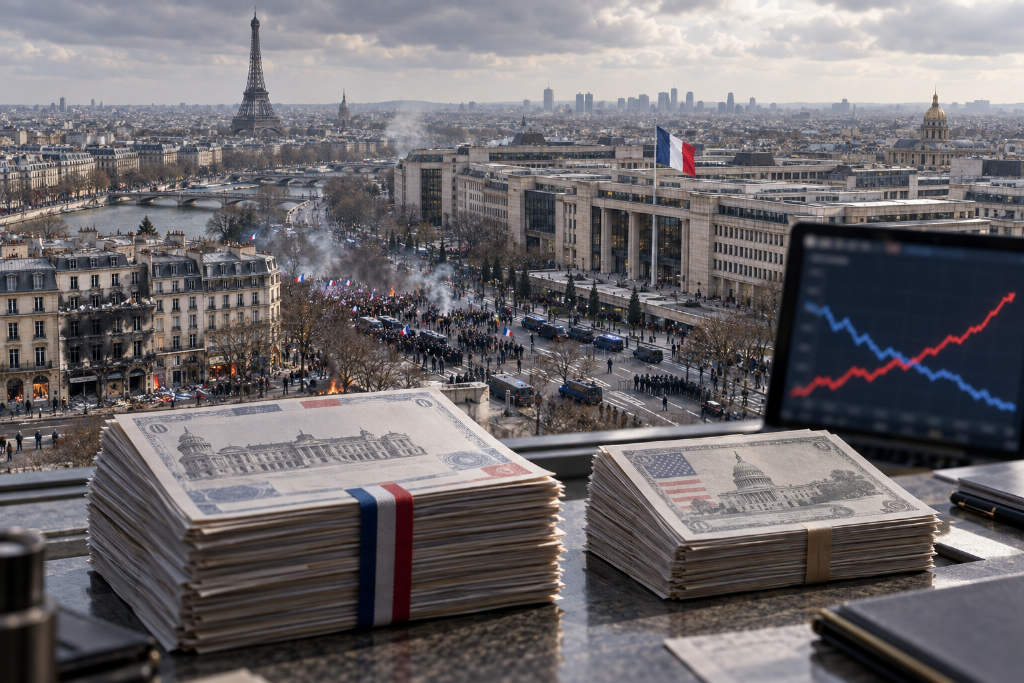
Pressure on French government bonds deepened on Oct. 22, with France’s 10-year sovereign yield rising above the U.S. 10-year Treasury yield for the first time since 2013. CNBC reported that the French 10-year yield jumped 11 basis points in the morning to 5.113%, a 24-year high.
French 10-year yield touched 5.1415% intraday
According to CNBC’s pricing page for French 10-year government bonds, the yield stood at 5.0813% at 2:39 p.m. Paris time on Oct. 22, up about 9 basis points from the previous session’s 4.9938%. The intraday high was 5.1415%.
At the same time, the U.S. 10-year Treasury yield was 5.046% at 7:58 a.m. Eastern time, down 10 basis points from 5.146% in the previous session.
France’s 10-year yield had only just moved above 5% on Oct. 21, the first time that had happened since 2002. CNBC said investors are increasingly doubtful that France can deliver a fiscal consolidation plan that would reduce its high deficit-to-GDP ratio.
Budget debate adds to political risk
The French parliament is reviewing the 2027 budget, but the government does not hold a majority in parliament and may use special powers to push the budget through. CNBC said that could bring short-term certainty around the budget, but would likely lead to more political unrest.
CNBC also said France’s debt-servicing costs are continuing to rise. If the spread between French borrowing costs and those of Germany, the euro zone benchmark, keeps widening, the European Central Bank may be drawn in.
Macron names Trump in criticism
Reuters, cited by CNBC, reported that French President Emmanuel Macron told reporters on Oct. 21: “After the fact, foreign disinformation appeared, prompting many people, including foreign leaders, to make comments that were both unacceptable and stupid.”
Macron said he was referring to Trump among others, and added that some politicians were using the situation in France for their own political benefit.
Earlier in the week, Trump posted on Truth Social that the unrest in France was caused by “migrants, jihadists and communists,” and said Europe should close its borders. Trump, Vice President JD Vance and House Speaker Mike Johnson, along with other Republicans, also referred to the unrest in France during U.S. midterm campaign events, saying Democratic immigration policies would create similar tensions.
Looting, arson and protests spread across French cities
Macron has been visiting Gulf states this week and has faced criticism over the trip. He said the recent violence would not happen again.
Last weekend, multiple French cities saw looting and arson, while large peaceful demonstrations also took place. Protest demands included public services, the cost of living and dissatisfaction with the political leadership. Interior Minister Laurent Nuñez said on Oct. 21 that some military forces would be deployed to help maintain order.
Morningstar sees insured losses of up to 1.2 billion euros
The protests have also created losses for businesses and insurers. Morningstar estimated that, absent any further major shock, insured losses tied to theft and damage at commercial premises and public buildings could reach as much as 1.2 billion euros, or about $1.34 billion.
Mehdi Fadli, senior vice president for global sovereign ratings at Morningstar, told CNBC that the unrest triggered by the Oct. 17 protests may have only a limited direct effect on the French economy, but it is happening at a time when the economy and public finances are already under strain.
Fadli also said the French government recently cut its 2026 real GDP growth forecast to 0.5% from 1%. He said that if protests last longer, continued uncertainty in the international environment and around the domestic presidential election could hurt household and business confidence, restrain economic activity, and add to fiscal pressure in 2026 and 2027.
UNEF and Yellow Vests call for more rallies this weekend
The UNEF student union and the anti-establishment Yellow Vests movement have both called for fresh street demonstrations this weekend.



