
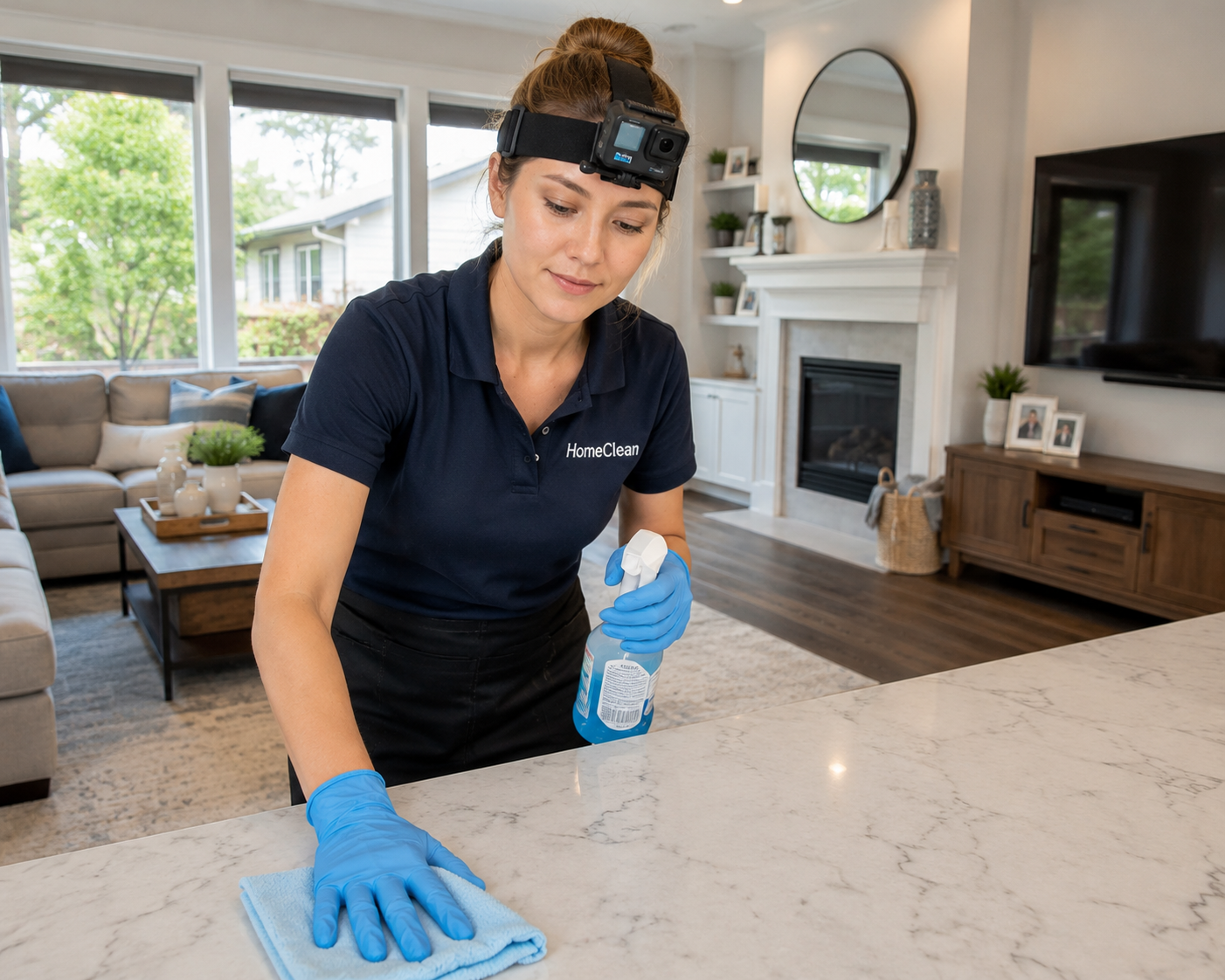
A German startup called MicroAGI has launched Shift, an app that offers free home cleaning services in New York City—but with a catch: cleaners wear cameras or smart glasses to record first-person footage, which is then used to train the next generation of household robots.
MicroAGI describes itself as a team of engineers, researchers, and operators accelerating embodied AI development. Embodied AI refers to the ability of robots to move and manipulate objects in the real physical world—a core bottleneck in humanoid robotics. The Shift app process is straightforward: users input their phone, email, home address, and access code to schedule a roughly two-hour cleaning session, completely free. Cleaners wear recording devices to capture first-person work footage, which is uploaded and used to train robot models.
10,000 Operators, $5 Million Paid
MicroAGI claims to have paid over $5 million to more than 10,000 "operators" in the first quarter of fiscal 2026, across 15 countries. The service is currently limited to New York but the company plans to expand to San Francisco, London, Zurich, and Munich, extending from cleaning to plumbing repairs and daily chores.
Real-world first-person video is a scarce but critical data source for robot training. Scale AI has collected about 100,000 hours of robot training footage; in March 2026, DoorDash launched its Tasks app, allowing 8 million U.S. delivery workers to film chores like folding clothes and washing dishes for pay, while deliberately avoiding states with strict privacy laws. In Nigeria and India, gig workers tie iPhones to their foreheads to record household tasks, earning around $15 per hour and submitting at least 10 hours of video weekly. End users of this data include humanoid robot developers such as Tesla, Figure AI, and Agility Robotics.
Anonymization Promises vs. Unerasable Data
Shift's FAQ claims all names, faces, and personal information are automatically anonymized before use. The privacy policy further states that the company runs "advanced machine learning models" directly on the smart glasses or cameras, performing "irreversible transformations"—including automatic face blurring and identification information masking—before uploading to the cloud. Screens, ID cards, paper documents, and phone displays are all processed. However, the privacy policy does not address whether users can request deletion of their cleaning videos from the training dataset. A more fundamental issue: anonymizing faces does not mean a home cannot be identified. Photos on the wall, documents on the desk, and specific room layouts can all leave traces that allow reverse identification. Embodied AI training requires precisely these details—object positions, environmental structures, spatial configurations—which are the hardest aspects of a home to truly anonymize.