

Every bear market quietly reshapes the listing logic of centralized exchanges. In 2026, with tightening liquidity and fading retail enthusiasm, every token listing decision becomes more deliberate—and thereby more signal-rich. This analysis systematically tracks new token listings from early 2026 through mid-May across six Tier‑1 exchanges: Coinbase, Binance Spot, ByBit, OKX, Bithumb, and Upbit, as well as Binance Perpetual contracts. The dataset contains 207 listing entries spanning 92 unique tokens. The data reveals a highly structured path of verification and liquidity transfer: which platforms first discover and price a project? Which ones absorb and amplify liquidity in the middle? And which ones complete market coverage at the tail end? By the time a token finally lands on Binance Spot, it has typically passed through multiple layers of exchange validation.
Listing Volume and Monthly Rhythms: A Clear Divergence
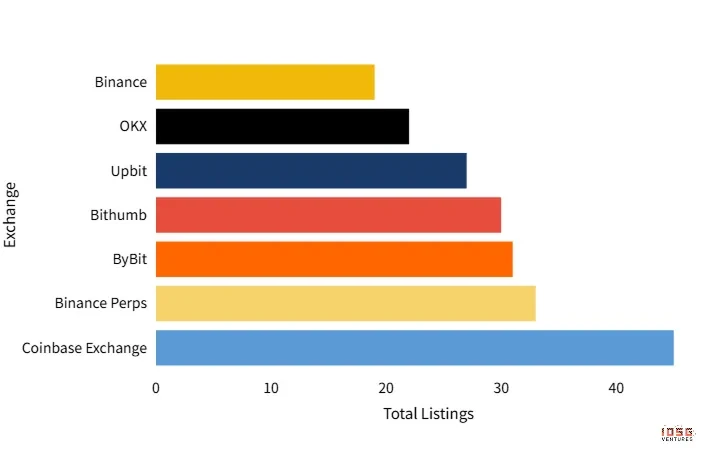
In terms of absolute numbers, listing activity displays a distinct hierarchy. Coinbase leads with 45 new listings, followed by Binance Perps (33) and ByBit (31). Bithumb (30) and Upbit (27) form the second tier, while OKX listed 22 tokens and Binance Spot only 19—the fewest among the exchanges tracked. These numerical differences reflect deeper strategic positioning: Coinbase, as a US compliance leader, aggressively expands asset coverage, whereas Binance Spot, prioritizing core liquidity, exercises maximum restraint in its spot listings.
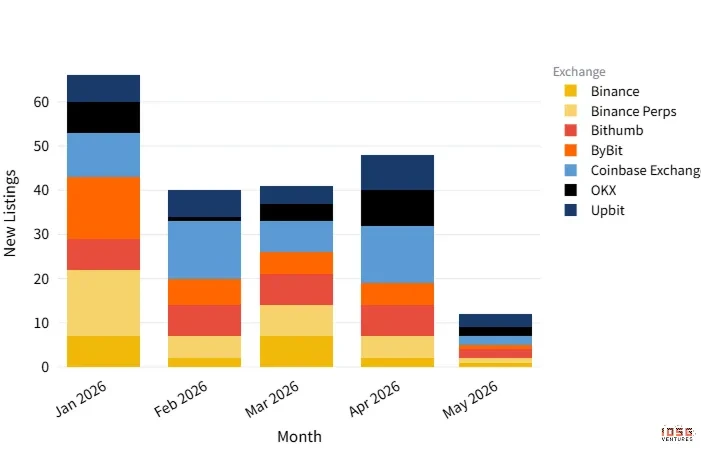
Monthly cadence shows January as the peak listing period, with Binance Perps adding 15 tokens and ByBit 14 in a single month. From February onward, the pace decelerated markedly, with monthly averages falling to 5–8 tokens per exchange, signaling a more cautious, selection‑heavy phase. Coinbase notably exhibited a counter‑cyclical rhythm, with two concentrated listing waves in February and April (13 tokens each), highlighting its independent and swift decision‑making. This divergence underscores how each exchange interprets market timing differently: Coinbase proactively captures early liquidity cycles, while Binance Spot remains extremely conservative.
Sequencing: From Early Discovery to Late Bag‑Holding
For tokens listed on multiple exchanges, we define the first exchange to list a token as the “first mover,” with all subsequent listings treated as “followers.” The data show that Coinbase is the standout first mover in 2026, with 67% of its listed tokens being first movers among the exchanges covered—making it the primary venue for initial price discovery. ByBit’s first‑mover rate stands at 39%, and Binance Perps at 48%. These three often list the same token within the same week, collectively forming the first tier for new token launches. Together, they set the initial pricing range and provide the best exit windows for early holders.
Korean exchanges systematically occupy the tail end of the listing path. Bithumb’s follower rate reaches 85%, and Upbit’s average ranking is 4.44, with a high probability of being the last exchange to list. On average, they lag the first mover by about 28 days. This pattern is closely tied to Korea’s longer regulatory review processes and a local preference for introducing tokens only after broad consensus has formed. This structural delay means Korean users often obtain trading access only after the most attractive price moves have already occurred.
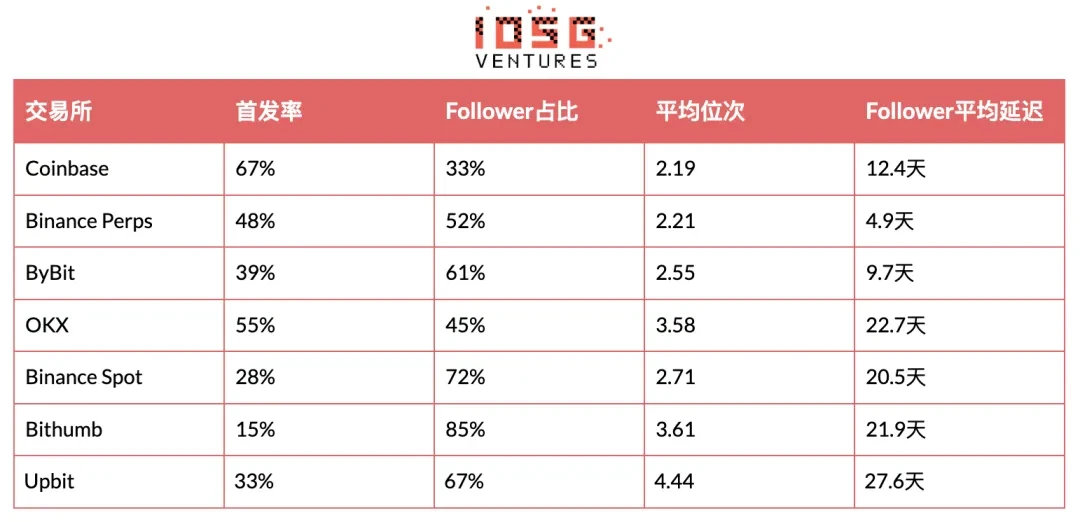
Within Binance, a clear funnel‑shaped division of labor exists: Binance Perps acts as a first mover about half the time, and in the other half it follows spot listings with remarkable speed—an average of just 4.9 days, the fastest among all exchanges. Its primary role is to rapidly test liquidity and market demand through the derivatives market. Binance Spot, by contrast, lists the fewest tokens and has a first‑mover rate of only 28%, clearly preferring to wait until the market has thoroughly validated a token. OKX demonstrates strong independent selection capability, with a first‑mover rate of 55%, though its overall listing volume is modest (22 tokens) and its average rank is 3.58, indicating high filtering standards and a prudent strategy.
ROBO: A 20‑Day Journey Along the Classic Path
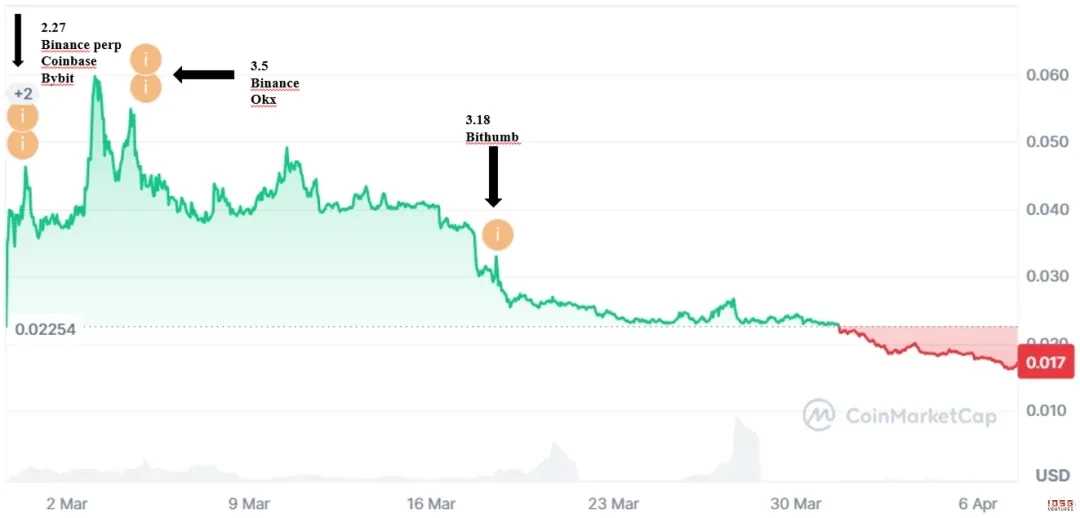
Take the token ROBO as an example. On March 5, Binance Spot listed ROBO, with an opening price hitting $0.0493—the cycle high. When OKX followed later, its opening price was already below Binance Spot’s level. On March 18, Bithumb listed ROBO at $0.0303, sparking a brief rally before the price resumed its decline and eventually fell below the first mover’s opening price. From first listing to Bithumb’s entry, ROBO traversed a full 2026‑style listing path in just about 20 days: Binance Perps, Coinbase, and ByBit as first movers → OKX and Binance Spot confirming at the high → Korean exchanges catching the bag at the end. It was a swift and unforgiving liquidity relay.
ROBO is not an isolated case. In the first five months of 2026, 28 tokens achieved listings on three or more exchanges, and their sequencing distribution showed the same tiered pattern as ROBO. While the specific order can vary slightly based on project characteristics, the overall path structure is stable and predictable. This reflects clear differences in risk appetite: Coinbase, ByBit, and Binance Perps tend to proactively seize early windows; Binance Spot prioritizes post‑validation safety; and the Korean exchanges, along with OKX, prefer to enter only after sufficient market consensus has been built.
Binance Perps’ Screening Mechanism: Leading Signals and Price Validation
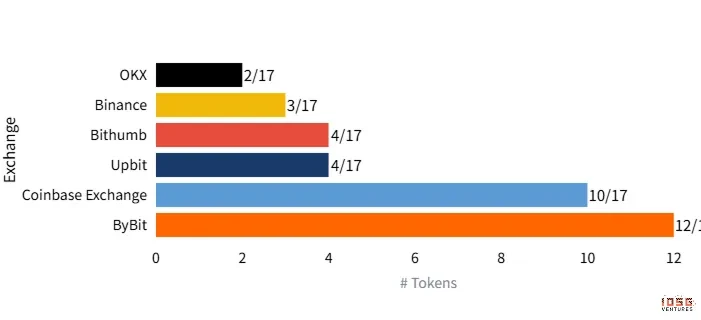
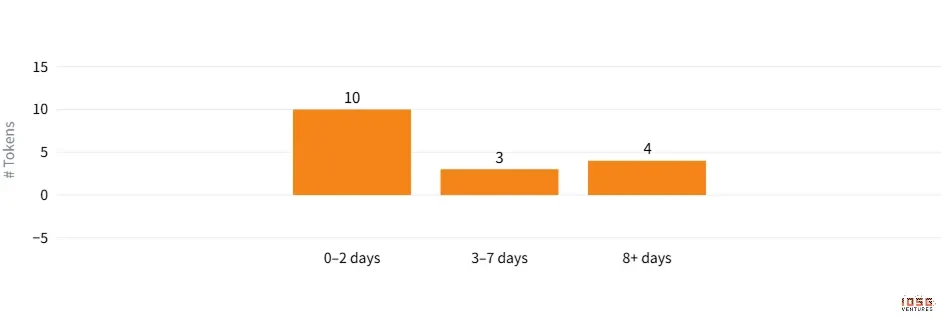
As a critical gateway for the derivatives market, Binance Perps listing decisions directly influence the flow of leveraged capital. Of the 33 tokens that entered Perps, 17 were first listed on other spot exchanges. Tracking shows that Coinbase and ByBit are the most significant leading signals for Perps inclusion. A full 75% of tokens listed on Coinbase eventually made their way into Binance Perps, and the figure for ByBit is 70%. When a token is simultaneously supported by both Coinbase and ByBit and exhibits relatively stable price action, the probability of landing on Binance Perps within one week is extremely high. This is one of the strongest, directly observable leading signals in the current market, enabling participants to anticipate Perps inclusion by simply monitoring those two exchanges.
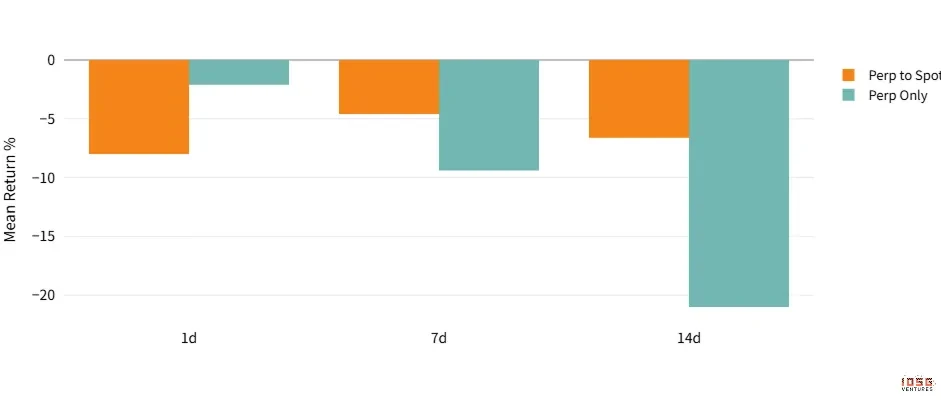
It is price performance—not just FDV—that determines Perps eligibility. While the average opening FDV of tokens listed on Coinbase and ByBit exceeds $100 million, FDV itself does not act as a differentiator. What truly matters is the post‑listing price trajectory. Tokens that fail to enter Perps typically show persistent declines, fleeting rallies, or rapidly shrinking volumes. Further data reveal that tokens ultimately graduating to Binance Spot (the Converted group) posted a 7‑day return of -4.6% and a 14‑day return of -6.6% after their Perps listing. By contrast, those that remained only in Perps (the Perp Only group) saw a 7‑day return of -9.4% and a 14‑day return plunging to -21.0%. Although both groups generated negative returns in the bear market, the Converted group demonstrated significantly stronger price resilience, indicating that Binance already factors in “sustainability” during the Perps stage.
Triple Divergence: Entry Position, Peak Return, and Terminal Outcome
Examining entry positions, price discovery is concentrated in the first‑mover window. When ByBit and Coinbase act as followers, their entry prices are roughly equal to or slightly below the first mover’s price, demonstrating rapid price convergence among the top‑tier exchanges. Binance Perps, when acting as a follower, enters at an average premium of 11.5% over the first mover, but thanks to its extremely fast follow‑on (4.9 days), it still occupies a relatively early position. Binance Spot displays a Price Position of -10%, suggesting a tendency to list after a correction, giving its users a comparatively better entry price. Korean exchanges face the most adverse positioning: Bithumb’s average premium is 19.4%, while Upbit’s reaches 27.4%, and with an average delay exceeding three weeks, users frequently find themselves catching the top. This structural disadvantage severely compresses the room for subsequent gains.
In the 2026 bear market, overall post‑listing price performance was weak, with no exchange showing a positive average 30‑day return. The decline deepened from 7 days to 30 days, indicating not short‑term volatility but a sustained downtrend. Yet peak returns display a radically different distribution. First movers enjoy a clear advantage: ByBit’s average peak is as high as +86%, and Binance Perps’ median peak hits +49%. The first‑tier listing cohort captures the highest price elasticity, offering early holders ample opportunity to exit near the top. The space for late‑stage followers is severely compressed: Bithumb and Upbit peak at around +35%, while OKX reaches only +25%. This divergence confirms the liquidity transmission path—first‑mover exchanges bear the primary price‑discovery function and provide the best exit liquidity; as time passes, subsequent exchange buyers increasingly absorb already‑realized gains, resulting in diminishing marginal utility.
Combining entry position, peak potential, and terminal return, users on different exchanges face radically different risk/reward profiles. Users of first‑mover exchanges (Coinbase/ByBit) enjoy the lowest entry prices (-10% to -5.9%) and the highest peak potential in the market (average above +70%), so even if they miss the exact top, the absolute loss from the first‑mover price is relatively contained—and there is even a chance to lock in profits during the initial surge. Users on Korean exchanges, by contrast, face a classic “buy high + deep drawdown” scenario: they enter at roughly a 20–27% premium, but the peak has already been heavily exploited, leading to the deepest 30‑day declines market‑wide. Binance Spot occupies a special position: although its 30‑day return is as low as -24.6%, because it tends to list after a 10% correction, the actual principal loss is smaller than the headline number suggests—essentially a strategy of trading time for stability.
Quantitatively, the return gap between first movers and followers is most pronounced after 14 days: first movers averaged -12.2%, while followers averaged -16.7%. The difference of 4.5 percentage points stems solely from exchange choice. This confirms that in the 2026 environment, token‑listing events have evolved from “universal gains” into a zero‑sum redistribution of existing capital. For traders, “where you trade” matters more than “what you trade.” Those who can identify and participate during the first‑mover phase, then observe and adjust positions during the Binance Perps validation period, stand a far better chance of managing risk. By contrast, chasing new listings on Korean exchanges carries a high probability of enlarging losses.
From Traffic‑Driven to Verification‑Driven: Alpha within the Listing Path
In the 2026 bear market, CEX listing logic is shifting from “traffic‑driven” to “verification‑driven.” Exchanges are no longer merely chasing hype; instead, they are constructing a structured filtering and liquidity‑release path through a clear division of roles: Coinbase and ByBit act as early discoverers, Binance Perps handle rapid verification and liquidity testing, Binance Spot serves as the final confirmation gate, and Korean exchanges provide exit liquidity at the tail end. This path is not random—it is the outcome of rational strategic interactions among all parties. It offers quality projects a ladder from early exposure to mainstream recognition, while providing early investors and institutions a series of exit windows. At the same time, it starkly reveals the asymmetric positions of different participants: early entrants enjoy price elasticity and a liquidity premium, while tail‑end traders bear higher cost bases and lower return ceilings.
Against the backdrop of overall tight liquidity, token‑listing events currently function more as redistribution of existing capital than as catalysts for incremental growth. As macro conditions improve, this path may gradually evolve from “defensive screening” to “offensive expansion,” with first‑mover premiums widening and verification cycles shortening. Understanding and following this path cannot guarantee success on every listing, but it can substantially improve decision‑making certainty. In crypto markets, information asymmetry always exists, and the ability to structurally comprehend the listing chain is precisely one of the few Alpha sources that can be converted into a long‑term edge.