
In August last year, a ByteDance employee set out to buy two Seagate high-capacity hard drives for a personal quantitative trading platform. What followed was an investment that yielded over six times returns. After ordering on Pinduoduo, he noticed the same model's price increased multiple times within a week, moving only upward.

From Pinduoduo Price Hike to AI Data Center Logic Chain
Using price tracking tools, he plotted the hard drive's price history over several months and compared it with other large-capacity models from Seagate and Western Digital. The conclusion: the entire product line experienced sustained, one-way price increases, not short-term promotions. He deduced a structural cause: Seagate's HAMR technology boosts per-drive capacity, meeting AI data center needs. With limited production capacity, vendors prioritize higher-margin enterprise orders, squeezing retail supply. The price hike essentially reflected AI procurement demand passing through to consumers. Seagate's subsequent earnings confirmed: 39% year-over-year revenue growth, record gross margins, and the storage sector began being priced as part of the AI supply chain. He bought 500 shares at ~$150.

Validating with 13F Institutional Holdings
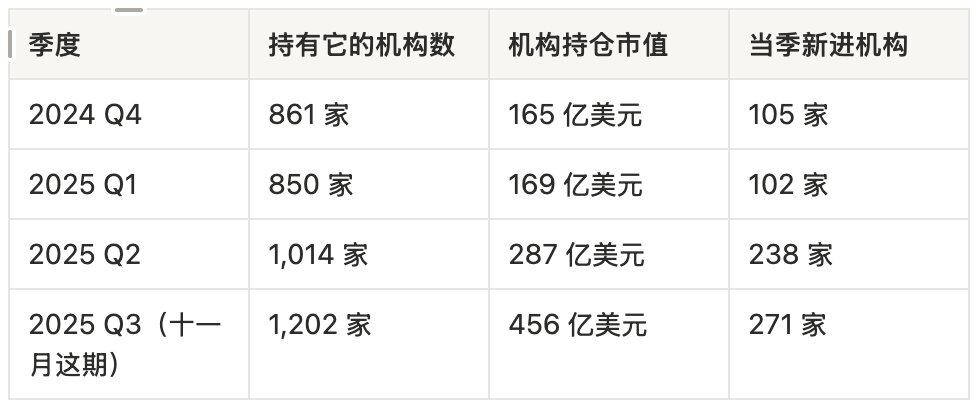
To confirm institutional participation, he referred to 13F filings from large asset managers. Rather than immediate further buys, he tracked trends over quarters. In H2 2024, only ~800 institutions held Seagate, with a slight decline. But Q2 2025 marked a clear upturn; Q3 accelerated to over 1,200 institutions, with the number of new positions increasing each quarter. While market cap growth partly came from share price appreciation, breadth indicators (number of holders and new positions) rose steadily, indicating sustained professional money flow. He then added large positions and bought LEAPS calls on $STX and $SNDK. From $150 to $965, the stock gained over 6x, briefly becoming the S&P 500's top performer. The initial 500 shares alone netted ~$400,000 in paper profit.

Investment Methodology: Converting Everyday Anomalies into Theses
The core logic is straightforward: everyday abnormal signals (price hikes, shortages, queues) often precede news and earnings reports, giving ordinary people an edge; avoid stopping at an impression—plot the price curve to distinguish trend from noise; ask whether demand is long-term and structural, then identify listed companies at key positions in the supply chain; finally, validate institutional stance using multiple quarters of 13F trends. The author stresses the method doesn't always work—he has failed cases with short-term fluctuations, acknowledging survivorship bias. He recommends applying this approach to crypto: when noticing surging on-chain fees, mining rig premiums, or abnormal demand for storage projects like Filecoin or Arweave, investors can run a similar analysis.

Disclaimer: This is a personal retrospective and does not constitute investment advice. All trading carries risk.