
On Oct. 15, 2026, the Financial Stability Board released the final version of Sound Practices for the Responsible Adoption of Artificial Intelligence in Financial Institutions, setting out 12 governance practices for firms using AI. The report spans AI strategy, risk assessment, data management, human oversight, cybersecurity and third-party services, and responds to management issues that have emerged as financial institutions have accelerated the use of generative AI and agentic AI in recent years.

The report was finalized after public consultation and is presented as an international practice framework that institutions can use in light of their own business models and risk profiles. FSB also says implementation still needs to reflect the laws and regulatory requirements of each jurisdiction.
The document is built around a simple point: AI governance in finance cannot be reduced to model performance alone. In the example used to explain the issue, a bank wants AI to help process small-business loans. Business teams want faster reviews. Model teams care about accuracy. Compliance teams focus on customer data and explainability of decisions. Operations teams need to know lending can continue if a vendor goes offline. FSB’s framework is meant to bring those decisions into one management process.
The 12 practices run from firm-wide governance to the full AI lifecycle
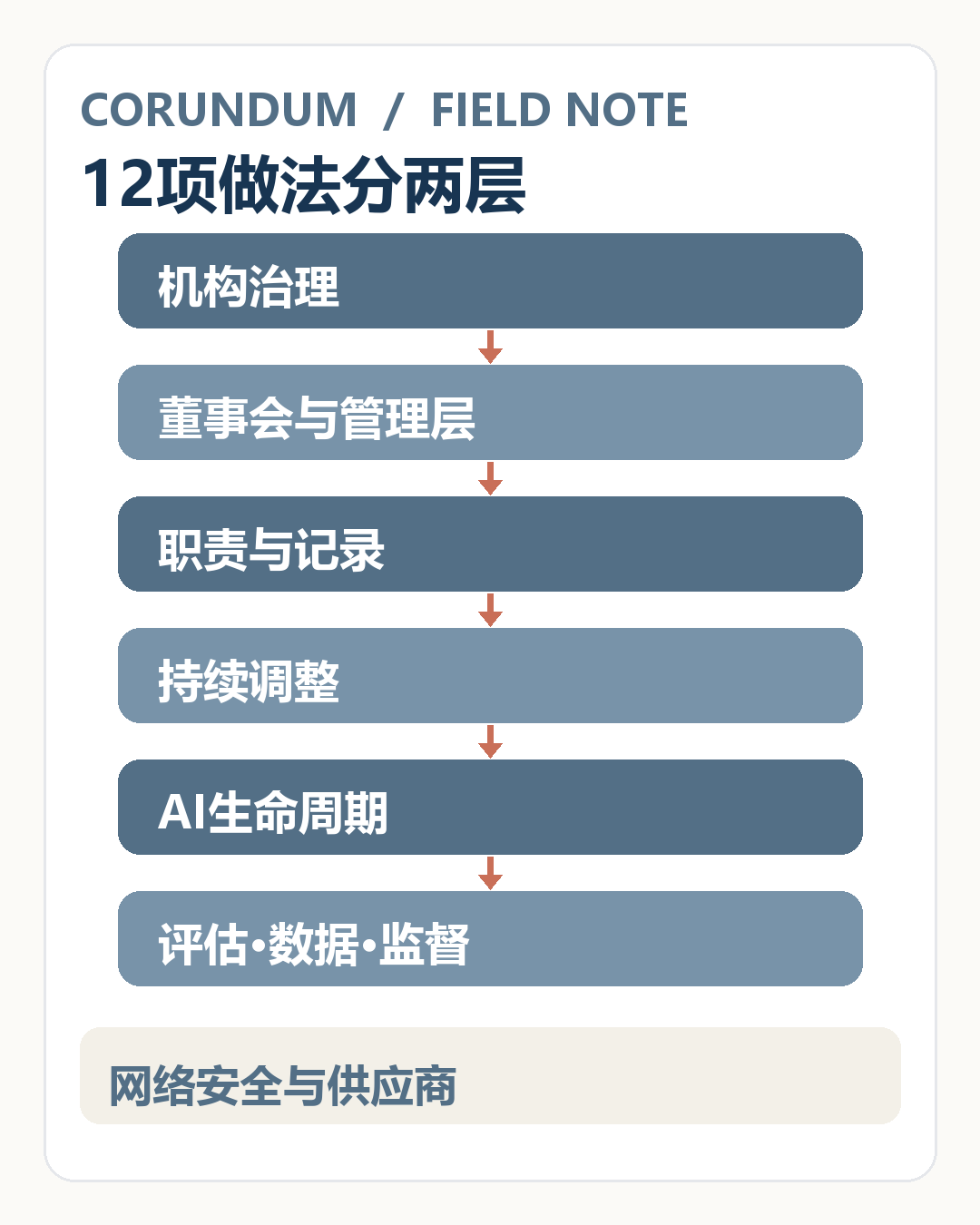
FSB divides the 12 practices into two groups. The first four deal with institution-level governance. The remaining eight cover AI from adoption, development and deployment through ongoing use.
The governance section starts with the board and senior management. FSB says AI use should be considered alongside the institution’s business model, risk appetite and overall strategy. If AI is involved in credit underwriting, customer service, transaction monitoring or internal decision-making, management needs to know where it is being used, what function it performs and what the consequences of failure could be.
The second practice focuses on accountability. Institutions are expected to define the responsibilities of business, technology, risk, compliance and audit teams, and fold AI risk into existing risk management frameworks. The third practice extends that logic by requiring documentation of AI use, risk assessments and related controls. The fourth says governance arrangements should be updated as technology and business conditions change.
Those four practices determine who approves an AI project, who maintains it and who can stop it. Boards do not need to review model parameters one by one, but they should know which important business lines use AI, what benefits are expected and how much risk the institution is prepared to take. Management then translates those expectations into product approvals and role definitions. In the lending example, a business owner decides at which step AI recommendations can enter the approval process; a model risk team designs tests; compliance staff review customer rights; internal audit checks whether the controls are actually operating. If there is a gap between roles, the institution needs to assign a final decision-maker before launch.
FSB’s documentation requirement is also broader than keeping a product manual. For each use case, institutions should be able to trace the business purpose, data sources, model versions, test results, points of human intervention, third-party dependencies and records of material changes. If a customer later challenges an approval outcome, the institution should be able to reconstruct the process from those materials. The same logic applies to software already in use: if a product that previously had no AI adds automatic summarization or customer classification, the institution should reassess where input data goes and how the feature is used.
The remaining eight practices move into specific use cases. They cover materiality and risk assessments, model and system selection, data governance, explainability and transparency, then system performance, human oversight, cyber and information and communication technology risk, and third-party AI dependencies.
FSB organizes the practices by governance theme, but many of the requirements cut across several stages of AI use. Institutions are expected to calibrate the depth of controls to their size, business complexity, role in the financial system and the extent to which AI is used in critical functions.

In the report, a materiality assessment means deciding whether an AI application could affect critical business operations, customer rights or risk decisions. A tool that summarizes meeting notes does not call for the same level of review as a system involved in loan approvals or client asset management. FSB’s approach is to align governance intensity with the use case and its risk, so that control resources are concentrated on applications with greater impact.
This lifecycle approach requires firms to look at data, models and business context together. The quality of training and production data affects outputs. Model updates can change performance. The way customers and employees use a system can create new risks. That is why risk assessment is expected to run through selection, testing, launch and ongoing operation.
Risk assessment, model selection and explainability are treated as operational issues
The fifth practice, materiality and risk assessment, is meant to start at project initiation and be repeated when the use case changes, the data scope expands or the model is updated. A customer-service knowledge base answering branch hours does not create the same consumer consequences as a system that automatically recommends high-risk investment products. Institutions can build assessment templates around the number of people affected, reversibility of decisions, data sensitivity, financial exposure and the ability of humans to take over, then decide what level of testing and approval is needed.
The sixth practice is model and system selection. Institutions may choose between in-house models, external APIs and AI functions embedded in common software. Business teams often focus first on price and features. Risk teams need to ask different questions: can the model work reliably in the institution’s language, customer base and market conditions; will the vendor notify clients when updates are made; will data be used for further training. If technical information is limited, the report says institutions can narrow the use case and data scope at launch and continue testing with their own samples, rather than treating a procurement demo as formal validation.
The seventh and eighth practices connect data and explanation. If historical lending data leaves out a category of customers, the model may remain inaccurate for that group. If frontline staff cannot explain a recommendation, customer complaints become harder to resolve. Data governance therefore covers completeness, accuracy, source permissions, access rights and security. Explainability should also be calibrated to context: citing sources for internal retrieval is different from explaining a decision that affects a customer’s access to financing.
FSB allows institutions to use compensating controls for models that are harder to explain, including use restrictions, additional review and extra testing. The point is that the people responsible for decisions should still have enough information to act.
The ninth and tenth practices move into day-to-day operation. Institutions should monitor whether model performance shifts as business conditions change, tracking error rates, complaints, anomalous calls and cases where humans override the system. Those metrics should stay tied to the original purpose of the use case. Human oversight must also be real. If a reviewer can only click approve on a screen, cannot see the basis for the output and has no authority to change it, oversight is unlikely to work. For higher-risk processes, the report points to mandatory second checks, sample reviews and automatic stop thresholds. Recording why staff accepted or rejected model recommendations can also improve later testing.
The final two practices place AI back into the technology and supply-chain environment. Model interfaces, data connectors and agent tools can create new attack paths, so cyber exercises should cover prompt injection, key leakage, incorrect tool use and outages at external services. Vendor risk also includes model performance, transparency, the quality of training and production data, subcontracting chains and concentration. If many banks rely on a small number of cloud platforms or foundation models, a failure at one provider could have broader business effects. At a minimum, institutions should know where their critical dependencies sit and who takes over if an important service is interrupted.
Public feedback pushed the final report to add more operational detail
FSB published the consultation draft in June 2026 and closed the comment period on July 22. It received about 160 responses from banks, insurers, other financial institutions, industry associations, technology service providers, academia and the public sector. Respondents broadly supported a principles-based, proportionate approach, while also pointing to practical implementation difficulties.
The final report keeps the principles-led and technology-neutral structure, but adds discussion of how smaller institutions can rely on existing roles and outside expertise to put governance in place. The case studies were expanded to include insurers, asset managers and payment service providers, widening the report’s relevance across the financial sector. FSB presents those examples as illustrations of implementation paths rather than fixed templates.
Third-party AI was one of the areas that drew concentrated feedback. When financial institutions use external models or embedded AI products, visibility into the model, the data and the supply chain is often limited, making independent risk assessment harder. The growing share of a small number of key providers in AI infrastructure has also raised questions about how firms would switch vendors and restore operations after a service disruption.
In response, the final report expands its discussion of third-party AI to cover embedded AI, subcontracted services and supply-chain dependencies, while stressing concentration management, business continuity and exit planning. For critical services, exit planning means having a workable path to switch services or keep operations running if a provider stops service, a contract ends or the risk exceeds what the institution can accept.
In contract negotiations, the report says institutions can seek information in four areas: how the provider handles inputs and outputs, how material model or service changes are communicated, what logs are available during incidents, and how data is returned or deleted after termination. Large providers may not accept custom terms from every client, but institutions can still reduce single-point dependency by limiting access scope, keeping internal backup processes and regularly testing alternative paths. Exit planning, in FSB’s framing, has to come down to staffing, data formats and the time needed for migration. It cannot remain a generic right to terminate in a contract.
Agentic AI was another area revised in the final text. Unlike standard text-generation tools, agentic systems can execute multiple steps after a goal is set, and some can call external tools or access business data. Feedback pointed to controls such as pre-execution authorization, least-privilege access, tamper-resistant activity records and runtime monitoring. The final report adds those considerations and notes that practice in this area is still developing, which may require more detailed guidance later.
Consultation responses also raised the possibility that if many institutions rely on the same model or a small group of providers, market behavior could become more similar and risks could amplify one another. The final report stays focused on how individual financial institutions can adopt AI responsibly. Broader systemic risks, it says, will continue to be observed through other financial stability assessments.
For institutions, the practical task is to embed the principles into routine processes
Inside firms, the first step is a living inventory of AI use. That inventory should state what business function each system supports, who is responsible for it, which customers or critical processes it can affect, which external models and cloud services it depends on, and how it can be paused or switched if something goes wrong. Because AI capabilities may also be embedded in office, customer-service or analytics products, the inventory needs to cover ordinary software and business tools, not only separately procured AI projects.
Second, AI risk assessment needs to begin during procurement and pilot use. Business teams define the objective. Technical teams assess the model and the data. Risk and compliance teams judge the effect on customer decisions, critical operations and legal obligations. After launch, institutions still need to watch operating performance and check whether data or model updates introduce new risks.
When a model’s decision path is hard to explain, institutions can reduce risk by limiting the use case, adding human review or requiring extra testing. Those compensating controls are meant to address the risk created by limited transparency and to sit alongside legal duties tied to data protection and consumer rights.
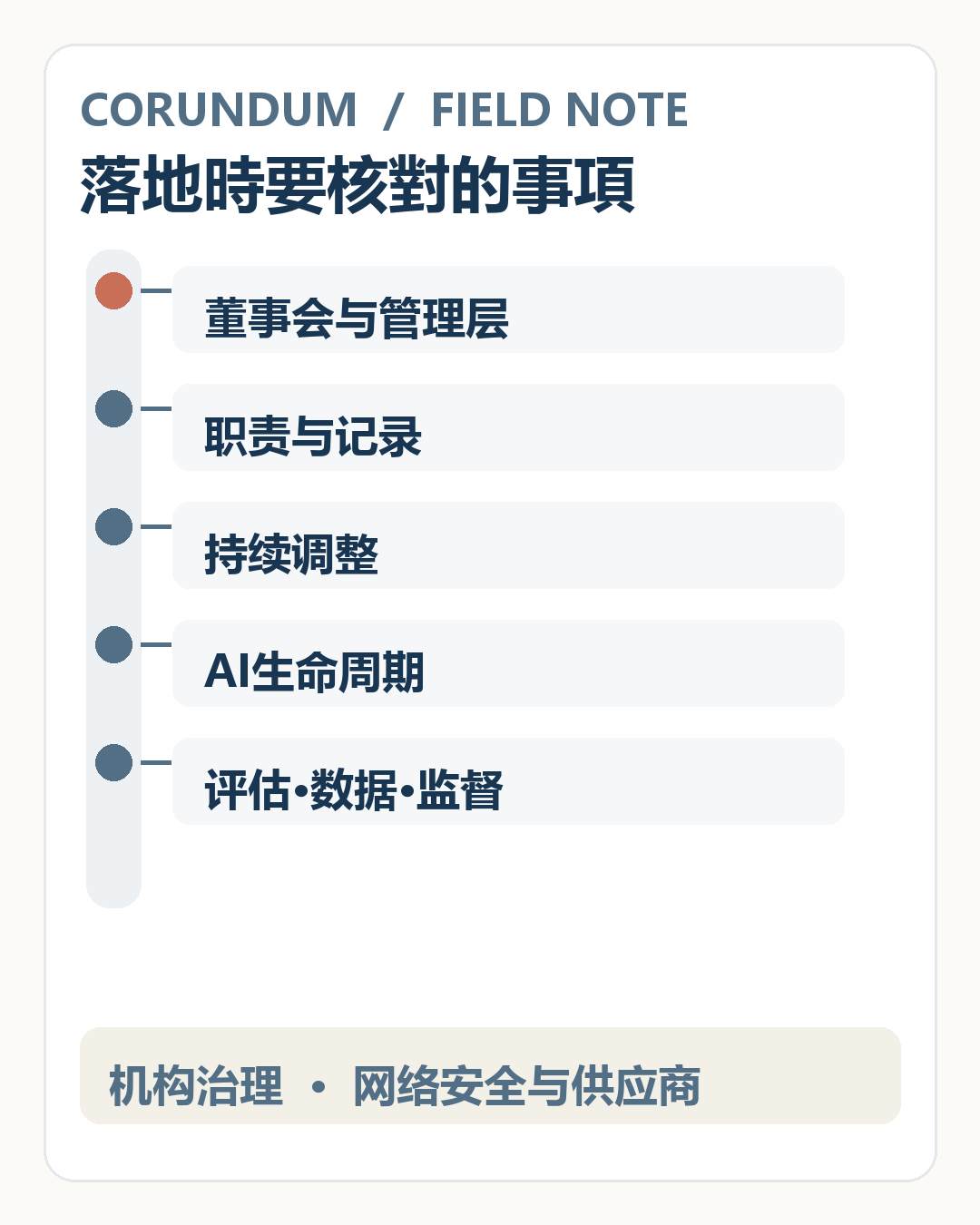
A workable internal process should also distinguish between experimentation and production. Test environments can use de-identified or synthetic data and limit users and call volumes. Before real customer data and business systems are connected, business, technology, security and legal teams should confirm data handling and permissions together. Launch approval is not the end point. Institutions can set review triggers for version changes: replacing a foundation model, connecting a new external tool, expanding to a new customer group or changing the degree of automation should automatically reopen review. Many AI risks appear after the use case gradually expands, even though the original project file still reflects a lower-risk scenario.
Third-party management also needs to be built into procurement and contracting. Institutions should understand what model information a provider can supply, how data is handled, which downstream firms support the service, how customers are notified of material updates and what alternatives exist if a critical service is interrupted. If a vendor provides only partial technical information, the institution can document what it has obtained, what risks remain unresolved and what operational arrangements are in place, then use that record for due diligence and ongoing management.
For agentic AI, institutions also need to define authorization boundaries clearly: what data the system can access, which tools it can call, which actions require employee confirmation and how tasks can be paused if something goes wrong. Supervisors need real intervention rights, enough time and access to execution records.
FSB gives a practical example. If an institution allows an agent to organize customer application materials, it can permit the system to read a designated folder and generate a checklist for verification, while leaving credit-limit changes and external communications to employees. If the same agent is expected to query, write and notify, the system can issue short-lived credentials at different steps and log each call. That turns “using an agent” from an abstract label into an execution chain that can be tested, audited and stopped.
In practical terms, the 12 practices can be condensed into four deliverables: board-approved principles for AI use, a continuously updated inventory of applications and dependencies, assessment and testing records for each material use case, and shutdown and recovery plans for incidents. Those materials connect to one another. The inventory shows management what projects exist. Assessments determine where stricter controls are needed. Testing shows whether controls work. Incident records then feed back into rule changes. Smaller institutions can reuse existing risk meetings and procurement processes, as long as responsibility and evidence remain traceable.
FSB presents the framework as a management reference, not a substitute for local law
FSB describes the 12 practices as a practical tool that can be adjusted to an institution’s circumstances. Firms applying the framework still need to map each AI use case against local requirements on data protection, consumer rights, outsourcing, model risk and financial-institution governance.
The report’s immediate value is that it offers a common governance checklist. From board responsibility and internal documentation to model selection, human oversight and vendor management, institutions can use it to test whether their current processes cover the critical points. As AI moves deeper into financial services, the responsible owners, controls and contingency arrangements behind that checklist will also need to be updated over time.
From an international policy perspective, the framework also gives different jurisdictions a similar set of questions to ask about AI in finance. Regulators may not use the same form, but they will still want to know who bears the risk, how models operate in critical business functions and whether customers are affected when external dependencies fail. Institutions that can produce the evidence described in the report will be in a better position to explain their control arrangements across different data, consumer-protection and prudential regimes.