
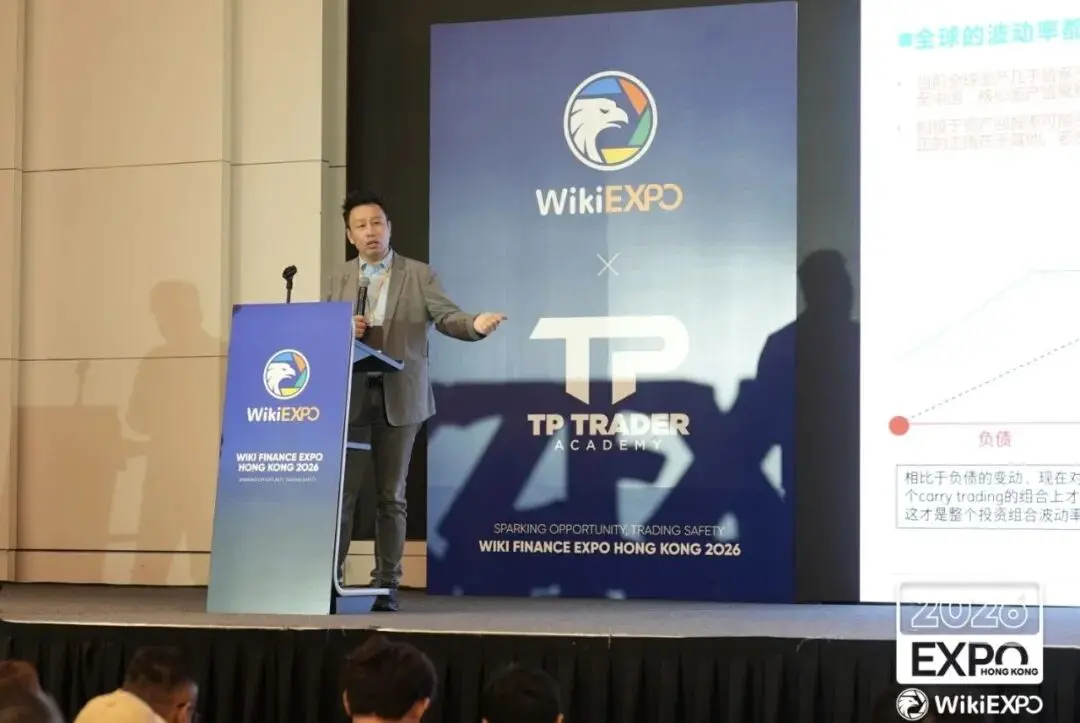
Fu Peng, chief economist at New Huo Group, said in a speech at Wiki Finance EXPO Hong Kong 2026 that mainstream crypto assets remain fundamentally linked to global core liquidity, and that the same liquidity framework now explains the sharp divergence across major asset classes.
According to Fu, interest-rate hikes and cuts alone do not describe the full liquidity backdrop. He broke liquidity into three layers: the amount of money in the pool, the temperature of that money, and how funding pressure is distributed across participants. He said liquidity can be tracked through rates, the yield curve, the Federal Reserve balance sheet and open-market operations, while in day-to-day market practice many traders also use major crypto assets such as Bitcoin as forward-looking indicators of liquidity conditions.
From broad speculation to a shrinking circle of winners
Fu said the period after the 2008 financial crisis saw global liquidity rise toward a peak between 2008 and 2021. After the pandemic in 2020, low rates and central bank balance-sheet expansion created an extreme easing window, and that environment produced what he described as rampant speculation in low-quality assets.
He cited the GameStop retail squeeze in U.S. equities and explosive gains in many low-quality crypto tokens as examples of the same phenomenon: when money is abundant, almost anything can be bid higher. Once liquidity starts to contract, he said, markets move into a "shrinking circle" phase. Capital begins to distinguish between strong and weak assets, and speculative names are dropped first. In his telling, that process of squeezing out the bubble had already started in the second half of 2021.
Fu pointed to the period from the second half of 2021 into 2022 as a clear case study. Bitcoin fell from above $70,000 to around $20,000, while Nvidia lost roughly 64% to 65% in 2022. He described that as a sponge being wrung out, with excess gradually forced out of the system.
He said the real turning point came in November last year. In his framework, 2021 marked the peak of central bank balance-sheet expansion, while late last year became the critical stage where liquidity tightening and balance-sheet runoff overlapped. Tightening does not bite the moment runoff begins, he said. Markets feel the pressure only once the process reaches a threshold.
Fu said Bitcoin was trading around $110,000 in November and December last year. At that time, he said, he even made a wager with Li Lin that crypto assets would likely be cut in half over the following year. If that happens, he said, it would again show that crypto is deeply bound to global liquidity.
The key indicator he highlighted for that period was the Fed’s Standing Repo Facility, or SRF. In his view, the signal from that tool was that balance-sheet runoff had moved close enough to a critical point for structural funding stress to appear. He argued that when banks tighten credit and liquidity contracts, stress is not spread evenly. It hits highly leveraged and weaker borrowers first, while the strongest institutions can still remain well funded.
That layered transmission produces the shrinking-circle trade, he said. Investors sell peripheral and liquidity-sensitive assets first and concentrate capital in the most central assets with the highest perceived certainty.
Fu said many retail crypto traders make a basic mistake when they assume that if crypto has no momentum, money simply rotates into U.S. stocks. In a genuine tightening cycle, he argued, capital cuts high-beta and highly speculative exposures from portfolios first. Crypto and small-cap thematic shares are both early candidates for reduction. When liquidity is plentiful, the market is willing to chase weak assets. When liquidity is scarce, capital narrows toward what it sees as the few genuine core assets.
AI’s old valuation rule is breaking down
Fu said global money since November last year has kept clustering around one long-duration productivity theme: artificial intelligence. He compared the AI investment cycle to a heavy fixed-asset buildout and used China’s earlier infrastructure cycle as an analogy.
He walked through that comparison in detail. In 2001, the central market topic was large-scale infrastructure construction in China. In 2002, development direction was set at the country’s annual legislative meetings. By 2003, central fiscal funding and land-finance support had been put in place, and road and bridge projects moved forward nationwide. In 2004, institutional portfolios were focused on upstream infrastructure names such as Sany Heavy Industry and Anhui Conch.
Fu argued that the same industrial logic applies to AI despite the change in label. After ChatGPT and similar products pushed enterprise demand into view, global technology companies started a concentrated digital infrastructure buildout in 2023, centered on compute and data centers. That spending wave benefited hardware, storage, optical modules and HBM memory. In his analogy, Samsung Electronics, SK Hynix and Taiwan Semiconductor Manufacturing Co. play roles similar to steel, cement and heavy equipment suppliers in a traditional infrastructure cycle.
Still, he said the second quarter of this year marks a key turning point for the whole chain, especially with liquidity tightening happening at the same time. After Google released earnings, he said, experienced investors could see that the market logic that dominated the previous two to three years was losing force. In 2023, 2024 and 2025, the rule had been simple: if internet platforms increased AI infrastructure spending, the market rewarded them with higher valuations. This year, even with capital expenditure still growing quickly, share prices have been falling after results.
Fu tied that shift to one metric above all: free cash flow. In his view, the most important signal in Google’s report was that free cash flow had gone to zero, and he extended that point to the broader group of leading companies making heavy AI infrastructure investments. Investors who still assume that rising capex automatically leads to rising equity prices are using an old framework, he said.
He said valuation has switched from rewarding the size of investment to asking whether the infrastructure build can generate sustained traffic, revenue and a path to payback. Zero free cash flow, in his framing, marks the move from phase one of the AI cycle into phase two. If companies want to keep raising spending from here, they need outside funding through stock issuance or debt. That raises the cost of capital and makes investors much stricter.
Fu offered a more precise tracking measure: the ratio of capex to cloud revenue growth. He put Google’s figure at about 1.9, meaning 1.9 units of infrastructure investment are producing 1 unit of cloud revenue. That, he said, is one of the main reasons the market is no longer willing to keep assigning very high valuations.
With tighter funding conditions and global capital still crowding into only a few high-conviction assets, he said, the transition in the AI industrial cycle makes bigger market swings hard to avoid.
Nvidia, memory stocks and the leverage problem
Fu used Nvidia to map the broader industrial cycle. He said 2022 was the starting point when Nvidia’s cycle was recognized, with the company’s market value falling from the trillion-dollar level to the hundred-billion-dollar range. After ChatGPT took off, Nvidia entered a clear value-growth stage in 2023 and 2024. Earnings kept improving, global AI capex pulled in more orders, market value moved through $1 trillion, $2 trillion and $3 trillion, and volatility stayed low with almost no deep pullbacks.
But Fu said he warned major financial institutions about the risk after returning from a research trip to Singapore in June 2024. The company itself, the industry’s supply-demand picture and the underlying business were not the problem, he said. The problem was off-exchange financial leverage.
He pushed back on the idea, common among younger investors, that stock prices must always align tightly with current fundamentals. Markets trade expectations, he said, and those expectations can run well ahead of reported conditions. HBM shortages and supply tightness may be real, but that does not guarantee a stock keeps rising. Earnings and capacity data describe the present. Prices trade the future.
Fu pointed to July 2024, when Nvidia fell 20% in just a few trading sessions and Japanese stocks dropped 10% in a single day. He said many analysts blamed the move on a Bank of Japan rate increase and the unwinding of yen carry trades. In his view, that only described the surface. The deeper issue was that global capital had crowded into a very small number of high-certainty assets, and extreme certainty bred extreme greed.
He used a card-game analogy to explain the point. If one player knows he holds a six against the other player’s five, an ordinary retail participant may go heavily long, but a professional trader may try to use full leverage. His summary was simple: certainty breeds greed, and greed expresses itself through leverage. Once leverage builds to a critical point, violent swings and fast drawdowns become inevitable.
Fu said similar behavior is visible today in some memory-chip stocks. He said there is no major industry negative, operations are stable, orders are full and earnings continue to grow, yet prices still suffer repeated sharp drops. He referred to young traders in South Korea who can show large gains one day and heavy losses the next. The issue, he said, is not Samsung, not SK Hynix and not HBM supply-demand dynamics. It is excessive leverage inside the market.
That is the same underlying mechanism as Nvidia’s sharp break in July 2024, he said. High-certainty assets create leverage bubbles, and once leverage reaches the threshold, the trade breaks. He gave a simple warning sign: when newly graduated, inexperienced young investors start using all of their money and leverage to go all in on Samsung or SK Hynix, risk is already close.
Fu said this matters because the market has been in a period of contracting capital for years. Investors broadly know where the few core assets are, but the danger now sits less in industrial fundamentals and more in liquidity and leverage.
On the broader U.S. equity market, he said a sideways range for the major indexes this year would already count as an optimistic outcome. He acknowledged that U.S. stocks fell in March and rebounded in May and June, but said that rebound was an extreme structural move, with only a small number of names lifting the index while most shares kept drifting lower. He said the pattern in China’s A-share market over the past year has been similar, adding that 55% of listed stocks were trading below the levels associated with 3,000 points and that the index was being held up by only a few AI leaders.
His summary of the current setup was direct: liquidity is tightening, market divergence is severe, and the AI industrial cycle has reached a critical turning point. He stressed that the long-term AI story has not changed and that productivity upgrades remain the main theme, but said investors cannot just hold AI names blindly through every phase of the cycle.
A five-layer framework and less emphasis on macro dissection
Fu said he uses a five-layer framework made up of industry, economy, inflation, liquidity and markets. At the current stage, he said, industry, liquidity and market structure matter most, while the weight placed on macroeconomic analysis has fallen significantly.
Asked whether investors still need to dig deeply into the U.S. economy, he said the answer is no. U.S. companies are still carrying out large-scale capital spending, while the household sector completed deleveraging back in 2008. In short, he said, the key feature of the U.S. economy is resilience.
Global allocation and the AI supply chain map
At the market level, Fu said AI is the only true global theme. In his view, the core investable markets ahead are Japan, South Korea, Taiwan, mainland China and the United States. Outside those areas, he said, allocation value is very limited. In Europe, he singled out ASML as the only name worth particular attention.
He argued that the performance of South Korean equities has little to do with South Korea’s domestic real economy, and he said the same is true for Japan. Looking at Japan’s stock market more closely, he said, the core assets are upstream equipment makers tied to the AI supply chain. Investors focus on Samsung and SK Hynix, but the key production equipment those companies buy comes from Japanese firms, which makes the chain highly integrated from top to bottom. In Taiwan, he said, TSMC is the only true core asset of that scale.
Fu described AI as a productivity-driven industrial investment theme with a fixed cyclical structure. The point investors need to remember, he said, is that the moment when major technology companies’ free cash flow falls to zero marks an important inflection point. Before and after that point, the pricing logic for the whole asset set changes.
He divided the AI chain into upstream, midstream and downstream segments and said each one has its own life cycle, sector rotation and allocation window. Investors should not treat AI as a belief system and hold blindly forever, he said. The market’s consensus that AI is the next major productivity engine does not mean any single stock is a permanent hold at any price.
On Nvidia specifically, he said the company’s phase of rapid growth as the core upstream hardware name has largely passed and that it moves into a mature blue-chip stage from 2025, which helps explain why the size of its gains has narrowed since last year. He added that Samsung and SK Hynix are likely to enter a mature phase as well, with growth shifting gradually from upstream hardware to downstream applications.
Fu laid out a longer timeline for the AI cycle. In his projection, upstream hardware led the market in 2022, software valuations will go through digestion and reshaping in 2026, and terminal applications will face valuation adjustment and repricing around 2030. He estimated the full AI super-cycle at roughly 20 to 25 years, with 10 years already completed. The first decade was dominated by upstream hardware infrastructure, and the next decade will center on end applications.
Even so, he said there is a current discontinuity in the cycle. The next 10 to 18 months should be treated as a transition window, not as a period for all-in positioning. He also distinguished between AI coding tools and developer-assistance products on one side and real end-user applications on the other, saying the two belong to different layers of the industry and should not be valued the same way.
Karen Warsh and the end of the old central bank backstop
Fu ended by returning to liquidity and connecting it directly to crypto. He said incoming Federal Reserve Chair Karen Warsh is a critical signal because her arrival marks a break from the central bank policy framework built after the 2008 financial crisis under Ben Bernanke.
Fu said he wrote in January that the personnel change points to a return to a pre-2008 policy path. He reviewed the background this way: the 2008 crisis exposed major systemic risk, and policymakers drew lessons from the Great Depression of 1929, concluding that a pure free-market approach could not stabilize itself in a crisis. That led to broad adoption of Keynesian-style stimulus after 2008.
He said Bernanke, Janet Yellen and other Fed leaders all worked from the same basic principle: when a financial crisis erupts, the central bank must step in to stabilize markets. But, he added, every policy has two sides. Market support can calm panic and prevent a repeat of depression-style collapse, yet a long-running and open-ended safety net also encourages speculation and inflates large asset bubbles.
Fu referred to the so-called "Fed put," the idea that investors buy dips because they expect the central bank to rescue the market. When the whole market comes to believe that gains belong to private investors while losses are socialized through central bank support, asset prices become seriously stretched, he said.
In Fu’s reading, the core message in Karen Warsh’s public remarks can be reduced to one line: central banks should stick to their statutory duties. Those duties are to stabilize employment and control inflation, not to provide a permanent floor under equity markets. As technology advances and productivity improves, he said, conditions now exist for central banks to step away from long-term market backstopping.
He compared that shift to parenting. Once a child reaches high school and can function independently, parents should stop handling everything for them. Fu said many market participants have reduced Warsh’s arrival to a simple debate over rate cuts or balance-sheet policy, but the central issue is balance-sheet runoff, not short-term rates. The real challenge is how to complete runoff in an orderly way and return central banking to the standard role it held before 2008.
That, he said, means the longest and largest wave of global liquidity easing in modern history, running from 2008 until Warsh’s appointment, is over. Investors should not expect a repeat over the next five to 10 years of the broad, tide-lifts-all-assets environment seen between 2008 and 2026. Capital will flow back toward assets with real long-term value, and investment strategy will shift away from broad diversification across everything and toward a smaller set of high-quality core holdings.
Crypto’s maturing market structure
Fu said crypto will go through the same change. Traders are already seeing Bitcoin and Ether market capitalizations stabilize, volatility come down, market liquidity improve and the investor base become more institutional, he said. In his framework, those are classic features of core assets that remain after speculative excess has been flushed out.
He added that the old narrative centered on low-quality speculative crypto tokens has already failed. Liquidity remains the top variable across all financial assets, he said, and once investors understand the liquidity framework first, industry and company-level analysis become much easier to organize.
Fu closed by saying the session was too short to unpack every part of his five-layer framework in detail, but that he hoped to leave the audience with the underlying logic and the method. Once that foundation is clear, he said, short-term market fluctuations become easier to place in context.