
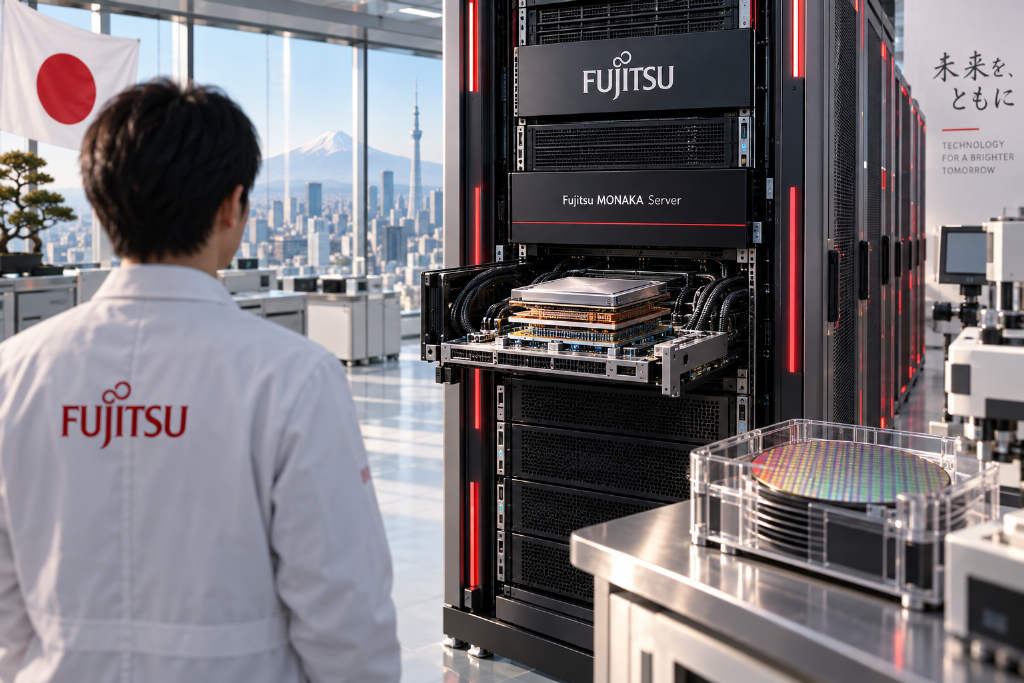
Fujitsu announced on Sept. 14 that it is starting sales of its in-house next-generation CPU, FUJITSU-MONAKA, and is launching a domestic AI server built on the chip, the Fujitsu MONAKA Server. The processor is being mass-produced on Taiwan Semiconductor Manufacturing Co. (TSMC) 2 nm technology, and its technical foundation comes from Fugaku, the supercomputer developed jointly by Fujitsu and Japan’s RIKEN.
The release marks a fresh attempt by a Japanese company to re-enter the global server CPU market with a homegrown processor after years away from that field.
2 nm process and 3D stacking are at the center of the MONAKA pitch
Fujitsu said MONAKA is the world’s first CPU to combine a 2 nm manufacturing process with a 3D stacked architecture. The chip uses a heterogeneous integration approach: compute cores are built on 2 nm, while cache and I/O are produced on 5 nm, matching different functions with different process technologies to balance performance and cost efficiency.
MONAKA uses the Arm instruction set architecture, integrates SVE2 vector processing, and includes Fujitsu’s own ultra-low-voltage operation technology. The chip runs at up to 3.8 GHz and has a memory transfer rate of 8800 MT/s.
For AI inference, Fujitsu said MONAKA uses dedicated matrix instructions for hardware acceleration and delivers twice the inference throughput of comparable CPU rivals. On security, the company said the chip includes Arm CCA confidential computing capabilities, aimed at protecting data and applications in memory in cloud and multi-tenant environments.
Fujitsu MONAKA Server arrives in 1U and 2U versions
Fujitsu also introduced the Fujitsu MONAKA Server at the same time. The server is manufactured at the company’s Kasashima plant in Ishikawa Prefecture, with design, development and production all completed in Japan.
The system comes in 2U and 1U configurations, designed for AI agent and AI inference workloads respectively. The 1U model adds Compute Express Link, or CXL, support, allowing memory and accelerator resource pooling across servers. Fujitsu positioned that as a way to keep pace with larger AI models in the future.
On cooling, the company said the server can operate in air-cooled environments at 40°C ambient temperature and in liquid-cooled environments at 45°C water temperature. Fujitsu said the design can cut server cooling power consumption by as much as 80%, reducing pressure on data center energy use.
Global chip shipments start in November, with Japan and Europe first for servers
Fujitsu said MONAKA CPUs will begin shipping in November to global cloud operators, data center operators and server manufacturers. The MONAKA Server will first target Japan and Europe, with enterprise customers, research institutions and the defense sector as priority markets.
According to the company, 24 Japanese firms in finance and telecommunications have completed deployments of test machines, and more than 40 companies are discussing adoption.
Overseas, Fujitsu said it has signed a supply agreement with U.S. server manufacturer SuperMicro. The company plans to enter the U.S. and Asian markets in 2027, with U.S. hyperscale cloud service providers as a target group.
TSMC handles the current generation, while a 1.4 nm successor may involve Rapidus
TSMC is producing the current generation on its 2 nm process. For the next-generation 1.4 nm product expected in 2029, the report said production could shift to Japanese foundry Rapidus, although Rapidus’ mass-production capability remains uncertain.
Fujitsu ties the chip launch to a broader sovereign AI push
Fujitsu framed the move as larger than a chip launch. The company plans to use MONAKA as a starting point and connect it with its Fujitsu Kozuchi AI platform and its enterprise generative AI offering, Takane, building an integrated stack that runs from AI infrastructure to platform and services. The stated goal is a full sovereign AI foundation.
Japanese companies have tried several times to enter the CPU market, but those efforts did not dislodge U.S. vendors such as Intel and AMD from their grip on the server CPU business. Fujitsu is now trying again with technology accumulated through Fugaku, advanced mass production from TSMC, and Japan’s longer-term push for semiconductor and AI self-reliance.