
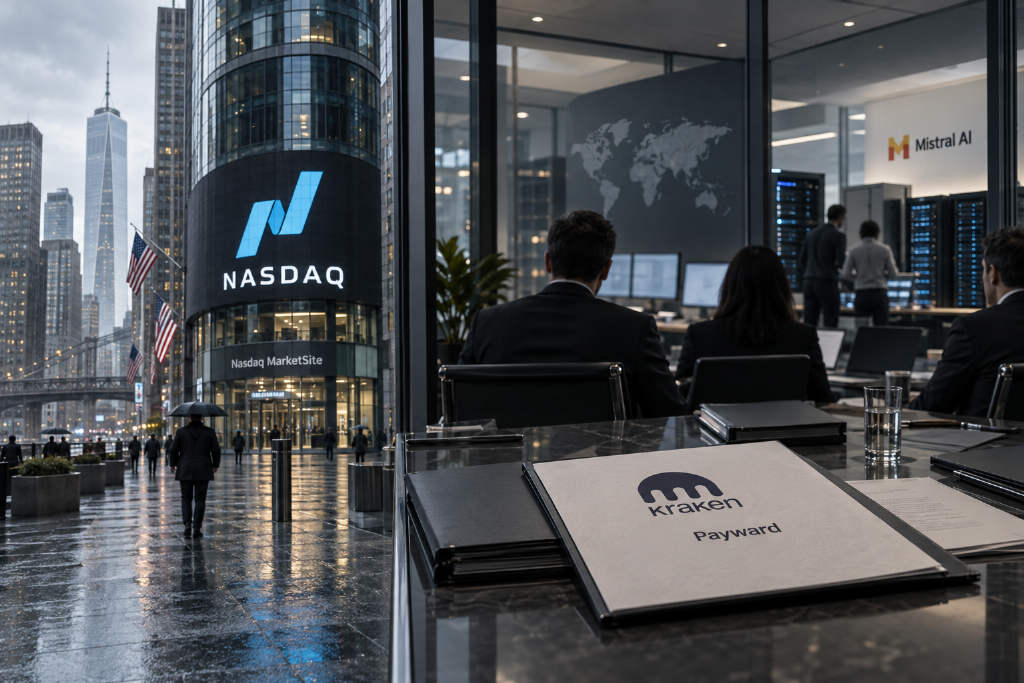
Capital in crypto kept flowing toward stablecoin payments, compliance infrastructure, and the overlap between traditional finance and digital assets last week, while AI investors stayed focused on infrastructure-heavy bets. PANews said Nasdaq invested $100 million in Payward, the parent company of crypto exchange Kraken, and Mistral AI closed a €3 billion Series D at a post-money valuation above €21 billion.
According to PANews’ incomplete tally, the global blockchain sector logged eight financing events during Sept. 7-13, with disclosed funding topping $158 million.
Crypto funding snapshot
PANews highlighted five headline items in the crypto market for the week: Antarctic Exchange raised $7 million; Latitude completed a $35 million Series A; Agentum raised $7 million; Nasdaq invested $100 million in Payward at a $21 billion valuation; and Circle said it would acquire Tazapay in a stock deal valued at $400 million.
DeFi
Singapore-based decentralized perpetuals exchange Antarctic Exchange raised $7 million at a $70 million valuation. Backers include Valisa Capital Markets, Lucidity Capital, Republic Crypto, and proprietary traders making their first move into crypto assets.
The platform targets retail derivatives traders and offers tools designed to resemble those found on centralized exchanges. Its founding team includes former executives from OKX, Binance, and MEXC.
Infrastructure and tools
Latitude, a company building cross-border stablecoin payment infrastructure, raised a $35 million Series A led by Oak HC/FT. NEA, Coinbase, Lightspeed Faction, and OpenFX also joined the round.
The company was founded by former executives from Stripe, Uber, Coinbase, and Meta. It aims to help businesses send fiat to users in emerging markets through stablecoins while settling locally through methods such as bank accounts and mobile wallets.
TRM Labs, the San Francisco-based crypto crime tracking company, received a follow-on investment from existing investors just six months after raising $70 million in a Series C in September 2025 at a $1 billion valuation. Its valuation has now doubled to $2 billion.
Chief executive Esteban Castano said the company’s mission has broadened from blockchain forensics to mapping cybercrime more widely. He said AI has become a second growth engine rather than a pivot, and that the core crypto business remains strong. TRM Labs is preparing to launch a new investigations platform focused on AI-driven deepfake fraud, sextortion, and child sexual abuse cases.
Castano also said broader crypto adoption makes it possible to map criminal networks more comprehensively. He expects the company to reach a $100 million annual recurring revenue milestone in the coming weeks. TRM Labs has about 500 employees and offices in London, Singapore, and Washington.
IOSG Ventures said it invested in crypto payments infrastructure company Immersve, which is focused on connecting stablecoin balances to everyday consumer payments.
Immersve is a Mastercard principal member. Through a non-custodial clearing and settlement structure, it links stablecoin wallets to existing merchant acceptance networks. The company has already provided crypto card programs for Binance, Bitget Wallet, and KuCoin, allowing users to spend USDC and other stablecoins directly at merchants that accept Mastercard.
IOSG said the GENIUS Act in the U.S. has clarified the status of stablecoins as payment tools, and monthly spending on crypto cards exceeded $1.04 billion in July this year. In its view, stablecoins are moving faster toward becoming infrastructure for everyday global payments.
Web3 and AI
Agentum, an autonomous AI agent economic layer in the BNB Chain ecosystem, raised $7 million from MEXC Ventures, BingX Labs, Arca Fund, Wave Digital Assets, Echo3, Greenwood Global Capital, UZ capital, and Vega Ventures.
The company describes itself as a trust and settlement layer for AI agents. It is designed to let AI agents publish tasks, bid for work, execute jobs, and settle payments on-chain without human intervention.
Built on BNB Chain, Agentum combines on-chain identity, collateralized bidding, escrow, staking, portable reputation, trusted execution environments, and zkVM-based verification to build trust and accountability among autonomous agents.
Centralized finance
Nasdaq Inc. is investing $100 million in Payward, the parent company of Kraken. The investment comes as Nasdaq continues building infrastructure to support tokenized stock trading.
The funding, made through Nasdaq’s venture arm, values the crypto company at $21 billion and deepens the relationship between the two companies after a partnership announced in March.
Other Web3 deals
Web3 AR mobile game RealGo said it completed a $6 million strategic round from UZ Capital, GW Global, and Infiniteall AI, bringing total funding to $9.5 million.
The new capital will go toward core product development, global team expansion, and AI exploration. The company said it is refining a meme ecosystem built around AR, AI, location-based services, mobile gaming, and on-chain assets. RealGo is a Web3-based augmented reality mobile game that uses AI, AR, and location services to turn physical locations into interactive playgrounds.
Geo-DePIN project TINA raised $3 million from THINKWARE, Gemhead Capital, Archer Capital, Astra Capital, Mayer Venture, and Tidal Capital.
TINA said it will use the proceeds to expand TINAGeo globally, grow its dashcam ecosystem, and advance Geo-DePIN data infrastructure. Built on Solana, the project rewards users for contributing and verifying POI location data and for collecting spatial data through daily driving. It is also working with THINKWARE on the TINAGeo Dashcam to push forward its Drive-to-Earn model.
M&A
Stablecoin issuer Circle said it will acquire cross-border payments platform Tazapay in an all-stock transaction valued at $400 million. The deal is expected to close in 2027, subject to regulatory approval.
Tazapay is headquartered in Singapore and holds a Major Payment Institution license there. It is registered in India, the U.S., Canada, and Australia, and is seeking licenses in the UAE, the EU, and Hong Kong. The company processes more than $25 billion in annualized payment volume, with roughly 60% of that tied to stablecoins.
Since 2020, Tazapay has raised about $68 million in total. Circle participated in its 2025 Series B and 2026 Series B+ rounds. Tazapay was also among the first partners in the Circle Payments Network, and the two companies had already worked closely on a stablecoin-based cross-border payments network.
Data analytics and indexing platform Bilinear Labs said it has been acquired by Sei Labs. Its team will join Sei Labs to work on Sei Network, Sei Giga, and related projects.
Bilinear Labs will stop operating on Sept. 14. The platform was built in Rust, had indexed hundreds of billions of events, and introduced BYOABI technology.
Selected AI and robotics financings
Models and AI infrastructure
French AI company Mistral AI said it completed a €3 billion Series D at a post-money valuation above €21 billion. The company called it the largest equity financing ever completed by a European technology company.
Samsung Electronics led the round, with EQT-managed Scaleup Europe Fund and existing investor PSG Equity as co-leads. New investors include Advent, funds and accounts managed by BlackRock, and the Grand Duchy of Luxembourg. Existing investors that also participated include Andreessen Horowitz, ASML, Belfius, BNP Paribas CIB, Bpifrance, Carmignac, DST Global, Eurazeo, General Catalyst, Headline, Hillspire, Index Ventures, Korelya Capital, Lightspeed, NVIDIA, Phoenix Court’s Solar Fund, including LocalGlobe, Latitude and Solar, and Salesforce Ventures.
The company said the capital will be used for frontier model research, compute and infrastructure expansion, commercialization, and international growth. Mistral AI currently operates in 20 countries and serves more than 125 enterprises, including Airbus, ASML, and HSBC.
AI chip startup Positron said it raised $875 million at a $5 billion valuation, a sharp jump in value over the past six months.
The round was co-led by NEA, Atreides Management, Valor Equity Partners, Andra Capital, SemiAnalysis Capital run by analyst Dylan Patel, and Netscape co-founder Jim Clark. Positron had raised $230 million in February at a $1 billion valuation.
The company said it has delivered around 50 racks of its previous-generation Atlas servers to Oracle. Other customers include Jump Trading and AI company Parasail. Positron is trying to gain ground in the crowded chip market by getting products to market quickly.
AI chip startup Celero Communications raised $275 million at a valuation above $3 billion. The round was co-led by Atreides Management, Valor Equity Partners, and CapitalG, Alphabet’s venture arm.
Founded in 2024, Celero develops coherent digital signal processors for fiber-optic data transmission in AI systems. The technology is meant to improve high-speed data transfer between data centers and across server racks within a single data center, helping build larger AI chip clusters. Atreides managing partner and chief investment officer Gavin Baker will join Celero’s board.
AI 3D company VAST said it completed its Series B and B+ rounds, raising a combined roughly 3 billion yuan, led by Matrix Partners China. Perfect World, BlueFocus, Xindongneng Investment, Yanqu Game, ThunderSoft, 37 Interactive Entertainment, VGC under CDH, CICC Capital, and CMC Capital joined the round, while existing investors including Fortune Capital, Primavera Capital, and Ince Capital continued to invest.
According to the company, VAST has raised about 5 billion yuan in less than six months. It also released the latest version of its flagship 3D foundation model, Tripo P2.0. The funding will support upgrades to native 3D models and data capabilities, buildout of training and inference infrastructure, product development, and commercialization.
AI applications and agents
AI coding startup Cognition AI raised $2 billion in a new round that lifted its valuation to $48 billion. The round was led by Andreessen Horowitz, Accel, Founders Fund, General Catalyst, and Avenir. Three months earlier, the company had been valued at $26 billion.
Cognition said annualized revenue climbed from $492 million in May to nearly $900 million. Its core product is the AI software engineering agent Devin.
Enterprise AI company Clay raised $115 million in a Series D led by Wellington. Sequoia Capital, StepStone, Andreessen Horowitz, Perennial, Meritech, DST, and CapitalG also participated. The post-money valuation rose to $7.1 billion.
Clay said its AI agents can use external data such as CRM inputs to build real-time business and customer profiles, then automatically create and execute workflows based on enterprise goals. Anthropic, Google, OpenAI, and Stripe are among its users.
AI wealth management company Savvy Wealth raised $100 million in a Series C at a $600 million valuation, led by Halo Fund. Existing investors including Thrive Capital, Industry Ventures, and Index Ventures also participated. Its total financing to date has surpassed $200 million.
The company said its AI wealth management platform, Savvy Intelligence, uses large language models from OpenAI and Anthropic to train AI agents that integrate investment, tax, and financial planning data. The new money will mainly be used to expand software products for wealth advisors.
AI-native CRM company Lightfield raised $47 million in a Series A led by Andreessen Horowitz. Maverick Capital, Coatue, Greylock, Lightspeed, Audacious Ventures, and Alumni Ventures also joined, alongside founders and individual investors including Guillermo Rauch, Immad Akhund, Mati Staniszewski, Jeff Wang, Scott Belsky, Avichal Garg, Nick Talken, and Zack Kisner.
The company said the proceeds will be used to speed up growth and expand AI agent capabilities. Lightfield focuses on automatically integrating customer interaction data and building a company “world model” that enables agents to find leads, move deals forward, and manage clients. Since launching in November 2025, more than 5,000 companies have registered.
AI agent terminal project Herdr raised $6 million in seed funding led by Bessemer Venture Partners. Y Combinator, e2vc, and Shopify CEO Tobi Lütke also participated.
The company said the funding will go toward improving the performance, stability, and scalability of the Herdr runtime, while building a team focused on Rust, terminal products, and AI agents.
AI M&A
Meta Platforms acquired Swedish AI startup Stilla.ai to speed up development of Meta Business Agent.
The AI agent is used to help merchants interact with customers on WhatsApp, Messenger, and Instagram and drive transactions. Meta said it wants to improve chatbot capabilities so businesses can convert customer inquiries into purchases more effectively. After the transaction, Meta also plans to expand its business presence in Sweden.
Stilla was founded in 2024 and is headquartered in Stockholm. It emerged from stealth in January this year and completed a $5 million pre-seed round. Following the acquisition, the Stilla team and its technology will be folded into Meta.
The deal points to Meta’s push to weave AI deeper into the commercial system built around its messaging ecosystem. Over the past decade, the company has built infrastructure linking merchants to the billions of users across its messaging apps. More than 1 million businesses now use Business Agent to handle customer interactions.