
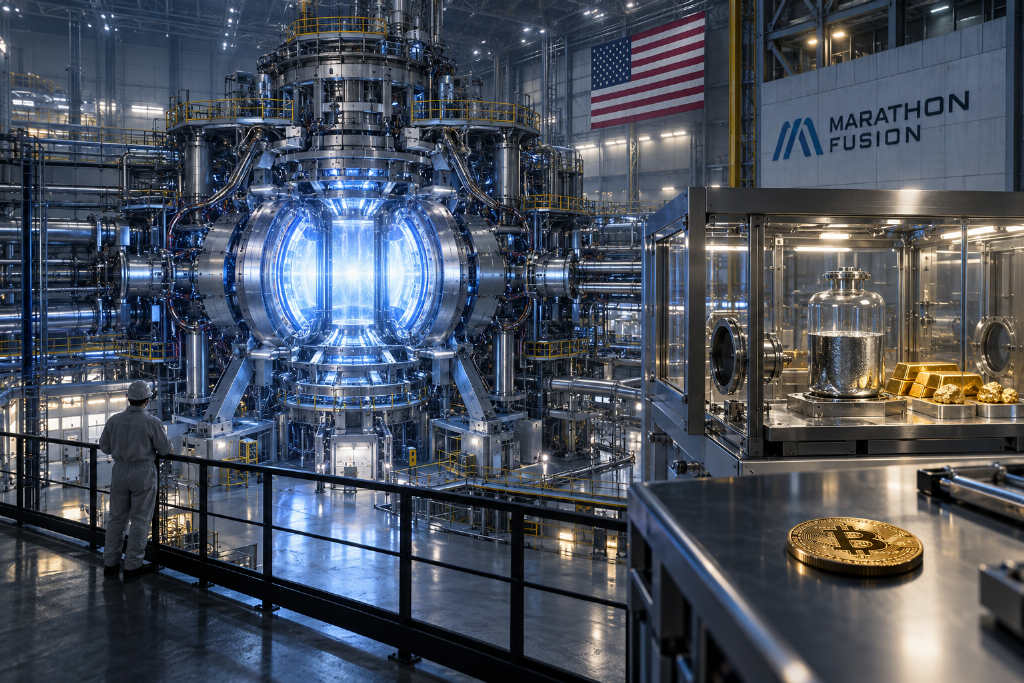
US fusion startup Marathon Fusion says it has produced gold from mercury, reviving a question that sits at the intersection of commodities and crypto: if gold supply can one day be expanded by technology, would Bitcoin’s scarcity look even stronger by comparison?
The company is not describing a chemical shortcut. In its research paper, Marathon says high-energy neutrons from a deuterium-tritium fusion reaction can irradiate mercury-198, creating a radioactive isotope that later decays into stable gold-197.
That has led to a broader market discussion. If gold were ever to face what some have called an “infinite mint bug,” the metal’s long-standing scarcity narrative could come under pressure. Bitcoin, by contrast, has a protocol-enforced supply cap of 21 million coins.
Armstrong says Bitcoin’s supply cap cannot be engineered away
Coinbase CEO Brian Armstrong said the development could ultimately favor Bitcoin. He compared the creation of “net-new gold with alchemy” to the lab-grown diamond business.
“But you can’t invent anything that will increase Bitcoin supply,” he said. “There will only ever be 21M.”
Marathon co-founder and CEO Kyle Schiller told Cointelegraph Magazine that the company has already seen strong interest from jewelers.
“We have gotten a shocking amount of interest from people who want to do jewelry,” Schiller said. “As with regular gold, I think it’ll be mostly used as a store of value.”
Still, the company’s result is far from proving that gold can be produced cheaply and at industrial scale.
Nikos Kavalis, managing director at precious metals research firm Metals Focus, told Magazine: “We are nowhere near a stage where we can talk about production significance.”
Scientifically plausible, but industrial economics remain open
The nuclear pathway may be scientifically credible. Turning that into an economical industrial process is a separate challenge.
Marathon said it produced stable gold at a rate 10 times CERN’s record. CERN, the European particle physics laboratory, uses powerful accelerators to study the building blocks of matter.
But CERN’s ALICE experiment produced only an estimated 29 picograms of gold nuclei during its 2015–2018 run, and those nuclei survived only for fractions of a second before being destroyed in collisions.
Marathon has not publicly disclosed the exact quantity produced in its own experiment. Research engineer Jake Harter told Magazine that the amount remains extremely small, “right now still microscopic,” though the company hopes to reach “macroscopic milligram quantities in 2027.”
That means the larger figures in Marathon’s paper are projections for a future fusion power plant, not current output.
The paper models about 2 tonnes of gold production per gigawatt of thermal fusion power each year. For context, the World Gold Council said global mines produced 3,672 tonnes of gold in 2025, so even one future fusion plant at that level would still represent a modest addition relative to worldwide mine supply.
Harter said the company would also need to scale production of the enriched mercury used in the process, and it would need to build the fusion reactor itself.
“In the process of maturing this technology, we’ll also be working on studies demonstrating materials compatibility, mercury pumping and gold extraction,” he said.
Can fusion gold follow the lab-grown diamond model?
The comparison with lab-grown diamonds is easy to see. Wholesale prices for lab-grown diamonds have fallen by more than 90% since 2018 as production scaled. Unlike older substitutes such as cubic zirconia, newer lab-grown diamonds are chemically identical to mined diamonds while selling at a fraction of the price.
Whether gold could follow the same path is less clear.
Nagham Hassan, a market analyst at investment platform eToro, said the comparison is understandable, but “the economics are completely different.”
Diamond production became cheaper as factories scaled up, she said, while producing gold through nuclear fusion “would require highly complex infrastructure that does not yet exist commercially.”
There is another complication: the gold produced would be radioactive.
“The gold would need to be stored for a bit over a decade before dropping to banana-levels of [radio]activity,” Harter said. He added that because most gold is “just stored as an investment,” he does not see that as a major barrier to earlier commercialization.
The larger issue is whether the economics will ever work.
“There is no demonstration that the process is commercially viable,” Kavalis said. “There are theoretical revenue projections, but nothing about what it will cost to run the reactors.”
Would Bitcoin gain if gold became less scarce?
Bitcoin is often described as digital gold because its supply is limited by protocol rules and capped at 21 million. Armstrong’s argument is straightforward: no one can invent a way to fabricate additional Bitcoin beyond that limit.
If a future technology created another source of gold supply, that could in theory put downward pressure on gold prices.
Fabian Schär, professor of distributed ledger technology and fintech at the University of Basel, told Magazine: “For any asset, a substantial increase in available supply would, other things being equal, put downward pressure on its market price.”
Even so, the report does not suggest an immediate market shift. The first fusion reactors are estimated to be at least a decade away, and major questions remain around commercial viability.
For now, Marathon’s work looks more like an intriguing experiment with possible future applications than an imminent threat to the gold market. By extension, any near-term boost to Bitcoin from this development also appears unlikely.


