

Galaxy said in a research report first sent to clients on Oct. 22 that it sees Bitcoin’s bear market as having ended in June, with the asset now trading through an accumulation phase that has preceded earlier advances. The report, later translated and published by Odaily, argues that this is a favorable point to buy and hold Bitcoin.
Galaxy’s core case for Bitcoin
The firm’s argument rests on four pillars. On the technical side, the 200-week moving average held as support and the 50-week moving average has now been reclaimed for five straight weeks. In positioning, short-term selling pressure has faded, while basis traders and macro speculators have cut more than half of their ETF and futures exposure. On fundamentals, Galaxy points to a roughly $2 trillion U.S. fiscal deficit, Treasury yields around 5%, and what it describes as rising pressure for currency debasement. On sentiment, it says the market has shifted for a third time toward “blockchain, not Bitcoin,” and that the previous two shifts happened near cycle bottoms.
The report also spells out what would force a change in view: a weekly close back below the 50-week moving average, followed by a failure to recover it within one month; spot Bitcoin ETF holdings falling below a key low; a clear and time-bound path toward cryptographically relevant quantum computing; or U.S. fiscal tightening.
When the market stops talking about Bitcoin
The author said a blockchain conference in South Korea late last month brought that pattern back into focus. Interest in digital assets was strong, but the agenda centered on the convergence of digital assets and traditional capital markets, with sessions on tokenization, real-world assets, stablecoins and upgrades to payment infrastructure. The author joined a panel focused on Bitcoin and crypto markets.
That experience was compared with the 2018 Consensus conference in New York, where many attendees from the major consulting firms were more interested in enterprise blockchain projects such as R3’s Corda and IBM’s Hyperledger. After Bitcoin’s sharp rise and pullback in 2017, attention moved away from Bitcoin and crypto toward blockchain as a more mature and safer concept.
The report says a similar mood was visible in 2015 and 2016, when the author was at Fidelity. At the time, few people wanted to discuss Bitcoin, while bankers were eager to discuss blockchain. The combination of the Silk Road episode, the ICO boom and the practical value of the underlying technology pushed financial institutions away from bearer assets, censorship resistance and permissionless systems, and toward ideas that were easier for the mainstream to accept.
Galaxy says Bitcoin and crypto did not disappear then, and have not disappeared now. What changed was the center of attention. In its view, the market again moved away from decentralization as a core principle and toward the less disruptive idea of upgrading financial infrastructure. The report adds that Wall Street’s attempts to embrace blockchain in 2016 and again in 2018-2019 did not produce major results, but says this cycle may be different because institutional acceptance of digital assets and blockchain technology is now much more concrete. Even so, it argues that the idea of non-sovereign, censorship-resistant hard money remains intact.
Technical signals: Galaxy says the bottom is in
Galaxy describes the 200-week moving average as a dependable floor in Bitcoin bear markets, while the 50-week moving average has acted as overhead resistance.
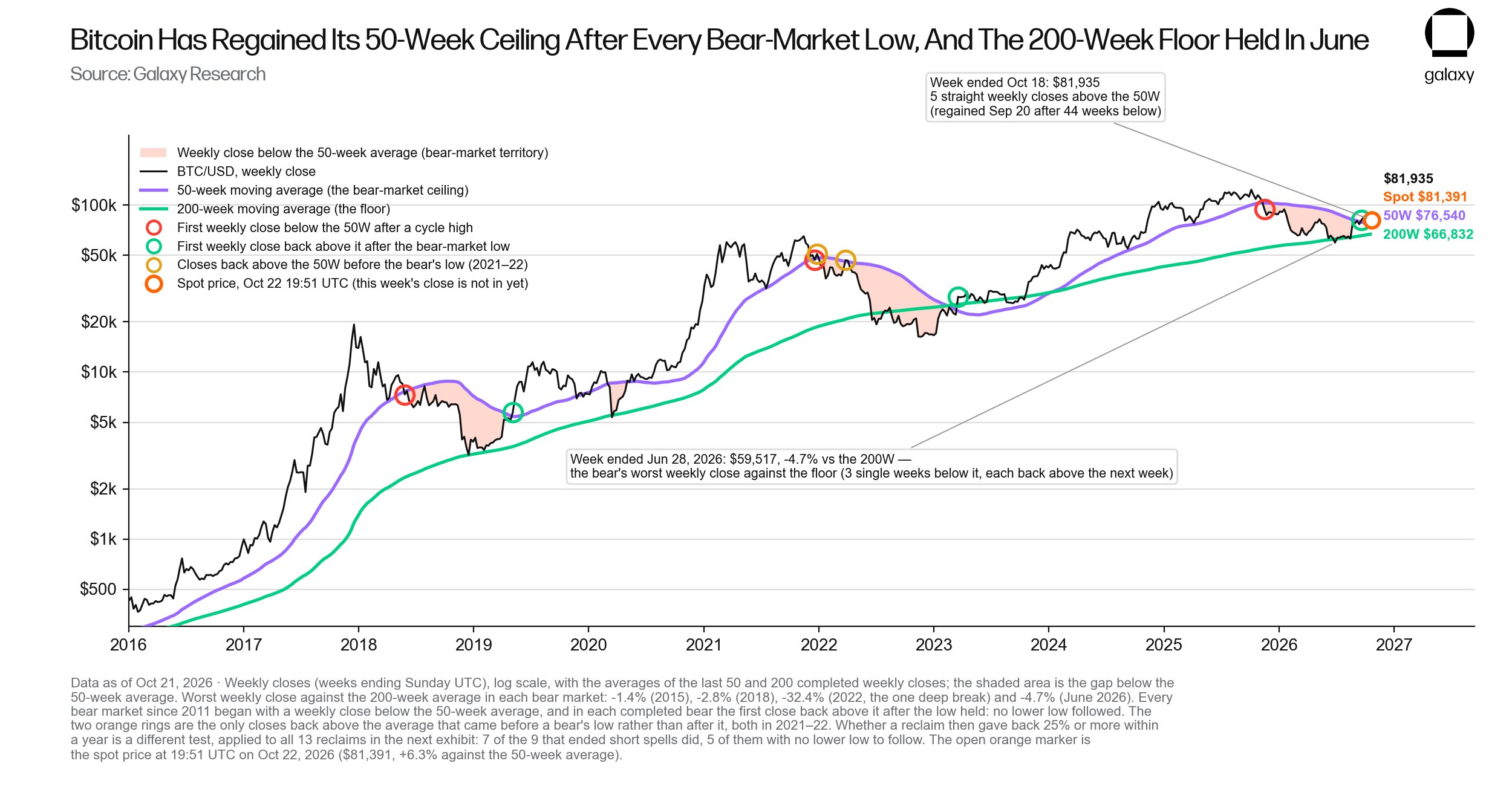
According to the report, Bitcoin fell below the 50-week moving average in the week ending Nov. 16, 2025, and then spent 44 weeks below it. The June low touched the 200-week moving average and held. At its worst, the weekly close was only 4.7% below the 200-week average. For comparison, the same figure was 1.4% in 2015, 2.8% in 2018 and 32% in 2022.
In the week ending Sept. 20, 2026, Bitcoin closed back above the 50-week moving average. By the week ending Oct. 18, it had held above that level for five consecutive weeks. Galaxy says that in every full bear market since 2011, Bitcoin has tended to begin a sustained move back above this “topside” resistance after the low is set.
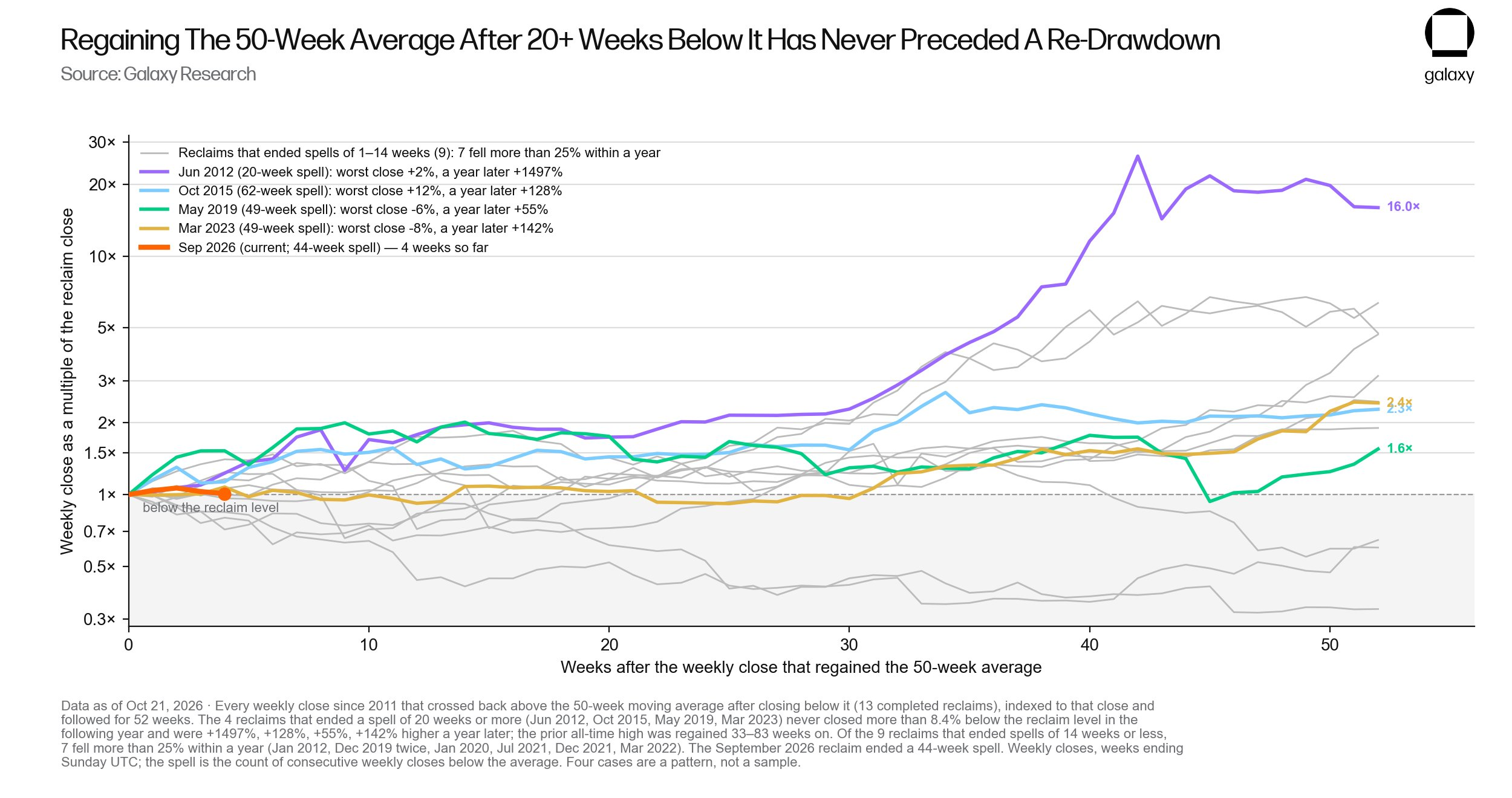
The report reviewed 13 historical rebounds since 2011 in which Bitcoin moved from below the moving average to above it, then split them by how long price had remained under the line.
In four cases, Bitcoin stayed below the moving average for more than 20 weeks. In those four rebounds, the price never fell more than 8.4% below the reclaim level during the following year. One year later, Bitcoin was up 1497%, 128%, 55% and 142%, and it returned to its prior all-time high within 33 to 83 weeks.
In the other nine cases, Bitcoin had spent no more than 14 weeks below the moving average, and seven of those nine later saw declines of more than 25% within a year. Galaxy says the September reclaim ended a 44-week stretch below the line, making it more comparable to the first group.
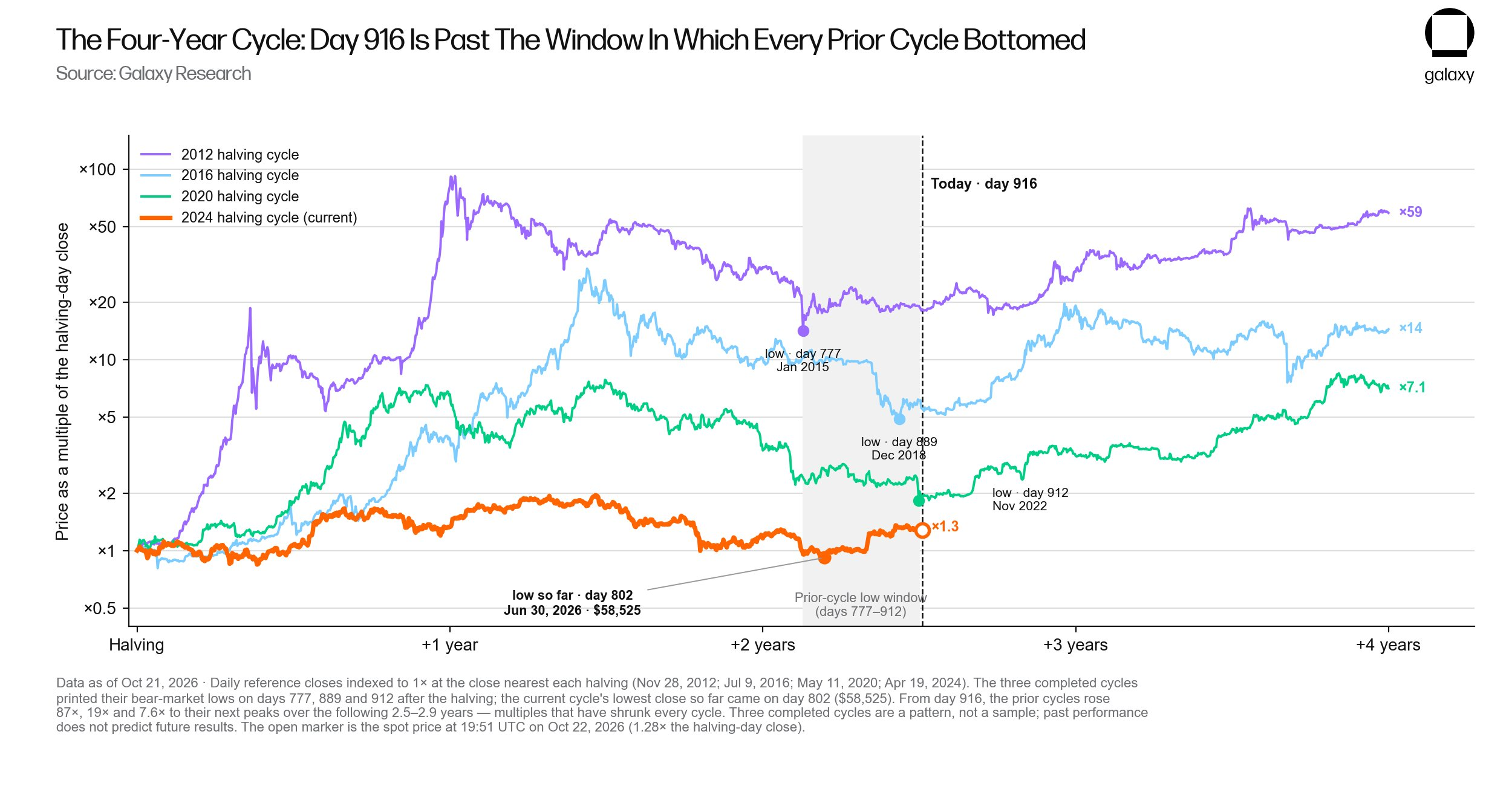
The report also leans on the four-year cycle framework. In the prior three cycles, Bitcoin bottomed on day 777, day 889 and day 912 after the halving. In the current cycle, the low so far came on day 802. Measured from those lows to the next peak, gains in prior cycles were 87x, 19x and 7.6x. Galaxy says the magnitude has declined from cycle to cycle, but the directional pattern has not broken.
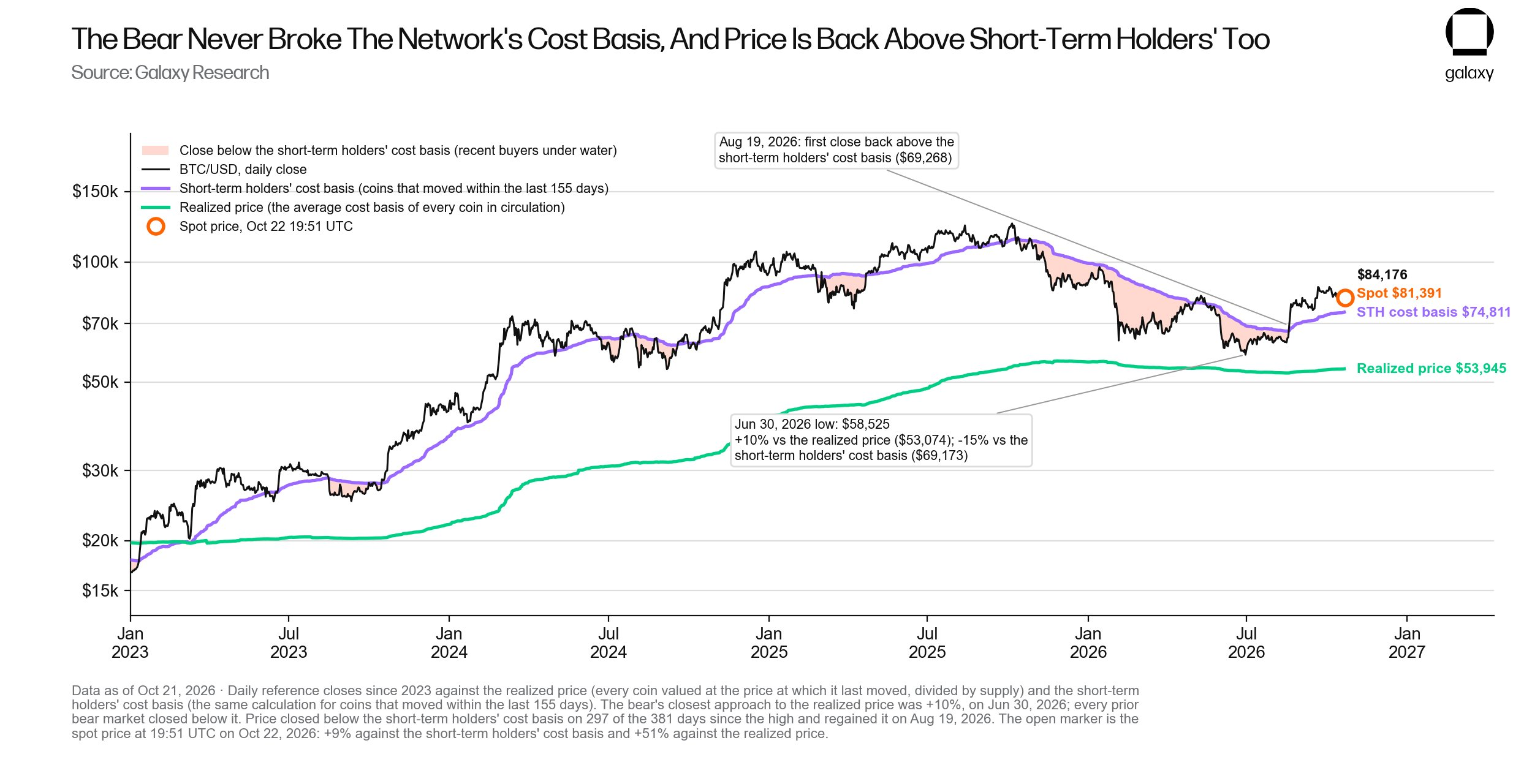
It also calls this the shallowest bear market on record, with a drawdown of 53%, versus 93%, 85%, 84% and 77% in earlier bear markets. The report says this is also the first bear market in which price never fell below the network cost basis. The market-value-to-realized-value ratio reached 1.10, compared with 0.56, 0.69 and 0.75 at the lows of the previous three cycles.
The average cost basis of the coins that drove Bitcoin’s rebound from $58,525 was $74,811, and price first moved back above that level on Aug. 19. As of Oct. 22, those holders were up 9%, with a spent output profit ratio of 1.009. Galaxy says there was no sign of meaningful profit-taking, which fits an accumulation phase.
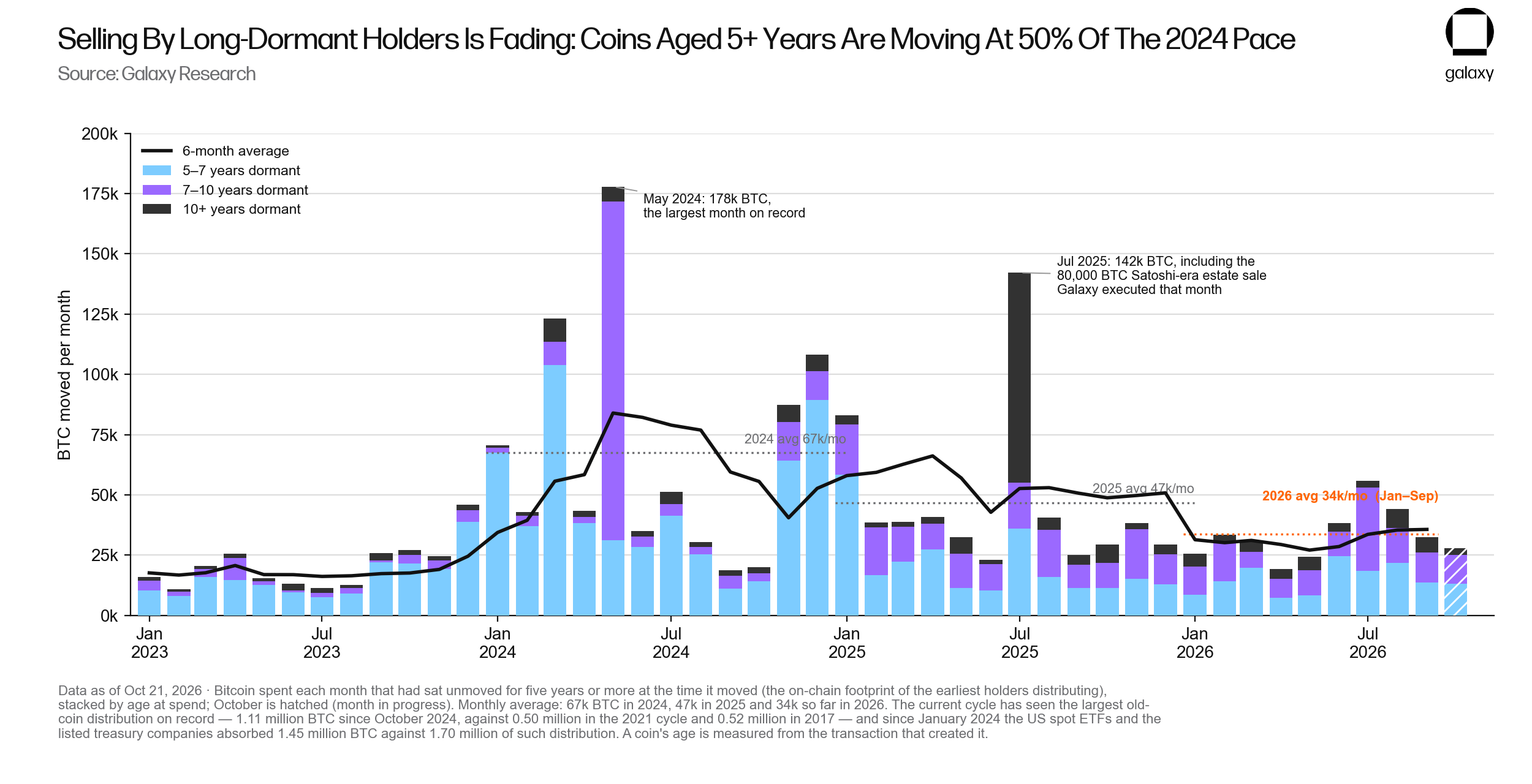
The report also says the sellers that capped price around the 2025 high are losing force. In 2024, Bitcoin that had not moved for five years or longer changed hands at an average pace of 67,000 BTC per month. In 2025, that fell to 47,000 BTC per month. Since October 2024, a total of 1.11 million BTC from this older cohort has moved, the largest distribution of its kind in any cycle, with most of it absorbed by spot ETFs and DAT companies holding Bitcoin. In 2026, that transfer pace slowed to 34,000 BTC per month, or half the 2024 level.
Positioning: fast money has left, long-term holders remain
Galaxy says futures market data show that macro capital now has only a limited footprint in Bitcoin.
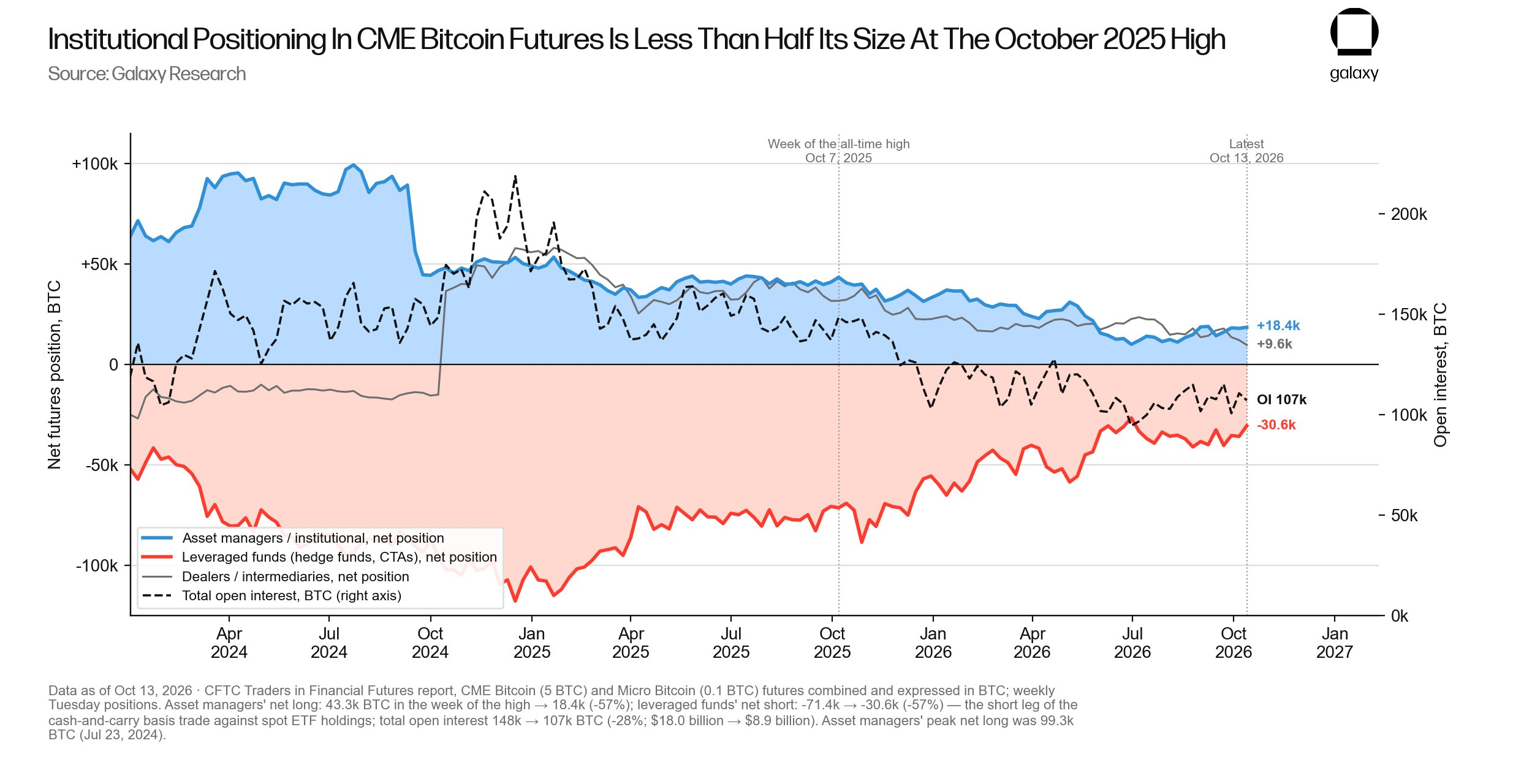
Using U.S. Commodity Futures Trading Commission data on financial futures traders, the report says asset managers held a net long position of 43,300 BTC in CME Bitcoin futures during the week Bitcoin set an all-time high. That has since fallen to 18,400 BTC, a 57% drop. Leveraged funds’ net short position, which Galaxy describes as the futures leg of spot ETF cash-and-carry trades, fell from 74,100 BTC to 30,600 BTC. Dollar-denominated open interest dropped 51%.
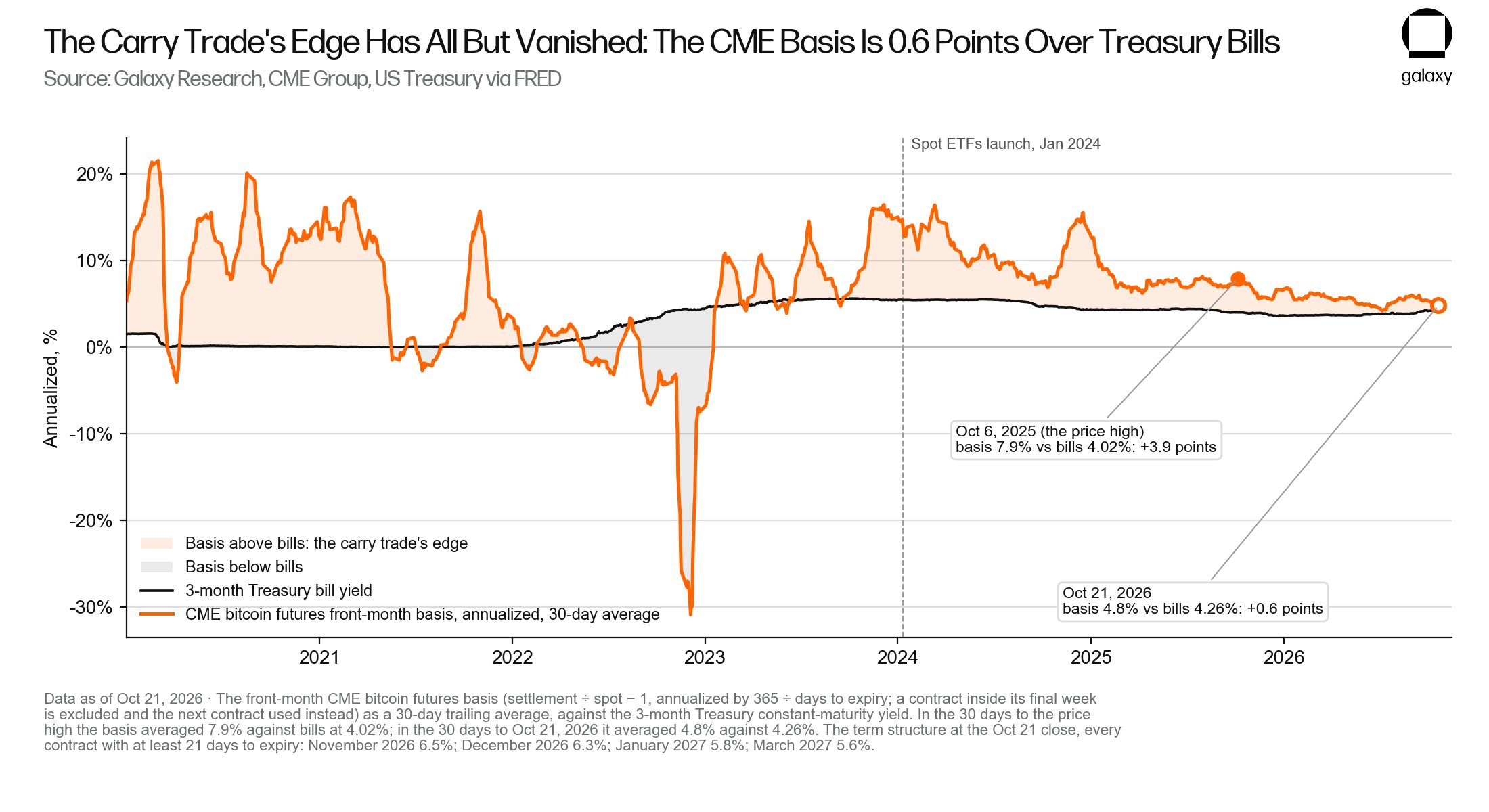
The economics behind those short positions have also weakened. In the 30 days before Bitcoin’s all-time high, the annualized average basis on the front-month contract was 7.9%, or 3.9 percentage points above the 3-month Treasury bill yield. In the 30 days through Oct. 21, that basis was 4.8%, only 0.6 percentage points above the Treasury yield.
Further out on the curve, some return remains, but Galaxy says arbitrage traders cannot capture the full gross spread. ETF management fees, monthly roll costs and margin posted at the clearinghouse consume about 1 percentage point, leaving roughly 1.5 percentage points of excess return relative to spot. At the all-time high, the same calculation produced about 3 percentage points of excess return, and the front-month contract alone was offering a 9.8% annualized yield.
Once the financing cost of the long leg is set at SOFR plus a spread, the extra return from leverage becomes minimal, the report says. After financing costs, the remaining return may not even cover tail risk, including episodes such as December 2022, when basis inverted to an annualized negative 31%. Galaxy says that shift in economics, rather than Bitcoin’s price itself, is what drove multi-strategy trading desks out of the trade.
13F filings show macro sellers stepping back
Galaxy says 13F filings reveal where much of the institutional selling came from, especially basis traders and macro speculators. As of Sept. 30, 2025, the last quarter-end before the price peak, reporting institutions held spot Bitcoin ETF positions equivalent to 355,000 BTC. By June 2026, that had fallen to 307,000 BTC, a 14% decline.
According to the report, that reduction came almost entirely from multi-strategy funds, macro funds, basis trading desks and bank proprietary trading desks that had been using ETFs for arbitrage or momentum trades.
Galaxy names nine institutions: Millennium Management, Brevan Howard, Goldman Sachs, Capula Management, Farallon Capital, D. E. Shaw, Schonfeld Strategic Advisors, Symmetry Investments and Tudor Investment Corp. Their holdings fell by between 29% and 100%, for a combined reduction of 68,000 BTC. That exceeded the aggregate decline of 48,000 BTC across all 2,200 reporting institutions, which Galaxy says implies that the rest of the reporting universe, taken together, was a net buyer.
The report says wealth management platforms and sovereign wealth funds absorbed the shares sold by those speculative players. It also says holdings among investors that do not file 13F reports, including investment advisers, family offices and individual investors, fell only 6.6% even as Bitcoin’s price dropped 49% over the same period.
From peak to trough, ETF holdings fell 11%, while Bitcoin’s price fell 53%. Since the June low, ETF holdings have increased by 87,000 BTC, while leveraged funds’ short positions have declined. Galaxy says that points to directional buying rather than arbitrage demand, and may help explain why this year’s episodes of market fear did not trigger broad Bitcoin selling.
Fundamentals: deficits, yields and AI financing
Galaxy says the macro backdrop remains supportive for Bitcoin. As of Oct. 20, 2026, total U.S. federal debt stood at $40.44 trillion, up from $23.2 trillion at the start of 2020. At the end of fiscal 2026, the federal deficit was $1.99 trillion, equal to 6.2% of GDP, while annual interest expense reached $1.28 trillion.
The bond market has already reacted, the report says. On Oct. 5, 2026, the 10-year U.S. Treasury yield reached 5.31%, its highest level since 2007. On Sept. 16, 2026, the Federal Reserve raised rates to a 3.75%-4.00% range, when CPI inflation was 3.7% and M2 money supply growth was 5.7%.
Galaxy argues that when a sovereign is running a 6% fiscal deficit while refinancing $40 trillion of debt at 5%, the pressure to dilute that debt through inflation rises over time. It says history shows central banks returning as the buyer of last resort when stress builds, citing 2020 and March 2023.
The report also frames AI infrastructure spending as a source of monetary debasement rather than simply a rival for capital. Morgan Stanley estimates AI-related debt issuance will reach $570 billion in 2026. By 2028, about $1.5 trillion of AI infrastructure spending will need to be financed externally. If that buildout happens, Galaxy says, it will be funded through credit expansion. If it fails, the losses will be socialized. Either way, claims on the future keep growing, while Bitcoin’s supply remains fixed.
Galaxy says this logic runs deeper than any single rate cycle. Demand for money that cannot be frozen, monitored or altered should rise as the tools to do those things become cheaper and more powerful, and AI lowers the cost of those interventions.
In that framework, tokenized deposits and stablecoins are designed with freeze mechanisms, while Bitcoin is the only holder-owned asset at scale with no issuer. As finance moves toward programmable money, the report says, demand for that kind of exit option should increase.
Sentiment: a third turn toward blockchain over Bitcoin
Galaxy says mainstream finance has repeatedly embraced blockchain technology while rejecting Bitcoin as an asset.
In 2015 and 2016, after the formation of the bank-backed R3 consortium and The Economist’s “Trust Machine” cover story, the dominant view became “blockchain, not Bitcoin.” During that period, Bitcoin’s weekly close fell as low as $231, and the next cycle peak was 83 times higher.
In 2018 and 2019, the message shifted to “blockchain, not crypto.” JPM Coin and Libra arrived, while Bitcoin was widely treated as finished. The price fell to $3,195, and the next cycle peak was 20 times higher.
In 2026, Galaxy says, the market has moved to “stablecoins and tokenization, not Bitcoin.” Banks are piloting tokenized deposits, the CLARITY Act failed a procedural vote, and AI has taken over the growth narrative. Each time sentiment has swung this far, the report says, Bitcoin has been within a year of the cycle low.
The data, in Galaxy’s view, fit that pattern. Since the start of 2024, the supply of circulating stablecoins has grown 129% to $304 billion. At the same time, Bitcoin, the asset these on-chain systems were originally built to settle, still trades one-third below its high. Galaxy says that suggests capital remains inside the system rather than leaving it.
Search data tell a similar story. On Oct. 13, 2026, Google search interest for the term “Bitcoin” fell to its lowest level in years. The Fear and Greed Index stood at 71 at the October high, dropped to 5 in February 2026, and was 15 at the June low. ETF flows were flat this month. Galaxy says Bitcoin has been rising while largely ignored, leaving a market that is under-owned, overlooked and moving higher.
Risks: global drawdowns, AI and quantum computing
Galaxy says Bitcoin could still fall further if global markets suffer a sharp drawdown, including from AI-related anxiety or geopolitical events.
Even so, the report points to the four prior cases in which Bitcoin spent an extended period below the 50-week moving average and then reclaimed it. In those cases, the worst later weekly close was 8.4% below the reclaim level, and each bear market was shallower than the one before it.
That leads to one of the report’s key risk markers: if Bitcoin posts a weekly close back below the 50-week moving average, now at $76,540, and fails to recover it within one month, Galaxy would treat the rebound as failed. The firm also says light macro positioning in Bitcoin should help cushion the impact of broader market stress.
On AI, the report lists three main risks: competition for capital, AI-driven hacking and social engineering, and the possibility that an AI bubble burst drags down risk assets. Galaxy says those risks do not strike the Bitcoin protocol itself, but instead affect exchanges, vendors, hardware or end users. It adds that the current AI buildout depends on debt financing and tax subsidies, which widens fiscal deficits and, in its view, reinforces the value of Bitcoin’s fixed supply. The report also says AI has not weakened SHA-256 or current signature schemes, and that any Federal Reserve intervention after an AI bust would support, not undermine, Bitcoin’s core thesis.
The market is also watching quantum computing. Galaxy says 7.1 million BTC, or 35% of total supply, sits in outputs where the public key has already been exposed on-chain.
At present, the report says, no cryptographically relevant quantum computer exists. The largest elliptic curve key broken on quantum hardware is 15 bits, while Bitcoin uses 256-bit keys. Google’s most advanced chip currently has 105 physical qubits, and a paper published by Google in March 2026 estimated that at least 500,000 physical qubits would be needed for a practical break.
Galaxy says the risk is real enough that work is already underway. A quantum-resistant output type, BIP-360, was merged into the Bitcoin protocol in February 2026. Galaxy’s Bitcoin Quantum Readiness Initiative has committed up to $5 million, and the Bitcoin Security Alliance, made up of nine institutions, has pledged $15 million over three years. The report says every banking system faces the same time pressure, and that Bitcoin’s migration path may end up being one of the most advanced and best-funded responses.
What would change the bullish view
Galaxy says its stance would change if any of the following happened:
- Bitcoin closes a week below the 50-week moving average at $76,540 and fails to reclaim it within one month.
- Spot Bitcoin ETF holdings fall below the July 13 low of 1.22 million BTC.
- A clear, time-bound path emerges toward cryptographically relevant quantum computing.
- The United States adopts fiscal tightening.
For now, Galaxy says none of those conditions is in place. That leaves the firm with the same conclusion it presented to clients: the market bottom has formed, selling pressure has eased, the debasement case has strengthened, and speculative capital has already stepped back.
The report ends by saying Bitcoin has already shown it can trade to at least $125,000, and that it has reason to revisit that level under the current market setup.



