
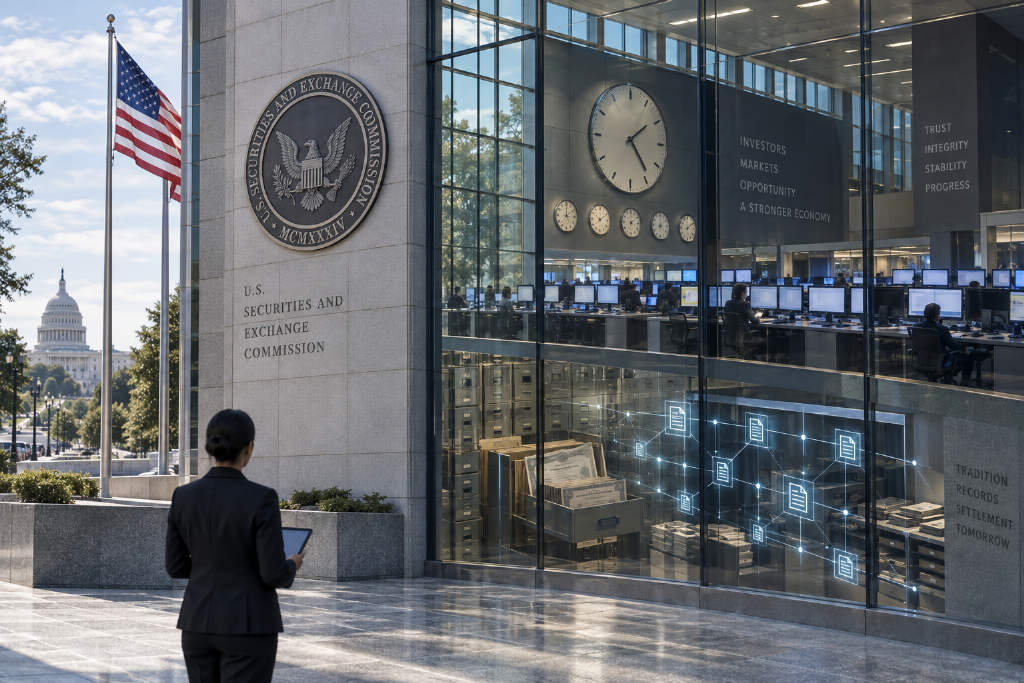
Galaxy said the U.S. Securities and Exchange Commission is moving to modernize a core layer of the market’s post-trade infrastructure, with implications for whether U.S. equities can eventually trade on a true 24/7 basis.

In a report written by Thaddeus Pinakiewicz and republished by MarsBit, Galaxy argued that the SEC’s proposed rewrite of transfer-agent rules and the agency’s planned Sept. 17 roundtable on 24-hour trading are part of the same end goal. Trading hours can only extend as far as ownership records, clearing, settlement, and compliance systems can operate without breaking down.
Transfer-agent rules and 24-hour trading are converging
Transfer agents maintain an issuer’s official ownership records, process transfers, and make sure one investor’s share does not somehow become another investor’s duplicate position. According to the report, most of the relevant rules have seen little substantive revision since the late 1970s and early 1980s, when paper certificates and manual workflows were still the norm and “digital assets” had little practical meaning.
At the same time, the SEC is preparing a roundtable for Sept. 17 focused on 24-hour trading. The agenda includes exchange and broker readiness, overnight surveillance, closing-price mechanics, clearing and settlement, expected liquidity, cybersecurity, staffing, market-data continuity, and the path from extended weekday trading to a fully 24/7 market.
Galaxy’s point is that these are not separate policy tracks. One concerns transfer-agent rules. The other deals with trading hours. In practice, both lead to the same question: how long can the market stay open if the underlying ownership ledger and post-trade rails are still built around an end-of-day reset?
Pieces of the 24/7 market are already in motion
The report listed several recent developments that, in Galaxy’s view, show the market structure is already being pushed closer to continuous trading:
- On June 26, the SEC approved expanded operating hours for consolidated equity market data, running from 9 p.m. Sunday to 8 p.m. Friday, with a one-hour nightly technical pause on weekdays.
- On June 29, the National Securities Clearing Corporation, or NSCC, a DTCC subsidiary, launched 24x5 clearing from Sunday evening through Friday evening.
- On Aug. 5, the SEC approved temporary overnight price bands. Unlike daytime Limit Up-Limit Down rules, hitting the overnight band does not automatically halt trading.
- On Dec. 6, FINRA’s Trade Reporting Facilities are expected to extend their hours to match a broader overnight-market rollout.
Galaxy said the market is already close to 24/7 in one sense, but only for investors who know where to look or have brokers willing to handle overnight orders, usually at a price. Access exists through alternative trading systems, or ATSs, and broker platforms, yet the national market infrastructure that makes regular-hours quotes and trades broadly legible still does not run through the whole night. The result, the report said, is a patchwork rather than one unified market.
The bottleneck sits in reconciliation, cash, and ownership records
Why has the market not gone further? Galaxy’s answer is that the real problem starts after the closing bell. Unless everything happens inside a single venue or on top-tier infrastructure, end-of-day processing still takes time. Positions, cash, failed settlements, and corporate actions have to be reconciled across institutions.
One firm’s books may say one thing while another firm’s books say something else, leaving multiple parties to spend the night working out who owns what and where operational errors sit. The report describes this as the accumulated residue of decades of market evolution: different ledgers, different security formats, different custodians, different settlement systems, and a structure where many parties maintain their own version of the truth and then compare notes later.
Galaxy points to blockchain and shared standards
Blockchain networks and shared standards have shown for more than a decade how far common state and programmable settlement can move this problem, according to Galaxy. The report also pointed to JPMorgan’s Kinexys as evidence from traditional finance. Galaxy wrote that Kinexys currently processes about $7 billion a day and has handled more than $4 trillion cumulatively since launch.
That system is mostly private and permissioned, the report noted, but it still demonstrates that a shared, programmable ledger can operate at institutional scale. For Galaxy, the key question is not ideological purity around “using blockchain.” It is whether common standards and platforms can make the financial system work more efficiently as a whole.
SEC proposal would explicitly allow blockchain-based recordkeeping
Galaxy said the proposed transfer-agent changes would expressly recognize blockchain and distributed ledger technology as permissible media for recordkeeping. The report added that existing rules were not necessarily hostile to that approach in the first place. They are largely technology-neutral, and transfer agents could already argue, with support from some SEC staff guidance, that onchain records satisfy their obligations.
Galaxy said it has already done this for GLXY shares on Solana with Superstate, its onchain transfer agent. Superstate, acting as a registered transfer agent, records legal ownership onchain in real time. Those shares remain limited to verified investors and whitelisted wallets, so they are not yet stocks that can compose permissionlessly across DeFi. Even so, Galaxy said the model shows the underlying mechanism already works.
In that sense, the SEC proposal narrows the gap between “our lawyers think this is allowed” and “the rule text clearly allows it.” Lawyers, the report said, are an expensive consensus mechanism. Risks tied to consensus, rollbacks, and forks do not disappear; they become operational risks that transfer agents must control and document, rather than reasons to reject blockchain recordkeeping outright.
Hester Peirce’s question goes to the center of tokenized equities
Galaxy highlighted a question raised by SEC Commissioner Hester Peirce as the most provocative part of the proposal:
“Should transfer agents continue to be required to collect the name and physical address of a security holder, or should the rules permit collection of other identifiers, such as email addresses and digital wallet addresses?”
Galaxy said the issue is likely to trigger fierce debate around anti-money laundering and know-your-customer requirements, but it is also a serious policy question. Privacy advocates would likely welcome the change. Under the current mix of securities rules, though, it opens a long list of complications.
Could tokenized stocks take on bearer-like features?
The report asked whether tokenized equities could function more like bearer assets. The comparison with bearer bonds is not exact, Galaxy said, but it is still useful. In a true bearer instrument, possession is everything. U.S. lawmakers largely wiped out domestic bearer issuance decades ago through tax treatment, rather than by claiming the concept was metaphysically impossible or formally outlawing it outright.
Not every tokenized stock is, or should be, a bearer-like instrument, Galaxy wrote. But for products designed to circulate in something closer to that manner, a public wallet address may actually reveal more than an issuer would know in a true bearer model. A wallet is persistent, observable, and auditable. It does not identify the person behind it on its own, but it is not zero information either.
Reporting thresholds and control tests still have to be solved
That leads to a chain of practical questions. What happens when one wallet, or 20 wallets controlled by the same person, crosses the 5% beneficial-ownership threshold? A wallet address will not file Schedule 13D or 13G. The person controlling it would. If holdings go beyond 10%, Section 16 reporting comes into play as well.
In theory, ordinary ownership levels might remain private until a statutory threshold is crossed. At that point, disclosure would be required. But someone still needs a defensible method for aggregating addresses under common control.
Galaxy then pushed on the meaning of “control.” Is it the private key? A multisig signer? A smart contract? A custodied account? A DAO vote? A wallet managed by an adviser but economically owned by a client? These are already difficult questions for DAO designers and governance-token architects. In the securities context, the breaks between regulatory concepts become even sharper.
Open-network transferability remains far from settled
The report raised a broader question as well. If a wallet address can be the registered holder, and the transfer agent’s ownership record only needs the address, could issuer-sponsored tokenized shares eventually leave closed whitelist systems and circulate on public networks, similar to xStocks and other SPV-based stock wrappers, including Robinhood’s euro-denominated stock products?
Galaxy stressed that the SEC has already been clear: putting securities onchain does not change the application of securities law. Beneficial-ownership reporting, transfer restrictions, sanctions controls, and the wider Bank Secrecy Act and KYC framework around brokers, custodians, and regulated financial institutions do not disappear just because the security is represented as a token.
At the same time, Galaxy noted that the proposal itself asks whether collecting full names and physical addresses creates unnecessary unauthorized-disclosure risk. There is still a wide policy gap between “blockchain can maintain ownership records” and “any anonymous wallet can freely receive the security.” Even so, changing the transfer-agent rules could still matter because it may reduce the volume of personally identifiable information sitting in centralized databases that can be compromised.
Why this matters for overnight price discovery
Galaxy argued that the case for automated, standardized settlement systems built on blockchain and open protocols is becoming more convincing. For people who do not care much about settlement, or who think around-the-clock markets only serve speculative behavior, the report pointed to research on the statistical differences between overnight and daytime returns.
Material information often arrives while major exchanges are closed, and overnight price moves are heavily driven by that information, Galaxy said. The SEC’s August filing on overnight price bands made the same point. An exchange shutdown does not shut off information. It creates a split between investors who can reach OTC or other alternative venues and those who cannot.
Galaxy concluded that the proposal lays groundwork for a more restrained version of what DeFi has been trying to build for years. If more investors gain access to near-continuous and eventually 24/7 trading, brokers may have less ability to charge rent for “finding” overnight liquidity, and more basic financial functions could become commoditized. Intermediaries would not vanish, but they would have to compete more on service and cost than on simple access control.
Information does not stop when markets close, the report said. What closed markets do today is leave OTC access disproportionately in the hands of privileged institutions. In Galaxy’s view, regulation is finally starting to catch up.