
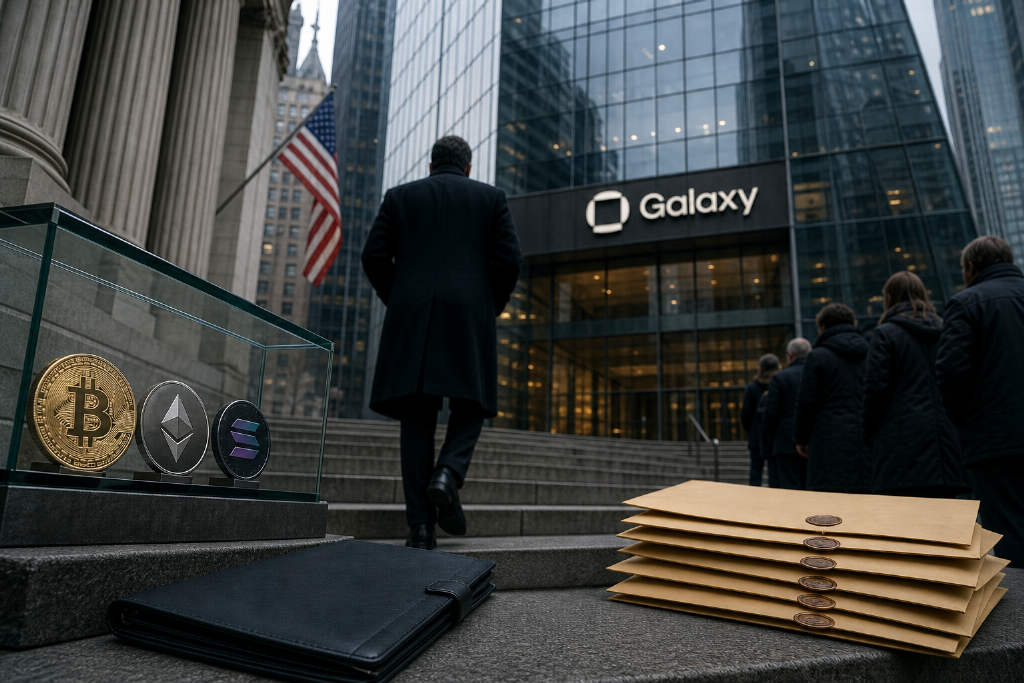
BlockFi founder Zac Prince has unveiled a new crypto lending program at GalaxyOne, offering interest-only loans, waived origination fees, and other promotional terms designed to bring in more customer assets. The launch comes as members of a BlockFi class action that won a court-ordered payout tied to Prince are still waiting to receive any money from a $13.25 million settlement.
New borrowing product launched at GalaxyOne
Prince, now a managing director at GalaxyOne, is backing what the company describes as a crypto portfolio line of credit. Customers who use the product can place digital assets with GalaxyOne and borrow against them.
Galaxy is pairing the offer with fee waivers and interest-only payment options as it tries to pull in more capital and give depositors greater financial leverage. Describing the launch, Prince said, "We’re excited to bring a competitive crypto-backed borrowing product to market." He also stressed the product’s "competitive" fees.
The new line of credit allows clients to borrow against BTC, ETH, and SOL. Galaxy says there is no origination fee and no rehypothecation. Even so, borrowers still face the risk that their collateral could be liquidated if asset prices fall. Galaxy has framed those guardrails as a key product distinction.
BlockFi settlement approved, but customers are still waiting
Prince was a defendant in the ongoing BlockFi, Inc. Securities Litigation. The case settled claims that he violated US securities laws by selling BlockFi Interest Accounts without adequate disclosures.
A judge ordered the insurance companies backing Prince and BlockFi’s executive team to pay $13.25 million to this class of BlockFi customers. That settlement pool is being funded by BlockFi’s insurers, while Prince and the other defendants legally waived any admission of wrongdoing.
Although the agreement received court approval, the payout has not yet been distributed. According to the still-in-progress BlockFi, Inc. Securities Litigation, the $13.25 million remains pending while a claims administrator is "moving forward the next steps in preparation for distribution." The court approved the deal in December 2025.
BlockFi’s earlier model leaned on high yields
From 2018 to 2022, BlockFi attracted digital asset deposits by offering yields of as much as 9.5% APY. Those rates were described in the report as clearly unsustainable, and the company filed for bankruptcy in November 2022.
Alongside BlockFi’s high-yield interest accounts, Prince also ran the company’s crypto-backed loan programs. Both were terminated four years ago.
Return to crypto lending before victims are paid
The report draws a sharp contrast between the pending settlement and Prince’s return to crypto lending. It says Prince is again making personal income by launching new versions of crypto loan products, even though the affected BlockFi customers have not yet received their distributions.
Galaxy’s 2026 proxy filing does not disclose Prince’s compensation. Still, the report says he has apparently returned to profit from crypto lending before members of the BlockFi class have been paid.
Galaxy’s past ties to Terra LUNA
The report also points to Galaxy’s history with Terra LUNA, another collapsed crypto project. In a separate matter tied to Do Kwon’s failed high-yield scheme, New York’s attorney general secured an agreement requiring $200 million in disgorgement after finding that Galaxy promoted LUNA while selling the token, which later became nearly worthless.
Galaxy neither admitted nor denied the findings in that settlement. The attorney general wrote, "Galaxy helped a little-known token increase its market price from $0.31 in October 2020 to $119.18 in April 2022, while profiting in the hundreds of millions of dollars."
LUNA is now trading below $0.00005. Under the agreement, Galaxy must pay the disgorgement amount to New York in four installments through 2028.