
“You can fly. Not metaphorically. Mechanically.”

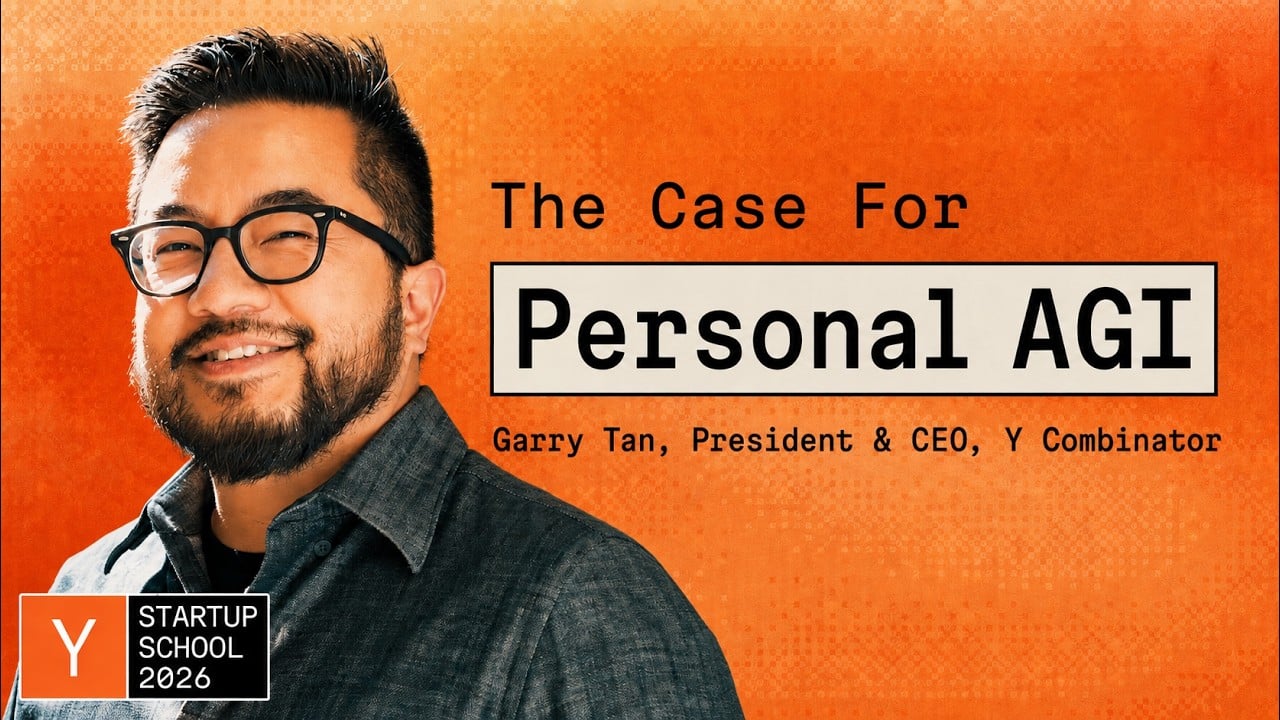
That was how Garry Tan framed his case at Startup School 2026: personal AGI is already here, and most people are going to use it the wrong way.
Tan, the president and CEO of Y Combinator, said the term does not refer to artificial general intelligence. He used it to describe a personal AI agent system that runs on your own infrastructure, inside your own codebase, with your own keys. The idea is to turn your conversations, meetings, decisions, code, and mistakes into a library that agents can use while you sleep to process email, prepare meeting briefs, and do research. Tan said he has open-sourced that system as GStack, which he described as having 123,000 GitHub stars and ranking among the top 100 projects in the site’s history.
Tan opened with Spinoza, not AI product slides
Instead of starting with product roadmaps or model trends, Tan began with Baruch Spinoza.
He recounted how Spinoza, born in 1632, was expelled from Amsterdam’s Jewish community at age 23 and subjected to what Tan described as the harshest curse issued by that community in that century. People were forbidden to speak to him, trade with him, come within four cubits of him, or read anything he wrote. Tan said the order stood apart from roughly 40 such decrees of the time because it had no clause for repentance and has never been revoked.
Before the ban, the community had tried to pay Spinoza an annual salary of 1,000 guilders if he would occasionally attend synagogue and stay quiet. In startup language, Tan said, they were paying him to stop building. Spinoza refused, saying even 10,000 would not do because he wanted truth, not comfort.
Tan then jumped to 1929, when a New York rabbi telegraphed Albert Einstein with a challenge: “Do you believe in God? Answer in 50 words.” Einstein answered in 25, saying he believed in Spinoza’s God, one revealed in the harmony of the laws of the world rather than a God concerned with human fate and conduct.
Tan said people on the internet call him “one of the most AI-crazy people,” so he found it fitting to open with “one of the most canceled people in history.” In his telling, Spinoza kept building after being cast out, and Ethics had to be hidden in a desk and smuggled out. Tan used that thread to suggest a spiritual continuity between doubted AI believers today and exiled thinkers centuries ago.
What Tan means by personal AGI
Tan’s definition was specific. Personal AGI, he said, is an AI agent system running on your own infrastructure. It is not AGI in the usual sense. It is a way to make your knowledge compound over time and sharply increase your ability to build.
He described three core parts of the stack:
- a knowledge base, which he called a “library”;
- an agent coding framework, GStack;
- and a browser-driving capability for the agent.
The dividing line, in his view, is whether you rent intelligence or own it. Renting means your context sits on someone else’s servers and every conversation begins from scratch. Owning means your agent knows what you asked yesterday, what you decided last month, and what you got wrong last year.
Tan stressed that the issue is not simply how smart the model is. Models are improving, he said, but that does not matter much if their output never turns into durable memory. He split users into “2x people” and “100x people.” They use the same Claude, the same weights, and the same context window. The difference is whether they treat it as autocomplete or as a team.
From 14 lines of code to 400x output
Tan leaned heavily on his own experience. In 2013, when he was a YC partner, he worked during the day and built Bookface, YC’s internal social network, at night. He said he produced 14 effective lines of code a day, which matched the median in programmer productivity literature.
This year, while running YC full time, using the same brain, the same amount of time, and still picking up his kids at 5 p.m., he estimated his output at roughly 400 times that 2013 level.
He also tried to cut the number down before anyone else did. If you do not trust raw line counts, he said, apply the harshest penalty you want for redundancy. Assume the agents write bloated code. Assume half of it is scaffolding. Assume he is bragging. Even then, he said, the number still lands at at least 8x, with a middle estimate of 10x. “However you torture the number, it’s big.”
He added that the effect is not limited to coding. In his view, people early in their careers can use the same approach across design, product management, growth, and other forms of knowledge work.
YC portfolio data and AI-generated codebases
Tan backed that up with YC portfolio data. He said that in the Winter 2025 batch, a quarter of companies had codebases that were 95% AI-generated.
Those companies are now using AI agents across the board, not only for software development, he said. He described that cohort as one of the fastest-growing and most profitable in YC history.
Tan did leave room on causality. He said he understands correlation and cannot prove that AI-generated code caused the growth. What he can say, he argued, is that YC’s fastest-growing founders did not use AI as autocomplete. They used it as labor.
Your life is the library
Tan spent a large part of the talk on the “library.” It is not a notes app or a standard knowledge-management tool, he said. It is your full archive of conversations, meeting records, decisions, mistakes, photos, and drafts, with agents doing most of the compiling, curation, and search.
His principle was blunt: you should never ask a question twice if it has already been answered.
He gave a practical example. If a founder emails him in crisis, the agent has already pulled their prior conversations, identified three portfolio companies that hit the same bottleneck, and surfaced the strategies that actually worked before Tan finishes reading the message. When the agent acts, he said, it acts with everything he knows.
That is the difference between an assistant and a colleague in Tan’s framing. An assistant helps you do things but does not know you. A colleague knows what you were thinking yesterday and why you made a decision last month.
He also described a typical day. While he sleeps, the agent processes his inbox. Not sorts it, processes it. It knows which emails come from founders in trouble, which come from salespeople, and which come from the 17 mailing lists he never unsubscribed from. Important messages are classified with context attached: who the sender is, the full history, what they are really asking underneath the words, and what it may mean for him. He wakes up to a briefing, not a pile of email.
Before each meeting, the agent prepares a pre-read with who he is meeting, what they discussed last time, what has changed since then, and what he should ask next. Research questions that strike at midnight are finished by morning. If something interesting happens in the world, the agent has usually read it, cross-referenced it against what Tan cares about, and filed it away before coffee.
GStack: skill files plus a browser
Tan said GStack sits on top of the library. He described it plainly: skill files plus a browser an agent can drive. “A few pages of English plus a way to act on the world.” Markdown is not magic, he said. The real pattern is “fat skills, thin framework.”
In that setup, each skill file functions like an employee. It has one capability and one clearly written responsibility, clear enough that a new hire could execute it. A resolver acts like an org chart, deciding which Markdown file should handle an incoming task.
That means, according to Tan, you can run an organization before you have incorporated, before you have a co-founder, before you have a logo or a pitch deck. The organization is you plus your agents. You are the founder and the whole management layer, and the headcount under you is up to you.
Emergent and Retail as examples of the new math
Tan pointed to two YC companies as examples of what that operating model can produce.
Emergent, from YC’s Summer 2024 batch, went from public launch to nine-figure revenue in eight months, he said. When its annualized revenue hit $15 million, the team had 15 people.
Retail, from the Winter 2024 batch, reached about $60 million in annualized revenue with roughly 40 people, according to Tan.
He said that level of revenue per employee has no precedent in software, oil, or railroads. In his telling, these are not freak exceptions. They are the first companies built natively for a new physics.
Tan described the YC batch room as full of hundreds of founders each day, each doing work that used to take a full year. His point was direct: this is not the future. It is the passing grade for the current cohort. If you are not doing it, your competitors are.
He argued that this also changes what software is. Software no longer has to be precious. You can spend a weekend building an exact tool for one person’s need. The old advice was to scratch your own itch and hope it is also the market’s itch. The new version, he said, is better: scratch your own itch because scratching the itch is itself useful now.
The five-step plan
Tan gave a five-step path for building a personal AGI system.
- Start today. Not next week, not after reading more papers. Open Claude Code, or whatever tool you choose, tonight and write your first skill file.
- Capture everything. Save every conversation, every meeting, every decision. Do not pre-judge what matters. The agent can help sort it out.
- Write skill files. Any time you catch yourself repeating a task, turn it into a skill file. Each one is an employee with a capability and a clear responsibility.
- Use a resolver. It is your org chart. It routes incoming tasks to the right skill file and becomes the management layer for a one-person company.
- Do not ask twice. Tan said YC has a saying: if you have to ask two times, you failed. People who capture what they learn get smarter every day. People who wake up with amnesia each morning are wasting time.
He also laid out a 90-day timeline. In week one, the system is honestly a toy. The library is thin, the skills are clumsy, and you spend more time patching than saving time. By week four, the flywheel starts. The agent begins answering from your context. The morning brief turns into something worth reading. You write a third and fourth skill file because the first two worked. By week 12, Tan said, you have a library that can answer before you finish asking, with a dozen or more skills handling the work you used to avoid. One or two tools may already be getting borrowed by others, which, in that room, he said, is called a startup.
The curve looks like any compounding curve: flat, flat, flat, then suddenly not flat. Most people who try this will quit in week two, he said. That is exactly why the people who stick with it feel like they are cheating by week 12.
Who owns the skill files owns the cognition
This was the heaviest section of the talk. Tan returned to Spinoza’s definition of sadness as a reduction in one’s power to act and said the issue will become political.
He used a fictional support engineer named Maya. Over two years, Maya teaches her agent 40 skills: how to handle a P0 incident at 2 a.m., how to calm a customer about to churn, how to write a postmortem.
If those skill files live inside the company’s systems, then when Maya leaves, what remains is a complete copy of her cognition that the company can hand to the next person. Maya becomes replaceable. If the same files live on Maya’s own infrastructure, then what she carries to her next company is an amplified version of herself that can be deployed immediately.
For Tan, a skill file is not just a document. It is a piece of cognition extracted from someone’s head, written down, and made executable. Every skill taught to an agent externalizes part of the self. The same file points to two opposite futures, and the deciding variable is who controls it.
His response on RAG, memory, and privacy
Tan addressed three objections he expected to hear.
The first was, “Isn’t this just RAG?” His answer was that retrieval is the easy part. What matters is being worth retrieving. How the library gets enriched and linked, what becomes hot memory versus cold reference, and who arbitrates when two facts conflict — that is the product.
The second was memory architecture itself. He did not go deep on that point, but he signaled that this is not a simple vector database lookup problem.
The third was privacy. If you put your email, meetings, and kids’ schedules into one system, what happens if it leaks? Tan’s answer matched the rest of the talk: that is why it has to be yours. His brain runs on his own infrastructure, in his own codebase, with his own keys. By contrast, he said, the default state is not privacy at all. Your life is already scattered across 10 clouds owned by companies whose incentives do not match yours, and everyone but you can search it.
In his framing, consolidating context does not create the risk. It takes custody of a risk that already exists. “Custody is the security model.” If you do not trust yourself to hold the keys, he said, the answer is not to trust someone else’s terms of service more.
Why he open-sourced it, and where he ended
Tan also explained why he made the whole stack open source. People assume there must be a catch, he said. Since he is at YC, he does not need to make money from his personal infrastructure. But “because I can” is the answer to the wrong question. The real answer, he said, is that tools of leverage should be given away for free.
He brought up his younger son as well. His son has deep passions for certain things, and no one is going to build this system for him. So Tan built it himself. No one is going to build yours for you either.
His closing line was: “Everything is made up, and you get to make up your version.” Every institution in the world, including the one that pronounced a curse over a 23-year-old in 1656, was made up by people not smarter than you.
He said the difference between founders today and founders in prior generations is that earlier builders needed to recruit dozens of believers before they could start. Now all you need is a laptop and the years of life history you already possess.
There were about 7,000 people at the event, he said. That means 7,000 candidates and 7,000 efforts. For most of history, nearly all of those efforts would have died waiting for money, headcount, permission, or someone else’s belief.
The machine he showed that night, he said, is the first technology he has seen that lets effort go directly to work. One person. No middleman. No permission. He does not think the world yet understands what happens when 7,000 people walk out of a building with that kind of leverage.
Tan closed by citing the nine-word ending of Spinoza’s Ethics: all things excellent are as difficult as they are rare.
Then he added his own update: the difficulty has just collapsed. The rarity is up to you.
Go build.