
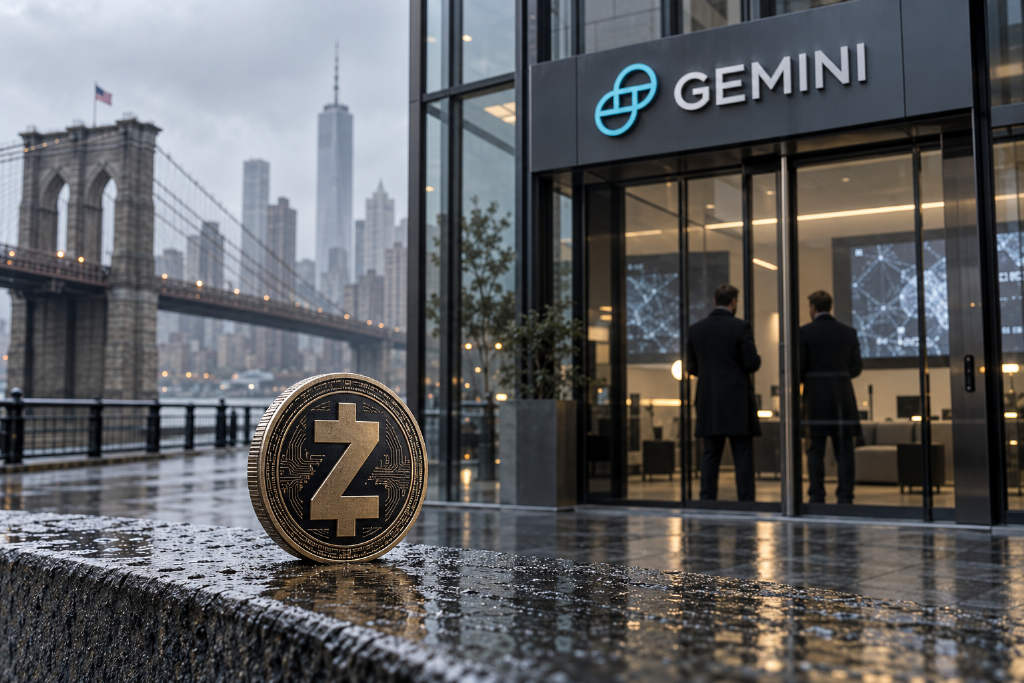
Gemini co-founders Cameron and Tyler Winklevoss have again made the case for Zcash, arguing that artificial intelligence could make financial privacy more valuable over time and support a much higher long-term valuation for ZEC.

In an Oct. 20 interview with Maxime Desalle, Cameron Winklevoss said that if the market were to value Zcash at about 10% of Bitcoin’s market capitalization, ZEC could trade above $5,000 per coin, with a path toward $10,000 over the long run.
The bigger point in the interview was not the headline number itself. It was the framework behind it: as AI improves, financial privacy may become a scarcer resource.
That view differs from the standard way many investors look at proof-of-work crypto assets. Bitcoin and similar networks are often discussed in terms of fixed supply, halving cycles, and institutional adoption. The Winklevoss twins argued that Zcash may be driven by a different set of variables, including AI’s ability to analyze public blockchains, the degree of exposure in personal financial data, and real demand for private transactions.
Their involvement with Zcash is not new. The twins bought Bitcoin in 2012, joined Zcash’s early financing in 2016, and later expanded their ZEC exposure and mining operations through Cypherpunk Technologies. In August 2026, Cypherpunk said it had acquired a batch of Zcash mining equipment in a $33.33 million transaction. Based on the company’s disclosure at the time, that represented about 18% of the network’s hash power.
That matters because their comments reflect both a long-term investment thesis and an existing business interest.
The central question raised by the interview is not simply whether Zcash can hit a specific price target. It is whether markets will start to reprice privacy as AI makes public information easier to analyze, and whether that demand can turn into real Zcash usage.
From digital gold to privacy money
When the Winklevoss twins first invested in Bitcoin in 2012, they said the core thesis was “digital gold.”
Cameron said they compared Bitcoin with gold and concluded that Bitcoin had advantages in supply, portability, and divisibility. Gold is scarce, but its supply is not fixed because new deposits can still be discovered and mined. Bitcoin, by contrast, has a hard cap of 21 million coins, and that ceiling does not change if demand rises.
Bitcoin is also easier to move and divide. Cameron used the film Die Hard as an analogy: even if someone successfully robbed an institution storing large amounts of gold, trucks would still be needed to move it. Bitcoin does not have that physical transport problem.
Still, the twins later concluded that Bitcoin falls short of gold in one important area: privacy.
Cameron said that if someone holds gold bars, other people may not know the size of that person’s holdings. Bitcoin is different. Every transaction is recorded on a public blockchain, where anyone can inspect and analyze it.
“Bitcoin is actually a very bad place to do illegal activity because all transactions can be audited, and they are permanently recorded,” Cameron said.
Tyler said Bitcoin’s significance was not limited to creating a scarce asset. He described it as the first money truly built for the internet. Bitcoin is both a protocol and an asset that runs on top of that protocol. Unlike bank wires or ACH transfers, it does not depend on legacy banking payment rails.
“We realized this is the internet of money. Money is the greatest social network of all time,” Tyler said.
That led to a follow-up question for the twins: if Bitcoin aims to be internet-native money, should it also have the privacy properties of physical cash? That became a major reason they turned to Zcash.
They joined Zcash’s seed financing in 2016. Cameron said the basic judgment has not changed much since then: financial privacy matters, and Bitcoin is weaker on that front than even the traditional financial system.
In a normal bank transfer, the counterparties and the banks involved can see transaction details, but the public cannot directly inspect those flows. With physical cash, the parties to a transaction usually do not need to disclose the payment amount or transaction record to the outside world. Bitcoin, by comparison, exposes transaction data to everyone.
Cameron said that if zero-knowledge proofs had been mature enough when Bitcoin was created, Satoshi Nakamoto might have built privacy into the original protocol.
Zero-knowledge proofs let one party prove a statement is true without revealing the underlying information. Zcash uses related cryptographic techniques to offer shielded transactions that can hide addresses, amounts, and other details.
Cameron said Bitcoin’s white paper describes it as “electronic cash,” but public transaction visibility means it does not fully match the properties of traditional cash. In his view, Zcash is trying to solve that gap.
Tyler pushed the distinction into the realm of monetary systems. He said Bitcoin separated money from the state by removing the government’s absolute monopoly over money. But if governments can still observe and analyze every transaction, that separation is incomplete.
“Privacy is a boundary. It marks where state power ends and where individual freedom and individual sovereignty begin,” Cameron said. He described the progression in three stages: traditional cash protects privacy but depends on centralized issuance; Bitcoin created decentralized money but left transactions public; Zcash is trying to combine decentralization with financial privacy.
Why AI sits at the center of their thesis
If financial privacy was the original reason the twins invested in Zcash, AI has strengthened that view.
Tyler said advances in AI make the privacy problem on public blockchains more visible. Bitcoin addresses do not usually contain a real name, but transaction histories remain public for long periods. When those records are combined with exchange identity data, online activity, and other public information, analytics firms may infer relationships between addresses and, in some cases, identify the people controlling them.
AI can increase the speed and scale of that analysis. In that sense, blockchain transparency is not just a technical feature. It can become a factor in personal asset security and financial privacy.
Cameron framed the point in blunt terms: “If you’re bullish on AI, you have to be bullish on Zcash, even if you don’t know it yet.”
His reasoning is that if AI keeps getting better at analysis, public financial data may become easier to identify, link, and use. Technologies that can validate transactions while protecting sensitive information may then command more value in the market.
Tyler called Zcash “the other side of the AI coin.” He said that the more AI develops in a parabolic and explosive way, the scarcer privacy becomes as an asset.
Under that view, Zcash is not only a private payments tool. It could also serve as an asset for investors seeking exposure to the financial privacy risks created by AI. That is a different angle from the usual AI trade, where investors look to chips, cloud computing, data centers, and software companies. The twins argued that AI may also create negative externalities, including greater information exposure and stronger surveillance capabilities, and that privacy technology could benefit from that shift.
Even so, this remains an investment hypothesis, not a proven market relationship. Better AI does not automatically mean a higher Zcash price. Whether privacy demand turns into sustained ZEC usage and ownership still depends on product experience, liquidity, regulation, and competition from other privacy solutions.
The twins also pointed to quantum computing as a possible catalyst.
Tyler said some elliptic-curve cryptography used by Bitcoin could eventually face challenges if sufficiently powerful quantum computers run Shor’s algorithm. He argued that Zcash’s shielded transaction design can reduce the exposure of sensitive information and offer an added layer of protection.
That is not the same as saying Zcash is fully quantum-secure. Some of its current cryptographic components still rely on mathematical assumptions that could be threatened by Shor’s algorithm. Zcash co-founder Zooko Wilcox has previously said the current version of Zcash should not be described as a quantum-secure cryptocurrency. For that reason, the interview’s discussion of a quantum advantage is better understood as a point about specific privacy mechanisms, not a claim that the entire protocol has completed a post-quantum upgrade.
A pricing logic that may diverge from Bitcoin’s four-year cycle
The twins also argued that AI could change the way Zcash trades over time.
Bitcoin market cycles are often discussed around the four-year block reward halving. Halvings reduce the pace of new issuance, and investors try to map supply changes, liquidity, and demand onto price cycles.
Zcash also has a fixed supply cap and periodic halvings, but Cameron said its future market behavior may not mirror Bitcoin’s.
He pointed to the 2013 Cyprus banking crisis. At the time, losses imposed on some bank deposits made the risks of the traditional banking system more tangible to the public and helped draw attention to Bitcoin.
In Cameron’s view, Zcash could eventually have a similar recognition moment, where a specific event makes the importance of financial privacy suddenly concrete and pushes the public to reassess the value of privacy coins.
That shift does not have to happen near a halving. “Relative to a four-year issuance cycle and block reward halving, major breakthroughs in AI and advances in AI models may be the more important factors,” he said.
Tyler also said it may be a mistake to project Zcash by simply overlaying Bitcoin’s historical chart. He noted that Bitcoin’s early development from 2012 to 2014 did not unfold in a world with today’s generative AI or the same level of discussion around quantum computing.
At the same time, AI is driving a new wave of infrastructure spending. Tyler said leading AI labs plan to spend about $1 trillion on data centers over the coming years. Cameron said that buildout could become one of the largest technology infrastructure waves in U.S. history, potentially larger than the early expansion of fiber networks and telecom infrastructure.
In their view, if stronger AI capabilities keep increasing demand for financial privacy, then AI infrastructure spending could become an indirect long-term catalyst for Zcash. That does not mean data center capital expenditure flows directly into Zcash. It means sustained gains in AI capability could change how markets value privacy protection. For that reason, the twins said they are watching AI breakthroughs more closely than the halving calendar.
How Cameron gets to a $5,000 to $10,000 scenario
Beyond technology and market cycles, Cameron laid out a more direct valuation framework for Zcash. He said that by his estimate at the time, Zcash had a market capitalization of about $25 billion, or roughly 2% of Bitcoin’s market value.
That led to a simple question: if financial privacy is a valuable monetary property, how much should the market pay for it? “We love Bitcoin, and I don’t think it’s going away. But I think the value of privacy is probably worth more than 2% of Bitcoin’s market cap,” he said.
Cameron then assumed that if Zcash’s relative valuation rose from 2% of Bitcoin’s market cap to 10%, while Bitcoin’s market cap stayed unchanged, Zcash would have roughly five times upside. Under that scenario, he said ZEC could trade above $5,000 and potentially move toward $10,000.
This is not a valuation model built on cash flow, profitability, or verified demand. It is a relative market-cap scenario analysis. Its assumptions include a higher market price on financial privacy, but also depend on Bitcoin’s future market value, ZEC’s circulating supply, and how capital is allocated across the market.
Tyler explained why they use Bitcoin as the reference point. Zcash comes from Bitcoin’s code lineage and keeps major design features such as a fixed supply cap and halving mechanics. “It wasn’t built from scratch. It stood on the shoulders of giants,” he said. In his framing, Zcash can be understood as Bitcoin with privacy added.
That does not mean Zcash must replace Bitcoin. Cameron said public and verifiable transaction records have value in some settings. Some institutions, for example, may want to publish Bitcoin addresses so outside parties can directly verify balances.
At the same time, many investors may be satisfied holding a fixed-supply asset as a long-term store of value, while preferring a privacy-enabled asset for payments and day-to-day transactions. Cameron said users could one day hold Bitcoin as a store of value, convert into Zcash when they need to pay, and then switch back into Bitcoin if needed.
Under that framework, Bitcoin and Zcash are not fully substitutable. They may serve different roles, with Bitcoin as transparent value storage and Zcash as private money for payments.
The twins also revisited the gold comparison that shaped their early Bitcoin thesis. They said gold may be relatively scarce on Earth, but not necessarily scarce in the same way across the universe. As space exploration and possible asteroid mining develop, gold’s long-term supply could change.
Bitcoin and Zcash, by contrast, have a 21 million supply cap set by protocol rules. Still, the possible effect of space mining on gold remains a long-term speculation and does not establish that gold’s current scarcity has already changed.
From holding ZEC to mining it through a public company
The twins’ support for Zcash goes beyond public commentary. They have also extended that thesis into public markets through Cypherpunk Technologies.
Cameron said Gemini listed Zcash as early as 2018, and the twins have supported the asset since then. But some investors cannot directly hold crypto because of account restrictions, compliance rules, or investment mandates. They wanted to create a way for those investors to gain Zcash exposure through traditional capital-market instruments such as stocks.
Cypherpunk Technologies is central to that effort. The company was not a brand-new business built from scratch in the year before the interview. According to public filings with the U.S. Securities and Exchange Commission, the listed company formerly known as Leap Therapeutics was renamed Cypherpunk Technologies in November 2025 after receiving financing led by Winklevoss Capital, and shifted toward a Zcash-centered digital asset reserve strategy.
At first, the company focused on buying and holding ZEC. It later expanded into mining and other privacy technology investments. In August 2026, Cypherpunk said it acquired about 4.2 GSol/s of Zcash mining hash rate through a $33.33 million equity transaction tied to Winklevoss Capital. Based on the company’s figures at the time, that represented about 18% of the Zcash network’s total hash rate.
That means the company is no longer relying only on ZEC holdings for price exposure. It is also participating directly in the network’s infrastructure.
Tyler said Cypherpunk’s long-term goal is not to remain a simple ZEC treasury company. The plan is to invest in and support technologies that advance financial privacy, personal sovereignty, and related freedoms. “We started with Zcash, then moved into Zcash mining. But really, any privacy-preserving technology is in our consideration set,” he said.
That broader positioning helps explain why their Zcash thesis extends beyond token price and into the wider privacy technology market. It also means Cypherpunk’s financial performance remains closely tied to ZEC prices, mining economics, and capital-market financing conditions, leaving open questions about how durable that expansion will be.
Regulation, surveillance, and the HTTPS analogy
Even as they argued for privacy technology, the twins acknowledged that regulation could become a major challenge to the thesis.
Asked whether governments might restrict privacy technology the way they have targeted parts of crypto in the past, Cameron said: “The question isn’t whether that war happens. It’s when it happens.”
Tyler said limits on privacy already exist in subtler forms. He pointed to the Flock camera surveillance system in the United States and said the public can easily confuse large-scale vehicle monitoring with traditional traffic enforcement. In his view, a standard speed camera targets a specific traffic violation, while always-on vehicle recognition systems may collect large amounts of travel data even when no clear violation has occurred. Once that information is aggregated in centralized databases and analyzed with AI, personal movement patterns may become easier to track.
The twins said the issue is not only government surveillance power but also data security. Large centralized stores of personal information can become targets for cyberattacks.
On crypto itself, Tyler used the internet’s shift from HTTP to HTTPS as an analogy. He compared Bitcoin to HTTP and Zcash to HTTPS. In an unencrypted HTTP connection, sensitive information may be transmitted in plain text. HTTPS adds encryption to protect communications. Tyler said Zcash plays a similar role for public blockchains by preserving the base function while adding privacy protection.
He also noted that governments once restricted the export of encryption technology and treated some tools as military or strategic items, before later accepting encryption as necessary for internet security. Encrypted communication is now a basic part of the modern internet. He argued that privacy cryptocurrencies could go through a similar process, facing regulatory resistance early and broader acceptance later.
That analogy has limits. It does not mean Zcash will receive the same regulatory treatment as HTTPS. Encrypted communications and anonymity-enhanced financial transactions raise different policy concerns, especially around anti-money laundering, sanctions enforcement, and transaction monitoring.
Cameron also raised the idea of a “wrench attack” in crypto. The term refers to cases where attackers do not try to break cryptography itself, but instead use threats, kidnapping, or violence to force holders to transfer assets or hand over private keys.
He said public on-chain balances can increase security risks for some holders, while privacy protection can reduce the exposure of sensitive financial information. In his view, governments may eventually conclude that making personal financial data too visible does not necessarily improve citizen safety.
Whether that policy shift happens, and when, remains highly uncertain.
Privacy as a condition for free thought
Near the end of the interview, the twins widened the discussion from financial privacy to freedom of thought.
Responding to the common claim that “I have nothing to hide, so I don’t need privacy,” Cameron pointed to Satoshi Nakamoto. “Why didn’t Satoshi put his real name on the Bitcoin white paper?” he asked. In Cameron’s view, Satoshi’s choice to remain anonymous may have reflected the challenge Bitcoin posed to traditional financial power structures. A public identity could have created additional personal security risks.
Tyler said the value of privacy is not limited to whether a person needs to conceal specific information. It also lies in whether privacy gives new ideas room to grow. He used Albert Einstein as an example, saying Einstein’s early work at the Swiss patent office in Bern, rather than inside a university hierarchy, may have reduced the constraints of academic rank and professional politics and given him more intellectual freedom.
The twins argued that privacy can help researchers, intellectuals, and ordinary people lower the risks of expressing non-mainstream views and reduce self-censorship. Even people who do not often exercise free speech may still benefit from the free expression, research, and innovation of others.
Tyler also said anonymity can keep debate focused on ideas rather than on the identity of the person presenting them. In Satoshi’s case, because the public does not know who he is, discussion tends to center on Bitcoin’s source code, technical design, and economic structure instead of judging the idea through personal background.
“You can only discuss the idea itself, the substance of it, the factual basis for it, and its own merit,” he said.
That is one of the core reasons the twins say they have supported privacy technology for so long. From a market perspective, though, the social value of financial privacy does not automatically mean any one privacy asset will keep appreciating.
Their long-term thesis still has to be tested against several variables: whether AI keeps increasing the analyzability of public financial data, whether users respond by demanding more shielded transactions, whether Zcash can expand payment and holding use cases under regulatory pressure, and whether advances in privacy technology ultimately show up in sustained ZEC usage.
If those conditions are met, Zcash could develop a demand narrative distinct from Bitcoin’s halving cycle.
If not, and if privacy demand fails to turn into real adoption or other technologies deliver similar protection at lower cost, rapid AI progress may not be enough to support a higher long-term valuation for ZEC.



