
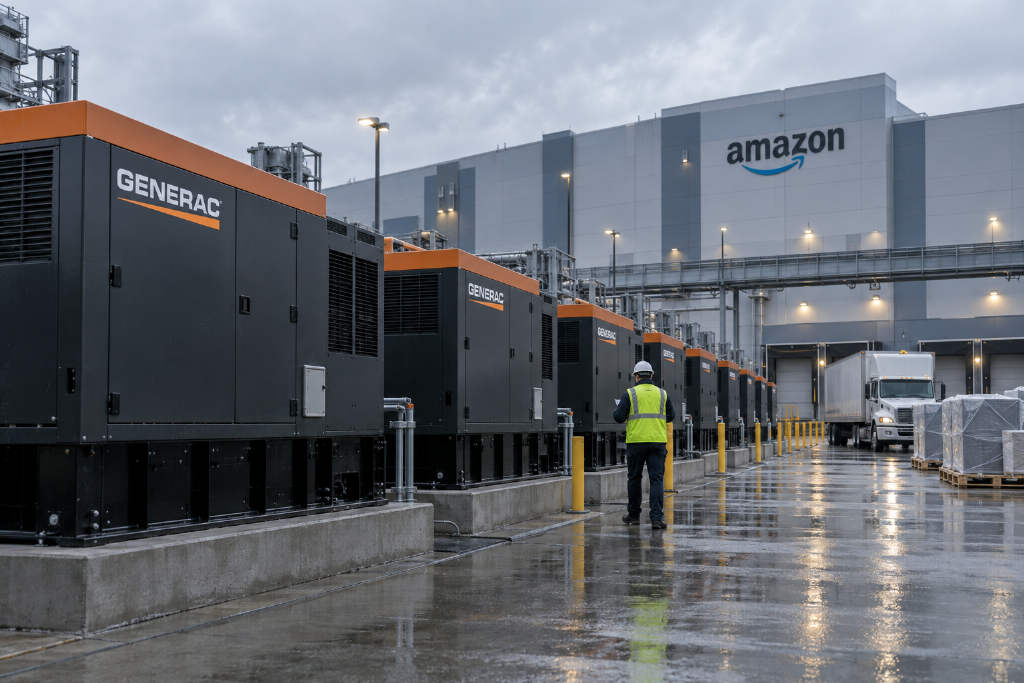
Generac has signed a long-term supply agreement with Amazon to provide backup generators for the company’s global data centers, with first deliveries in 2027 and 2028 expected to total $2.4 billion. The company disclosed the arrangement on Sept. 16. Its shares rose 18.3% on Sept. 17 after the news became public.
$2.4 billion is the disclosed delivery value, while $8 billion is a payment-linked ceiling
A key reason the agreement drew attention is its size relative to Generac’s existing business. Generac posted $4.209 billion in full-year revenue for 2025. The expected $2.4 billion in deliveries over the next two years equals about 57% of that figure.
But the widely repeated phrase of an “$8 billion Amazon order” needs to be read carefully. According to Generac’s regulatory filing, the $8 billion figure is not a fixed amount Amazon has already committed to purchase. It is the cumulative payment cap tied to the vesting schedule of warrants. As Generac receives generator purchase payments from Amazon and its affiliates, Amazon’s warrants vest in stages until cumulative payments reach $8 billion.
What can be confirmed now is the long-term supply relationship and the expected $2.4 billion in first deliveries during 2027 and 2028. Whether the relationship expands toward the $8 billion level will depend on Amazon’s actual future purchases, the pace of data center construction, and Generac’s ability to deliver capacity.
Amazon receives warrants for up to 1.6937 million shares
The transaction gives Amazon the right to buy up to 1.6937 million shares of Generac stock at an exercise price of $200.9266 per share. Roughly 308,000 shares vested immediately at signing. The remainder will vest in tranches based on payments Amazon makes to Generac for backup generator purchases.
That structure makes the relationship more than a one-off equipment sale. The more generators Amazon buys, the more warrants can vest. If Generac’s share price stays above the exercise price, Amazon can also participate in the value created by the supplier’s business growth.
If all 1.6937 million shares are issued, they would represent at least 2.57% of Generac’s fully diluted shares outstanding. The warrants also allow cashless exercise, so the headline share count should not be treated as cash Generac is certain to receive by simply multiplying the number of shares by the strike price.
Data centers are reshaping Generac’s growth profile
For Generac, the agreement points to a shift in how the market may view the company. It has long been seen mainly as a residential backup generator maker, with results influenced by extreme weather, outage frequency, and swings in household demand. Data centers are now pushing its commercial and industrial business into a larger growth role.
AI data centers need large numbers of GPUs, but those chips only keep running if power remains stable. Even when a facility is connected to the grid, it still needs backup generation that can start quickly during outages or grid failures. As power density and capital spending rise at individual AI campuses, backup power is moving from a standard supporting component to a core piece of infrastructure that keeps computing workloads online.
Generac had already said in June that it won a global supply agreement with an unnamed hyperscale data center operator. The latest filing identifies that customer as Amazon for the first time. Amazon’s adoption serves as a customer validation event for Generac’s large megawatt-scale products and may help the company compete for orders from other cloud providers, data center operators, and hosting companies.
Operating data and backlog figures
- Generac and Amazon disclosed the long-term supply and transaction arrangement on Sept. 16, 2026.
- Generac will supply backup generators for Amazon data centers.
- First deliveries in 2027 and 2028 are expected to total $2.4 billion.
- Generac issued warrants for up to 1.6937 million shares to an Amazon wholly owned subsidiary.
- The warrant exercise price is $200.9266 per share.
- About 308,000 warrant shares vested immediately at signing.
- The remaining warrants will vest in stages based on backup generator payments Generac receives from Amazon and its affiliates.
- If all 1.6937 million shares are issued, they would equal at least 2.57% of Generac’s fully diluted shares outstanding.
- Generac shares rose 18.3% in the first trading session after the disclosure.
- Generac reported second-quarter revenue of $1.17 billion, up 11% year over year.
- Second-quarter external sales in the commercial and industrial segment reached $556 million, up about 29%.
- As of the end of July, backlog for Generac’s data center products stood at about $1.6 billion, up roughly $1 billion from the prior update.
- Generac maintained guidance for full-year 2026 revenue growth in the mid-to-high teens and expects commercial and industrial growth of a little over 30% for the year.
Four issues the market is watching
First is execution. Large data center generators involve more than engines. They also require packaging, control systems, switchgear, sound attenuation, emissions treatment, and on-site installation. Generac has acquired Enercon and expanded its packaging and manufacturing capacity for large generators, but a $2.4 billion delivery plan over two years still puts pressure on supply chains, production, and project execution.
Second is whether growth converts into profit. Data center business can bring scale, but product mix, customer bargaining power, upfront expansion costs, and after-sales service requirements differ from the company’s traditional residential business. Hyperscale customers usually have strong purchasing leverage, so a larger order book does not automatically mean margins rise at the same pace.
Generac’s adjusted EBITDA margin in the commercial and industrial segment was 14.6% in the second quarter, below the 34.7% margin in residential. The two are not directly comparable, and residential margins were helped by tariff refunds, but the gap still shows that a revenue mix shift toward commercial and industrial could change the company’s overall margin structure.
Third is customer concentration. In 2025, no single customer accounted for more than 4% of Generac’s revenue. That may change once Amazon deliveries begin. A large customer can improve revenue visibility, but it can also increase buyer leverage and make Generac more exposed to delays, project changes, and swings in capital spending cycles.
Fourth is the technology path for backup power. Large diesel generators remain a major option for emergency power in data centers because of their fast start times, long run duration, and established operating record. But as emissions draw more attention, natural gas generation, fuel cells, battery storage, and hybrid power systems are also developing. Generac will need to show it can benefit not only from current diesel backup demand, but also from a future shift toward lower-emission and multi-energy systems.
AI infrastructure demand is spreading beyond GPUs
At a broader level, the order is another sign that data center capital spending constraints are spreading from chips into the full stack of physical infrastructure. GPUs determine how much computing capacity a facility can host. Transformers and transmission equipment determine whether power can reach the site. Cooling systems determine whether servers can run steadily. Backup generators determine whether workloads continue when the grid fails.
These categories do not attract the same level of attention as GPUs, but they are necessary for a data center to operate. The move in Generac’s stock reflects not only the prospect of $2.4 billion in Amazon-related deliveries, but also a change in how investors may frame the company’s valuation. In the past, its results were heavily tied to outages, hurricanes, and residential generator demand. Data centers may become a longer-duration and more predictable source of growth.
Even after the stock jump, investors still need to see orders turn into revenue, profit, and cash flow. The next points to watch include whether Amazon-related purchases show up in Generac’s data center backlog, how 2027 capacity expansion progresses, where commercial and industrial margins settle, and how quickly Amazon’s actual payments trigger additional warrant vesting.
The Amazon agreement shows that Generac has entered the hyperscale data center supply chain. The next test is whether it can do more than win orders: it needs to manufacture on time, hold margins, and convert the AI data center buildout cycle into sustainable free cash flow.