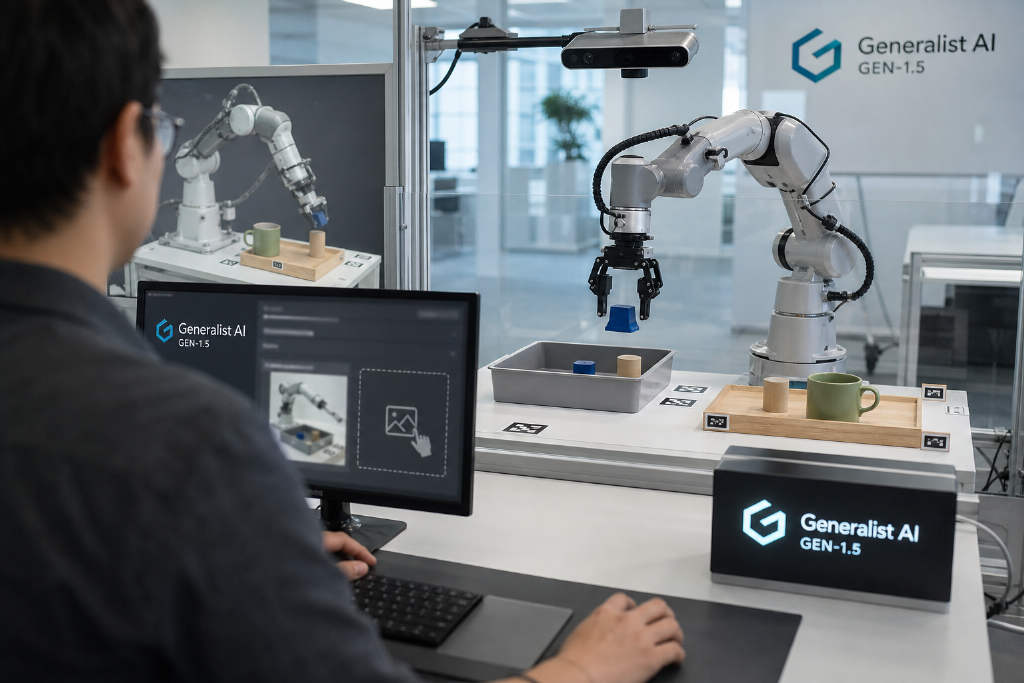
Generalist AI unveils GEN-1.5, a robot foundation model that learns new tasks from a single demo

Generalist AI unveils GEN-1.5, a robot foundation model that learns new tasks from a single demo

N
News Editor
2026-08-24 14:30:10
Generalist AI has introduced GEN-1.5, a robot foundation model designed to learn and execute new physical tasks from just one short demonstration. According to the release summarized by Techub and attributed to MarkTechPost, the model can pick up a new task from a 3-12 second demo without gradient updates, fine-tuning, or task-specific programming. In tests covering 10 different manipulation tasks, the untrained model achieved an average success rate of 59% with a single in-context prompt. When each task received five minutes of data, or roughly 50 demonstrations, plus 10 gradient update steps, the success rate rose to 83%. GEN-1.5 uses a "physical prompting" method that lets users insert sensorimotor examples into a 30-second context window through a drag-and-drop interface, after which the model performs the task. Its capabilities were built through eight months of continual pretraining on physical interaction data from homes, warehouses, and factories. The system is still a research release, with no public weights, API, or self-serve product available at this stage.

Generalist AI has released GEN-1.5, a robot foundation model that can learn and carry out new physical tasks from a single 3-12 second demonstration, according to a Techub summary citing MarkTechPost. The company said the system does not require gradient updates, fine-tuning, or task-specific programming to pick up a new task.

Single-demo performance across 10 manipulation tasks

In 10 different manipulation tasks, the model, without any prior training for those tasks, posted an average success rate of 59% from a single in-context prompt. With five minutes of data for each task, or about 50 demonstrations, followed by 10 gradient update steps, the success rate increased to 83%.

"Physical prompting" within a 30-second context window

GEN-1.5 uses what the report described as a "physical prompting" mechanism. Through a drag-and-drop interface, users can place sensorimotor examples into the model's 30-second context window, and the model then performs the task.

The report said the model's capabilities came from eight months of continual pretraining on physical interaction data collected across homes, warehouses, and factories, rather than from hand-crafted task design.

Research version only, with no public weights or API

GEN-1.5 is currently a research version. There are no public model weights, no API, and no self-serve product at this point. Access is available only through direct partnerships.

Simulation-to-real transfer and human imitation

The model also showed combinatorial generalization, zero-shot sim-to-real transfer, and human imitation, according to the report. One example said demonstrations recorded in simulation could be used directly to prompt a real robot. In another case, after limited fine-tuning, the model was able to use a banana as a temporary brush to complete a brushing task.

This article was originally published by Bit.Fan. For more cryptocurrency news and market insights, visit www.bit.fan.
1600

Disclaimer:

The market information, project data, and third-party content displayed on this platform are for industry information sharing only and do not constitute any form of investment advice or return commitment.

Cryptocurrency trading carries high risks. Users should fully assess their risk tolerance and make independent decisions. All profits, losses, and legal responsibilities are borne by the users themselves.