
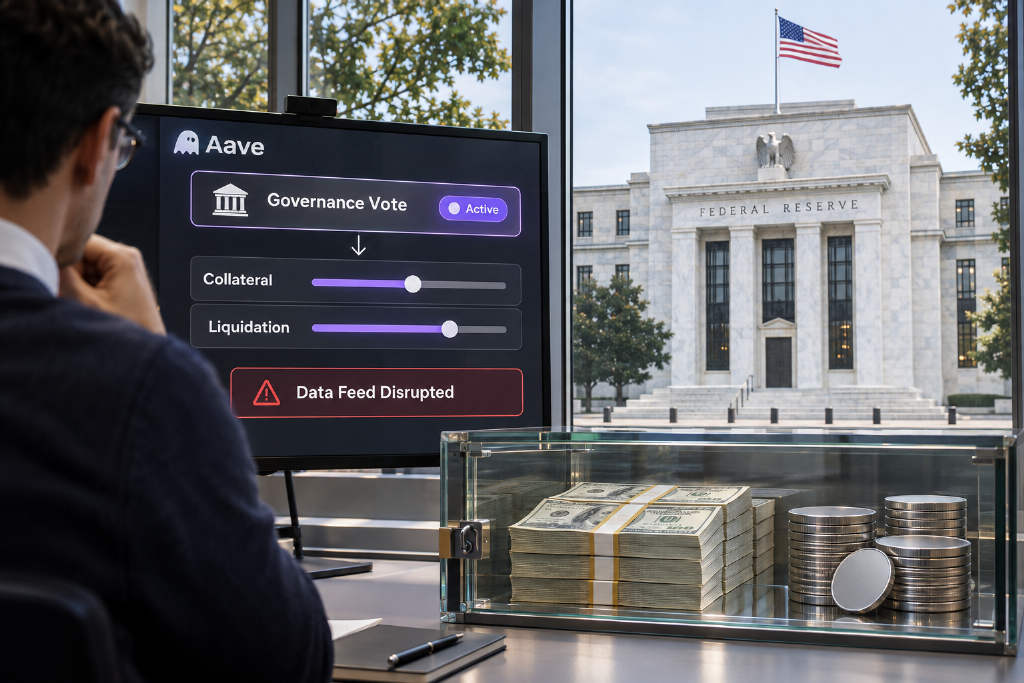
The Federal Reserve’s proposed rules for implementing the GENIUS Act would impose clearer requirements on stablecoin issuers, but they would not resolve a separate risk inside DeFi lending markets: loan terms can still be changed through governance voting after capital has been deployed.
The framework stops at the issuer
On September 24, the Federal Reserve proposed two rules tied to the GENIUS Act. The measures would require stablecoin issuers to back tokens with reserve assets and apply new capital and risk-management standards. The draft also requires redemptions to be completed within two business days, while issuers would have to report the number of stablecoins in circulation to regulators each month.
The act is scheduled to take effect on January 18, 2027, or 120 days after the final rules are published, whichever comes first. The Office of the Comptroller of the Currency had already approved its own final GENIUS Act stablecoin rules in October, including the framework for banks and non-bank issuers.
That gives the issuance side a more readable rulebook. Stablecoins could be used for debt repayment and cross-border dollar flows. The lending protocols that receive those dollars remain subject to a different set of risks. Collateral rules, liquidation thresholds and interest rates may still be changed by token holders through governance votes after a loan has been originated.
Oracle pricing and governance changes
Mike Hathaway and Joseph Quintilian, co-founders of the DeFi lending protocol Ajna, identify two connected problems in a typical on-chain lending market. An oracle supplies the price that determines when a loan is liquidated, while token holders can vote to change the market’s rules. In some cases, the change takes place after the money has already been lent.
The structure was designed to make DeFi easier to use. Curated vaults and standardized price feeds give institutions a screened list of markets and a risk vocabulary that fits the way credit committees assess counterparties. The convenience comes with concentration. If the same group of risk managers and the same price source support hundreds of billions of dollars in loans, one bad parameter or a brief price spike can travel through every market that depends on that source. Markets unrelated to the original mistake can then be pulled into liquidation.
Four incidents cited in the article
The article lists four bad-debt or liquidation events from the past year and more:
- In November 2025, Stream Finance recorded a $93 million loss. Analysts later traced about $285 million in possible exposure across protocols including Euler, Silo and Morpho.
- In February 2026, a Moonwell governance vote set a price feed that valued cbETH at about $1.12, while the actual price was about $2,200. The error left roughly $1.78 million in bad debt.
- In March 2026, a risk-control tool on Aave expired, causing wstETH to be undervalued by about 2.85% and triggering approximately $27 million in liquidations.
- In September 2026, Vesu liquidated 47 positions after receiving incorrect price data for two minutes. The positions were worth about $3 million.
The issue in these cases is not only a temporary price deviation. It is also the question of who can change the terms after a loan has been made. Institutional lenders price loans against fixed conditions. If a governance vote can change collateral requirements, liquidation thresholds or interest rates after funds have been issued, a credit department cannot reliably underwrite the contract. An externally managed oracle can also fail or become unavailable.
The article compares the pattern to an old Wall Street concern: an interconnected structure that is too large to fail may be rebuilt without the capital buffer that the Federal Reserve now requires from stablecoin issuers. The regulatory guarantee ends at the issuer. A dollar stablecoin can be fully reserved at issuance and still be lent into a market whose terms can be rewritten by a vote the following week. It can also be priced by a feed that reports incorrect data for two consecutive minutes.
Ajna’s proposal for immutable terms
Ajna’s proposed solution makes changes a matter of user choice. The model would remove the oracle and let lenders choose the price at which they are willing to lend. Interest rates would be set by a fixed formula in the contract rather than by a vote. Once a pool goes live, no one would be able to change its rules.
That approach has a cost. A vulnerability could not be patched directly. Users would have to choose whether to migrate to a new version. For institutions, the more important question may not be which market is safest. It may be who can change the terms of a loan after the money has been lent.
Effective dates and institutional capital
Two issues remain to be watched. The first is the regulatory timetable. The GENIUS Act is set to take effect on January 18, 2027, and the OCC approved its own final rules in October. Taken together, the two rule sets largely define the compliance outline for stablecoin issuers on reserves, capital and redemptions.
The current draft does not address oracle failures or governance votes that alter lending terms. For now, those questions remain with the lending market itself.
The second issue is where the money goes. Once reserve requirements, capital buffers and two-day redemptions are in place, the amount of on-chain dollars could grow. Much of that capital may first enter concentrated infrastructure such as curated vaults. Whether institutions give up convenience in exchange for terms that cannot be changed will shape the next generation of lending markets. The amounts tied to the four incidents since 2025 provide a concrete record of the cost of mutable terms.



