
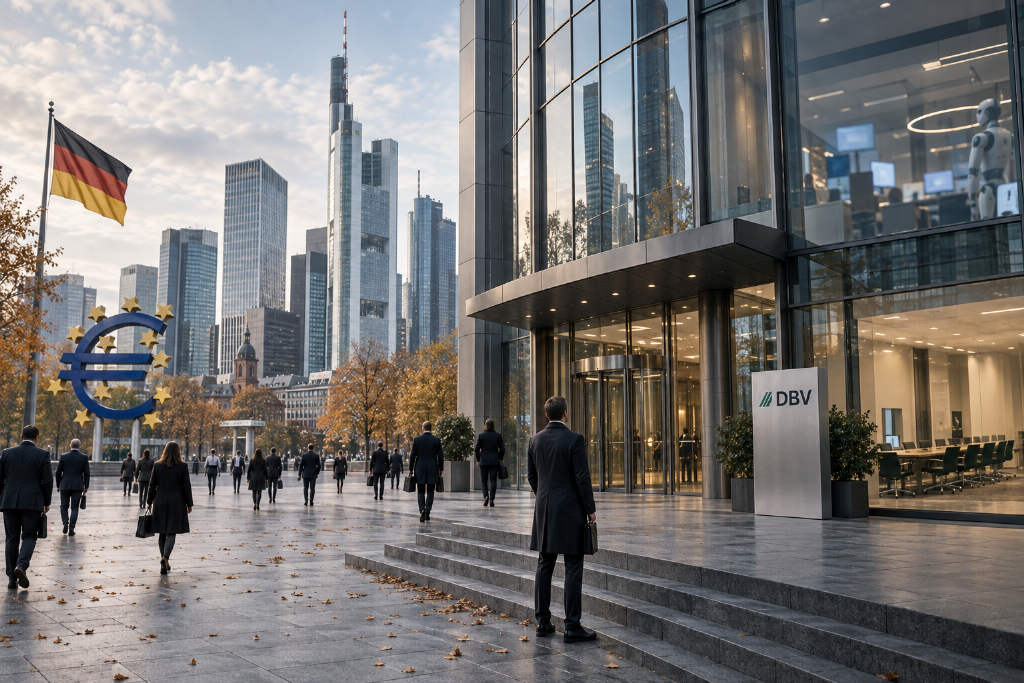
Germany’s bank employees’ union, DBV, plans to demand "AI relief days" in labor talks with private banking employers starting on Oct. 8. The idea is simple: if artificial intelligence has made work heavier in certain departments, staff there could get 1 to 3 extra days off per quarter, with a ceiling of 12 days a year.
DBV — the Deutscher Bankangestellten-Verband — says automation may speed up single tasks, sure. But it also means workers are pushed to process more cases in the same time, check more AI-produced output, and fix more mistakes. Bloomberg reviewed the union’s explanation to members before the negotiations.
Wolfgang Ermann, DBV’s negotiator for private banking, said: "Where work gets denser, more complicated, or carries more responsibility, companies need to compensate for that."
Proposal depends on a formal workload assessment
In a negotiation paper published on the 25th, DBV tightened the proposal’s scope. These relief days would not be handed out to everyone. They would apply only in departments where an assessment finds that the workload has actually become heavier.
What would trigger that assessment? Operational changes requiring consultation with employee representatives under Section 111 of Germany’s Works Constitution Act, for one. The report lists several examples: introducing or expanding AI, automating existing processes, rising case volume or data volume, and extra review work. Occupational safety risk assessments and employee complaints of overwork could also count as evidence.
If that review shows workload, complexity, or responsibility has increased without any upgrade in job classification, that would back the case for granting the leave. But if an employee moves into a higher pay grade because of those changes, DBV says that promotion already counts as compensation, so no separate relief days would be added.
The exact number of days would be decided through company-level agreements between each bank and employee representatives. And the time off would have to be taken within the same quarter. No carryover. Part-time employees would be covered too.
DBV calls the demand "value creation compensation." Its case: AI boosts productivity at banks, and some of that upside should go back to employees. At the same time, the extra strain should be offset inside the company.
Employers push back with survey data
AGV Banken, the employers’ association for private banking, has already come out against the idea. Secretary General Carsten Rogge-Strang told Bloomberg in August: "It makes no sense to say jobs are disappearing because of automation while also making labor more expensive through relief days. That would only raise cost pressure and, in the end, cost even more jobs."
AGV Banken also pointed to a Kantar survey of 942 private banking employees. In that poll, 52% said AI and related technological change created "no" burden at all for staff. Out of 12 stress factors listed in the survey, digitalization ranked last. And one more thing: employees who used AI often reported higher satisfaction on almost every measure.
Rogge-Strang also told HR publication Personalwirtschaft: "The vast majority of employees feel that using AI makes their work more fulfilling and more useful." He said no extra rest measures were needed and added: "We really shouldn’t exaggerate this."
Sascha Stowasser, head of the Institute for Applied Work Science (ifaa), said in an institute statement that you cannot infer any blanket need for extra rest simply from the use of AI, and that the level of strain depends on how work is organized.
DBV fired back on its website, saying AGV Banken had dismissed the demand in August before it had even seen the union’s detailed assessment method. Ermann said: "I was surprised it was rejected so quickly. At that point, the employers knew neither our trigger conditions nor the assessment criteria."
Talks also cover pay and other demands
The first round of talks is set for Berlin on Oct. 8, with another round planned for November. The report says the private banking sector covered here employs about 150,000 people.
The AI relief days are just one piece of DBV’s platform. Its central demand is a 9.5% wage increase effective Oct. 1 under a 24-month agreement.
Other items on the list: an extra 160 euros per month for apprentices and dual-study trainees, the option for employees to buy up to 10 additional vacation days, and a transition plan for older workers that cuts working hours while adding a monthly 1,500-euro knowledge-transfer bonus.
Union points to strong bank profits
DBV says the demands are justified by strong earnings at major banks. According to the report, Deutsche Bank recorded 9.7 billion euros in pre-tax profit in 2025, while Commerzbank returned about 2.7 billion euros to shareholders that same year.
The union also says even bank employees with long tenure often make only around 4,200 to 5,900 euros a month before tax. So, in its view, they sit closer to ordinary full-time workers than to the high-pay image people often attach to banking.
Proposal has not been approved
The AI relief day plan has not been approved. Right now, it is still a union demand in the current labor talks, and AGV Banken has already made its opposition plain.