
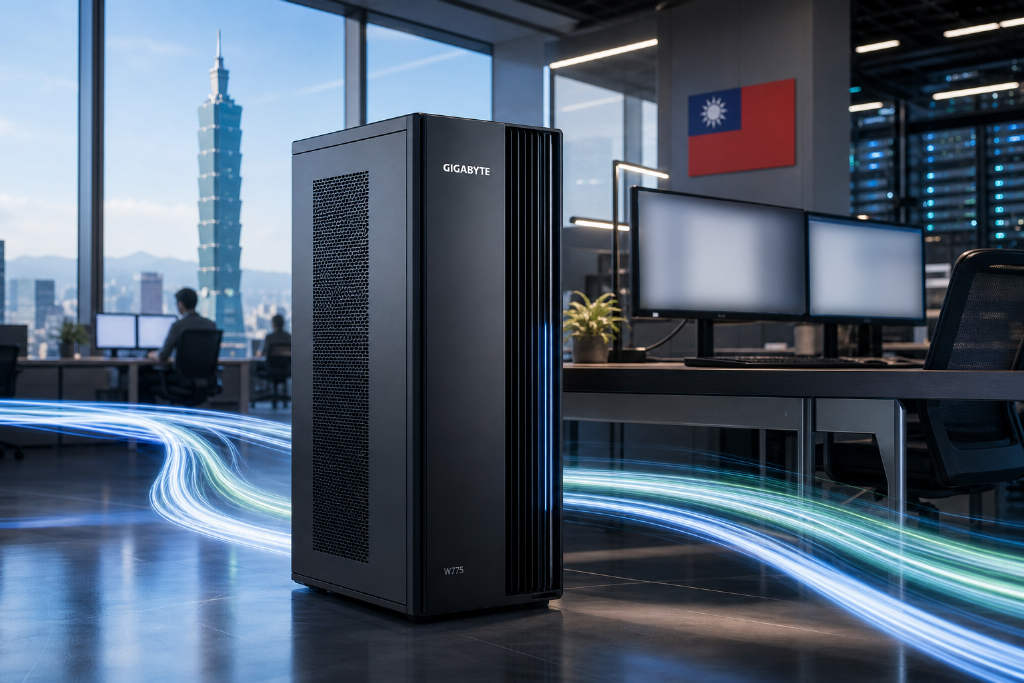
Gigabyte unveils the W775 desktop AI supercomputer
Gigabyte (2376) said on Aug. 20 that it has launched the W775 series desktop AI supercomputer. The flagship model is built around NVIDIA’s GB300 Grace Blackwell Ultra chip, which Gigabyte says condenses compute that was previously reserved for large data-center racks into a floor-standing chassis that can sit in an office.

The company said the product is meant to extend its AI lineup from data centers into edge and enterprise deployments.
Built for local deployment and inference
The W775-V10-L01 is positioned as a way for midsize companies to deploy AI inference capacity locally without building rack infrastructure or dedicating a large server room. Gigabyte said the system can support up to 400 people asking questions at the same time, with peak throughput reaching 9,000 tok/s.
That setup is intended to support enterprise AI workflows while reducing reliance on external cloud compute and the latency risk that comes with it.
GB300 Grace Blackwell Ultra desktop superchip specs
At the center of the system is NVIDIA’s GB300 Grace Blackwell Ultra Desktop Superchip, which combines a 72-core ARM Neoverse V2 Grace CPU and a Blackwell Ultra GPU through NVLink-C2C chip-to-chip interconnect.
On the GPU side, the system includes 252 GB of HBM3E memory with 7.1 TB/s of bandwidth. The CPU side comes with 496 GB of LPDDR5X memory and 396 GB/s of bandwidth. Combined available memory is close to 748 GB, enough to load a 70 billion-parameter LLM locally on a single node for inference, without distributed deployment or model compression.
Can be linked into a small GPU cluster
The built-in ConnectX-8 SuperNIC supports NDR InfiniBand at 400 Gb/s, which means the W775 is not just a standalone node. Multiple units can be linked together to form a small GPU cluster and expand inference or training capacity.
That also broadens the target market beyond companies that need a single deployment point to edge-computing use cases that require flexible scale, including financial transaction analysis, medical imaging diagnosis and on-premise LLM inference in manufacturing.
Order visibility improves as capital spending is raised
Alongside the product launch, Gigabyte gave a more upbeat financial outlook. The company said AI customers are moving faster on deployments, order visibility has improved materially, and cooperation with partner customers has continued to deepen and broaden.
Looking to the second half of 2026, Gigabyte said shipment momentum is expected to exceed the first half as customers make progress on infrastructure and key component supply stabilizes. Overall operating growth is also expected to be stronger than in the first half.
On capital spending, Gigabyte said it had already invested about NT$18.22 billion in the first half of 2026, mainly to buy a new office building and expand AI server plant capacity and equipment. Supported by stronger demand visibility, the company raised its full-year capex forecast to NT$28 billion to NT$30 billion from NT$23 billion to NT$25 billion, an increase of about 20%.