

Global sovereign bond markets are in the middle of one of their fiercest selloffs in decades, with long-dated yields climbing as inflation worries, fiscal expansion and a structural pullback in demand push government borrowing costs higher.
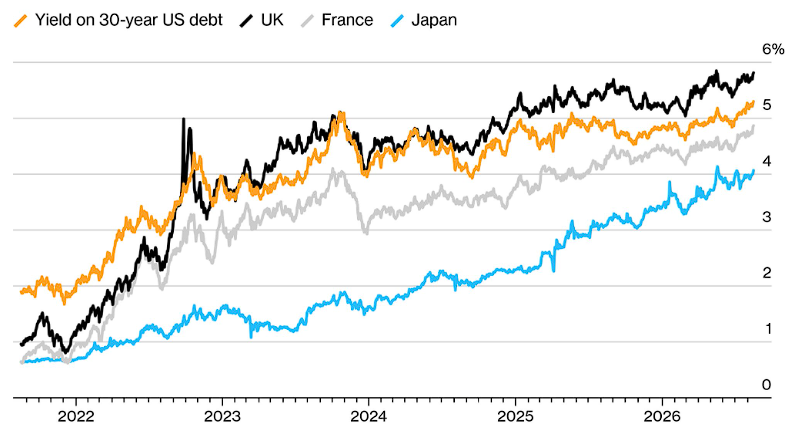
According to a Wallstreetcn report, the U.S. 30-year Treasury yield touched 5.33% this week, the highest since 2007. France's yield on bonds of the same maturity rose to its highest level since 2008, Germany's 30-year yield returned to levels last seen in 2011, the U.K.'s comparable gilt yield moved close to 6%, and Japan's 30-year government bond yield climbed to its highest since 1999.
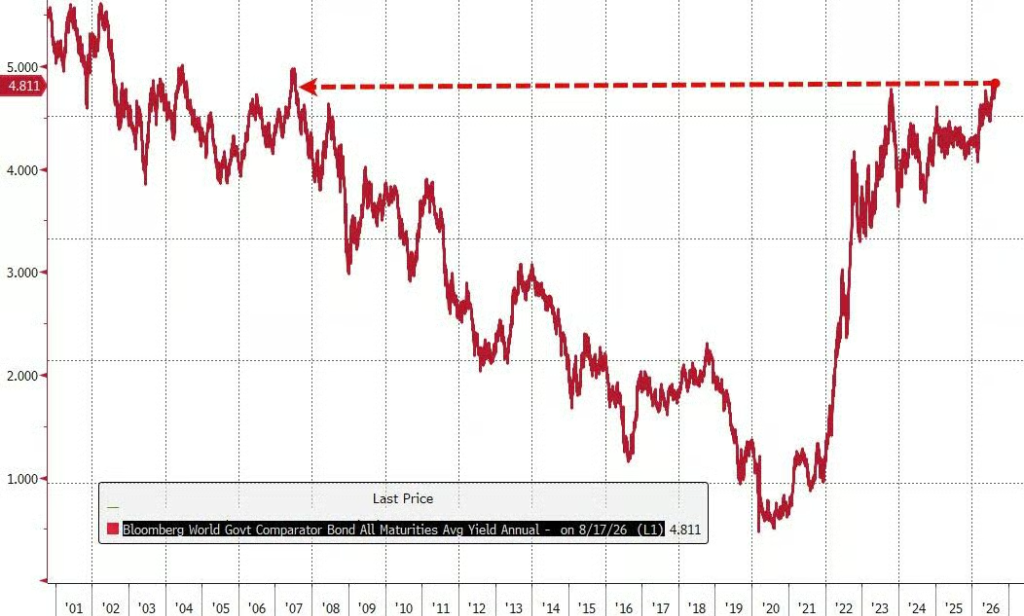
The report said the aggregate yield on global government debt has returned to 2007 levels. Separately, Bloomberg-compiled data showed the average yield on a benchmark basket of investment-grade sovereign bonds has jumped to about 4.5%, the highest since records began in 2015.
The long end has taken the brunt of the move
In the U.S., the selloff has been most visible in longer maturities. Since late June, the 30-year Treasury yield has risen by nearly 40 basis points. It touched 5.33% intraday on Tuesday before easing to 5.28%, still near a two-decade high.
Long-dated bonds are more sensitive to inflation and other risk factors. Justin Onuekwusi, chief investment officer at St. James's Place, said: 「The message from the market is that we expect inflation to be higher in the future, or at least that uncertainty is greater, so we require a higher yield to hold long-term bonds.」
Bloomberg macro strategist Skylar Montgomery Koning said the current structural rise in yields differs from past episodes because deficits are expanding without a clear weakening in the economy. 「Normally, wider deficits come alongside softer growth, and policy rates then move lower, which gives the bond market some cushioning. But pro-cyclical fiscal expansion now means governments are borrowing more while rates are already high, pushing yields even higher,」 she said.
Europe and Japan are under pressure as well
European bond markets have not been spared. France's 30-year yield climbed to its highest level since 2008, with investors also watching political uncertainty tied to 2027 budget talks and next year's presidential election.
According to Bloomberg, people familiar with the matter said Germany sold 30-year bonds through a syndicated deal on Tuesday at its highest borrowing cost in 15 years.
In Japan, absolute yields remain below those in other major markets, but the upward move in 30-year government bond yields has also been persistent, reaching the highest level since 1999.
As long-end funding costs rise sharply, some governments have started adjusting issuance plans and shifting toward shorter maturities. U.K. authorities have suspended most previously planned long-dated bond issuance. Even so, governments have limited room to maneuver in an environment where they can no longer lock in decades of funding at ultra-low rates.
Higher yields are feeding into politics
For the Trump administration, the report said, rising long-term yields have become more than a market issue and are turning into a political risk. Higher government funding costs are feeding through to corporate borrowing and consumer credit ahead of the midterm elections.
Interest payments on U.S. public debt remain a central driver of the widening budget deficit. So far in the current fiscal year, interest expenses have reached $1.17 trillion, up 15% from a year earlier, due in part to higher Treasury yields. The annual U.S. deficit is close to $2 trillion, while total national debt is nearing $40 trillion.
Chris Iggo, chief investment officer at AXA IM Core and now with BNP Paribas Asset Management, said: 「The November election could bring more policy risk and keep the market highly focused on fiscal issues before the usual budget season begins. Ideally, no one wants to face rising mortgage rates ahead of a major election cycle, even if current rates are still below 2023 levels.」
Strategists led by Ed Yardeni at Yardeni Research said on Tuesday that there is not yet a reason to panic over the U.S. bond market. 「We have not hit the panic button, but we are watching closely to see whether bond vigilantes do,」 they said.
Real yields and supply-demand imbalances are driving the move
While inflation concerns remain an important backdrop, the report said long-dated breakeven inflation rates across most major markets have stayed relatively stable. That suggests the rise in yields is being driven mainly by real yields, or the extra return investors demand on top of inflation compensation.
On the supply side, large-scale long-bond issuance by technology companies raising money for artificial intelligence investment has added to pressure at the long end. One example cited was Alphabet, Google's parent company, which recently decided to issue A$5 billion, about $3.6 billion, in bonds in the Australian market for the first time.
On the demand side, traditional long-bond buyers are retreating in a more systematic way. Pension funds and similar institutions have historically been stable buyers of long-duration debt, but that support is weakening as defined-income pension schemes fade and regulation channels more money toward equities. At the same time, larger government bond issuance means markets are relying more heavily on private investors who are more sensitive to price.
Minutes from the Federal Reserve's June meeting showed officials had discussed changes in the holder base for Treasuries. Ownership is shifting from 「official sector holders that are relatively insensitive to price」 to 「private investors who are more sensitive to price」, a change that could lift the term premium. Anshul Pradhan, head of U.S. rates strategy at Barclays, said this shift in buyer composition over the past decade has already increased the 30-year Treasury term premium by about 90 basis points.
Investors are split on what comes next
Institutional investors are not aligned on the outlook as yields keep rising.
Kelsey Berro, a portfolio manager at J.P. Morgan Asset Management, said the repricing could offer a potentially attractive entry point for new money. 「We think value is showing up more in the long end, particularly in real yields,」 she said.
Iggo at AXA took a more cautious view. 「It is difficult to say what level yields need to reach before the total-return outlook for long-duration fixed income genuinely improves. The only things that could change that picture are a sudden deterioration in economic data or some kind of external shock — and the latter seems more likely than the former,」 he said.